Trump Orders Changes to Childhood Vaccines Despite Medical Opposition
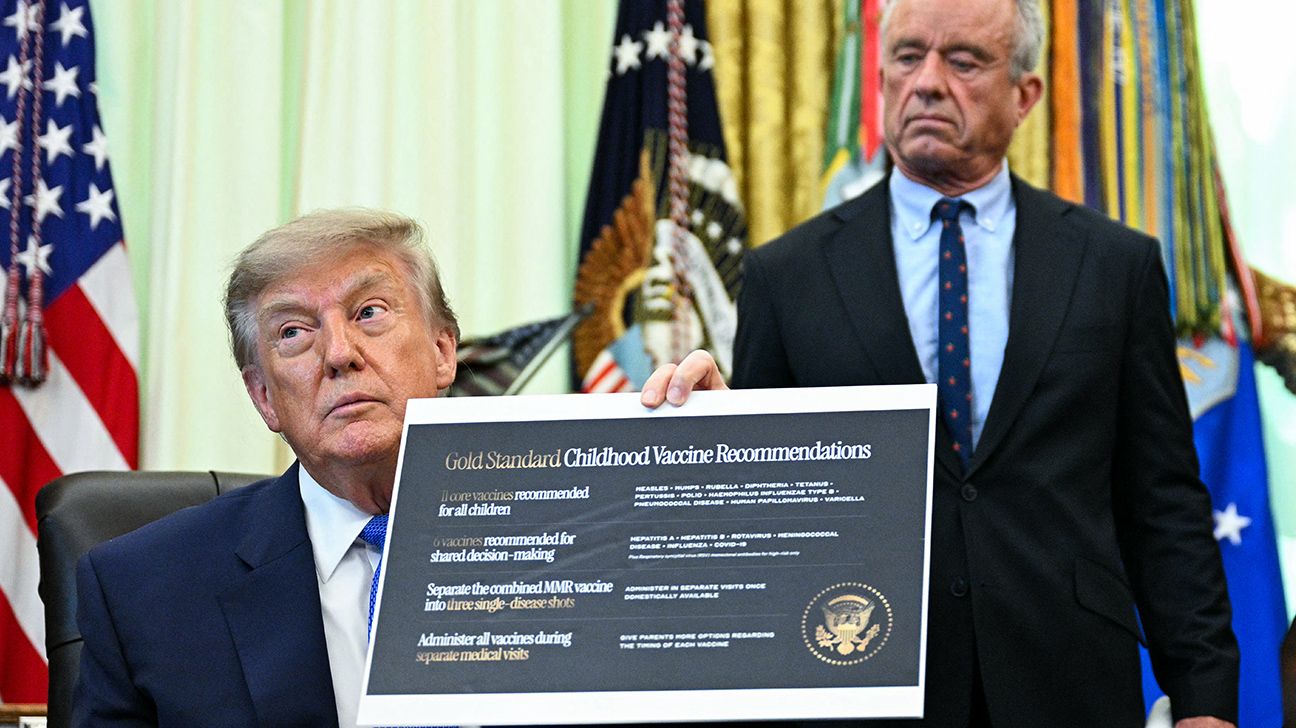
Secretary of Health and Human Services Robert F. Kennedy Jr. (R) looks on as President Donald Trump speaks before signing an executive order calling for changes to the childhood immunization schedule in the Oval Office of the in the Oval Office of the White House in Washington, DC, on August 10, 2026. Jim WATSON/AFP via Getty Images
President Trump signed an executive order to split the MMR vaccine into individual shots, despite opposition from medical experts.
Major health organizations, such as the American Academy of Pediatrics (AAP), warn that the changes are not supported by scientific evidence and could increase the risk of infectious diseases.
The executive order is only a recommendation. There are no immediate changes to vaccine requirements or school mandates at the state level.
A new federal recommendation sends conflicting messages about vaccine safety and raises alarm among medical experts.
President Donald Trump signed an executive order on August 10 outlining major changes to the childhood immunization schedule.
The order calls for the combined measles, mumps, and rubella (MMR) vaccine to be administered as three separate shots and for childhood immunizations to be given at separate medical visits.
It also presents a new framework prioritizing routine vaccination against 11 diseases for all children, in a move that would place several other vaccines into “high risk” or “shared decision making” categories.
At the Oval Office on Monday, President Trump repeatedly suggested a link between the timing or number of vaccines and rising rates of autism.
Decades of research have firmly established that there is no such link. A large new study of 2.5 million U.S. children found no association between the timing of the MMR shot before age 2 and a later autism diagnosis.
The President’s recommendations garnered swift criticism from pediatric and public health experts, who warn of the potential risks of deviating from longstanding vaccine recommendations.
“There is no new evidence to justify significant changes to childhood immunization guidance,” AAP President Andrew D. Racine, MD, PhD, FAAP, said in a statement on August 10.
“Dozens of studies involving millions of people show there is no link between vaccines and autism, and yet federal leaders continue to promote this outdated, disproven idea to scare families. Today’s executive order will do nothing to support families of children with autism or advance understanding of the condition,” Racine continued.
What the executive order says about vaccines
The “Gold Standard Childhood Vaccine Recommendations” issued by the White House are not federal law, nor do they have any immediate impact on school-entry vaccination requirements.
The executive order acknowledges that vaccination requirements for school attendance are set at the state level and advises states to review their current requirements.
It also directs Health and Human Services Secretary Robert F. Kennedy, Jr., and the HHS Task Force on Safer Childhood Vaccines to make individual vaccines available to families, starting with the MMR vaccine, and to reassess the timing and sequencing of other childhood vaccines.
“President Trump is one of countless parents who have voiced questions and concerns about the combined MMR vaccine,” said White House spokesperson Kush Desai.
“The Administration’s push to develop separate vaccinations for all three diseases will give parents more options on timing and frequency for their children, which ultimately will increase vaccination rates for all three diseases,” Desai told Healthline.
The order identifies measles, mumps, rubella, diphtheria, tetanus, pertussis, polio, Haemophilus influenzae type B (Hib), pneumococcal disease, HPV, and varicella as vaccines recommended for all children.
Other vaccines, including hepatitis A and B, rotavirus, meningococcal vaccines, influenza, and COVID-19 vaccines, are placed into categories for certain high risk groups or shared clinical decision making.
Because the order is not yet federal law, parents cannot immediately request separate measles, mumps, and rubella shots.
The Food and Drug Administration (FDA) currently lists M-M-R II and PRIORIX as licensed MMR vaccines in the United States.
It’s unclear when separate measles, mumps, and rubella vaccines will be available, as the FDA has not yet approved them.
Pediatricians concerned about vaccine schedule changes
Combination vaccines help ensure timely administration.
Requiring children to receive more shots at separate doctor’s visits could reduce vaccine adherence, which is already low in the United States. Delaying immunizations could result in unnecessary health risks.
Current guidance from the Centers for Disease Control and Prevention (CDC) states that administering eligible vaccines during the same visit increases the likelihood that children will be fully vaccinated at the appropriate age.
Medical experts agree there is no demonstrated benefit to separating vaccines, and warn of the potential risks in doing so.
Graham Tse, MD, pediatrician and chief medical officer of MemorialCare Miller Children’s & Women’s Hospital in Long Beach, CA, expressed disbelief and disappointment.
“The executive order is based on no scientific basis, no new study, no new data, nothing. It is based solely on the misguided beliefs of a single individual. The issue is this affects real human beings, children especially. [If] fewer children receive fewer vaccines, that will result in increased illness, injury, disability, and potentially increased deaths — all potentially avoidable with vaccines,” Tse told Healthline.
Daniel Ganjian, MD, FAAP, board certified pediatrician at Providence Saint John’s Health Center in Santa Monica, CA, told Healthline that splitting the MMR into three separate shots creates an obstacle course for parents.
“Every extra visit is another chance for a missed appointment, a forgotten follow-up, a kid who shows up to kindergarten only partially protected because life got in the way between visit two and visit three,” Ganjian said.
“There isn’t even a separate measles-only, mumps-only, or rubella-only vaccine available in the U.S. right now, so this order is asking pediatricians to implement a plan using vaccines that don’t exist yet.”
What research says about vaccines, MMR, and autism
Scientific evidence does not support a causal connection between childhood vaccination and autism spectrum disorder (ASD).
The MMR vaccine, in particular, has been at the center of controversy for decades, due to a disproven claim that it causes autism.
“Autism develops in the brain before a child is even born,” Ganjian said. “We just don’t have a way to spot it until certain behaviors show up, and those behaviors happen to show up around the same age as a routine vaccine.”
Tse noted that the causes of autism are multifactorial and not fully understood.
“There are no known instances where autism can develop after birth; however, the signs and symptoms of autism may not be recognized in the child until after birth and later in childhood. The reasons why vaccines have been promoted as a potential cause of autism are also multifactorial. There was a poor and disproven study that linked vaccines to autism; there have been celebrities and prominent individuals who have promoted a link between vaccines and autism,” Tse said.
Despite misinformation around vaccines and the so-called autism link, recent studies continue to provide reassurance.
A large study published on July 28 examined 2.5 million U.S. children and found no link between the timing of the first MMR vaccine and a later autism diagnosis.
A nationwide Danish cohort study published in 2025 examined aluminum exposure from vaccines and found no evidence of increased rates of autism or other neurodevelopmental disorders.
The broader evidence is even more consistent with these findings.
A 2021 Cochrane review of 138 studies and more than 23 million children found that MMR vaccines did not cause autism. The review also found that these vaccines are effective for disease prevention and acknowledges that some vaccine-related adverse effects, such as seizures, may occur rarely.
Other studies have also found no such association.
A landmark 2002 Danish study followed 537,303 children and found no association between MMR vaccination and autism.
A larger 2019 Danish study examined 657,461 children. Researchers found no increased risk of autism among vaccinated children, including children with other factors that could potentially increase autism risk.
“Study after study keeps landing in the same place: no link to autism. None,” Ganjian said. “But when the administration acts like the question is still open, it doesn’t matter how many papers say otherwise.”
Research has also addressed concerns about children who may have a genetic vulnerability to autism.
A 2015 U.S. study involving 95,727 children, including children with older autistic siblings, found that MMR vaccination was not associated with autism risk, even among children whose older siblings were autistic.
“The reality is that vaccines have been heavily studied and given to hundreds of millions of individuals over decades, safely, and absolutely no credible evidence of causing autism,” Tse said.
How spacing out MMR shots could impact families
Vaccine skepticism and hesitancy have resulted in declining immunization rates and a resurgence of infectious diseases.
As measles cases hit a record-breaking 35-year high in the United States, declining MMR shots remain a serious public health concern.
“Without enough individuals vaccinated, measles can spread rapidly, even starting with a single case,” Tse said. “The U.S. will see more cases of preventable serious diseases as vaccine rates decline due to vaccine hesitancy and misleading claims.”
The approach outlined in the executive order could result in longer periods in between inoculations.
“Breaking up the MMR vaccine into separate shots and potentially spacing them out will lead to few vaccinations, missed vaccinations, and more children at risk for catching these preventable illnesses and also spreading these illnesses to other individuals,” Tse said.
Separate doctor’s visits could also mean additional time away from work for parents and caregivers, increased transportation needs, additional child care arrangements, and potentially higher costs, depending on health insurance policies.
Vaccine timing matters because vaccines provide protection during the periods when children are most vulnerable.
“Delayed vaccines mean fewer kids protected on time,” Ganjian said. “When the federal government signs an executive order that treats a well-studied vaccine like it’s on trial, it doesn’t read as ‘extra caution’ to a nervous parent. It reads as ‘even the adults aren’t sure.’ And a parent who isn’t sure is a parent who waits. Waiting is how outbreaks happen,” he said.
Experts advise parents against making decisions about children’s health based on political rhetoric.
“Spreading false information, unproven and disproven theories, and frankly spreading fear, will make more parents who are wary of vaccinations or considering not vaccinating their children to not get them vaccinated,” Tse said.
“It also creates confusion amongst parents who look to the federal government and its agencies to guide them in decision making. Confusion can lead to delayed, missed, or skipped vaccinations, and the end result is an under-immunized or non-immunized individual and population.”
The best response, experts say, is not to panic, but to talk about vaccines and any concerns you might have with your child’s pediatrician.
The childhood immunization schedule recommended by the American Academy of Pediatrics (AAP) is based on science and offers the best protection for children.
“Plenty of parents already know to lean on AAP guidance over shifting federal recommendations at this point, and pediatricians are following suit. That consistency is what builds trust,” Ganjian said.
Tse echoed these remarks. “The AAP and other national organizations will continue to lobby and educate on the safety, benefits, and evidence behind vaccinations,” he said. ” Pediatricians and other healthcare professionals will also continue to educate their patients and families on vaccines and the need for, benefits, and evidence behind vaccines.”