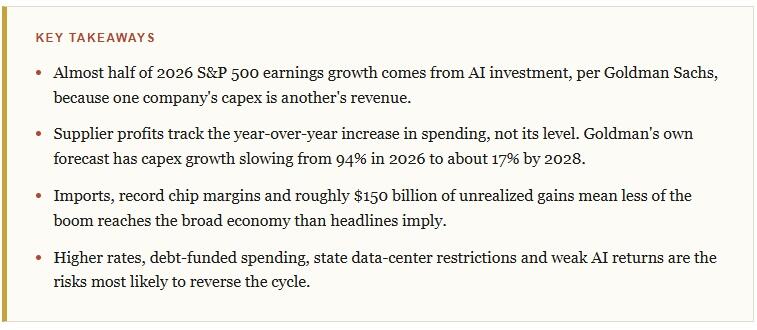
Companies’ AI spending is still driving near-term earnings, but outlets are increasingly flagging a transition from rapid growth to slower acceleration and potential value impairment. One analysis argues that a large share of S&P 500 earnings growth this year is linked to hyperscalers’ AI capital expenditure. It says profits for suppliers rise when spending accelerates, while buyers’ depreciation continues even if spending growth flattens, turning the earnings impact over time.
Another report focuses on the broader economics of AI infrastructure capacity. Gartner estimates a much larger revenue requirement than current AI infrastructure revenue forecasts, projecting that more than $3.5 trillion of AI infrastructure spending could face impairment by the end of 2030, and more than $4 trillion of asset value could be at risk through 2032. It also expects that many smaller “neocloud” providers will struggle to recover investments before semiconductor generations become obsolete.
Several outlets link this risk backdrop to equity-market moves during the same period, attributing declines in AI- and hardware-related stocks to concerns about the cost of capital. Across the coverage, the main differences are the emphasis on (1) how earnings flow-through changes as spending growth slows versus (2) whether revenue can support the cost of capital for long-lived infrastructure assets.