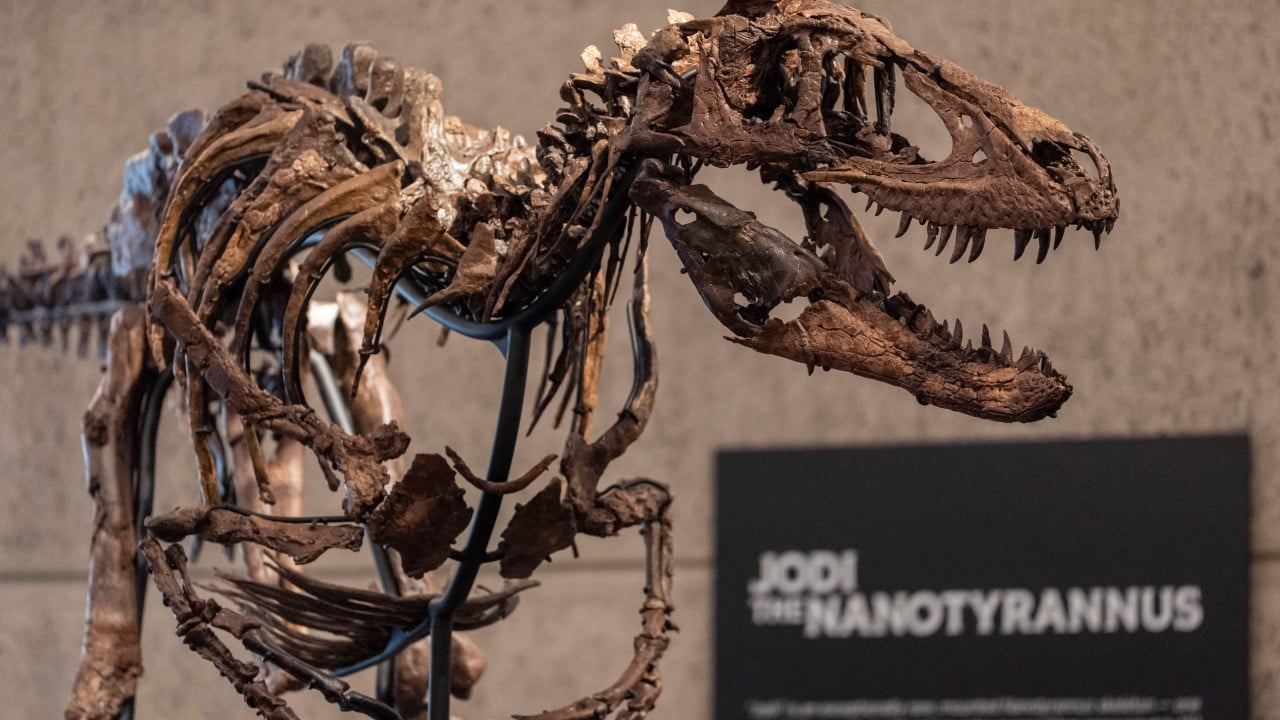
A Nanotyrannus skeleton nicknamed “Jodi,” described as resembling a mini T. rex, sells for $47.3 million at a Sotheby’s auction in New York. South China Morning Post reports Sotheby’s had expected the fossil to fetch between $6 million and $9 million, and identifies the buyer as a “mystery buyer.” The New York Times similarly frames the sale as a latest high-priced fossil auctioned privately.
Several outlets emphasize the price and the rarity of the specimen, with Globe and Mail calling it the second-priciest set of dinosaur bones ever sold. Phys.org and New York Post focus on the “mini T. rex” look, while Phys.org and other papers repeat that the fossil is now among the world’s most expensive. South China Morning Post adds scientific context, saying the Nanotyrannus is recently confirmed as a distant cousin of Tyrannosaurus rex, rather than merely a young specimen.
Overall, the coverage largely agrees on what was sold, where the sale occurred, the Sotheby’s role, and the $47.3 million headline figure. Differences are mainly in how they frame significance—record status versus visual comparison—and how much they add about expectations or classification context.