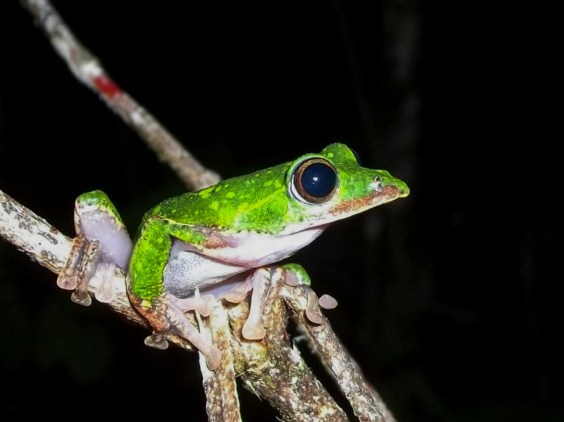
Researchers describe a newly discovered flying frog species, Rhacophorus kurniatiae, found on the island of Sulawesi in Indonesia. Multiple sources say the species was identified during field surveys in mountainous terrain and is notable for unusual egg-laying behaviour.
The reported observations place the frogs around Danau Coca-Cola, described as a seasonal mountain lake, where researchers saw large numbers congregating. Accounts say the frogs live at high elevation (over 6,100 feet) and have physical traits typical of flying frogs, including webbed feet used for gliding. The distinguishing reproductive detail highlighted across coverage is that the frogs lay eggs within a gelatinous matrix, with the eggs developing in a clear jelly-like form attached to leaves rather than foamy water nests.
Outlets differ mainly in framing: one focuses on the discovery itself and the distinctive egg method, while another adds broader context about the expedition setting, the researchers involved, and the scale of sightings, alongside brief descriptions of habitat and ecology.