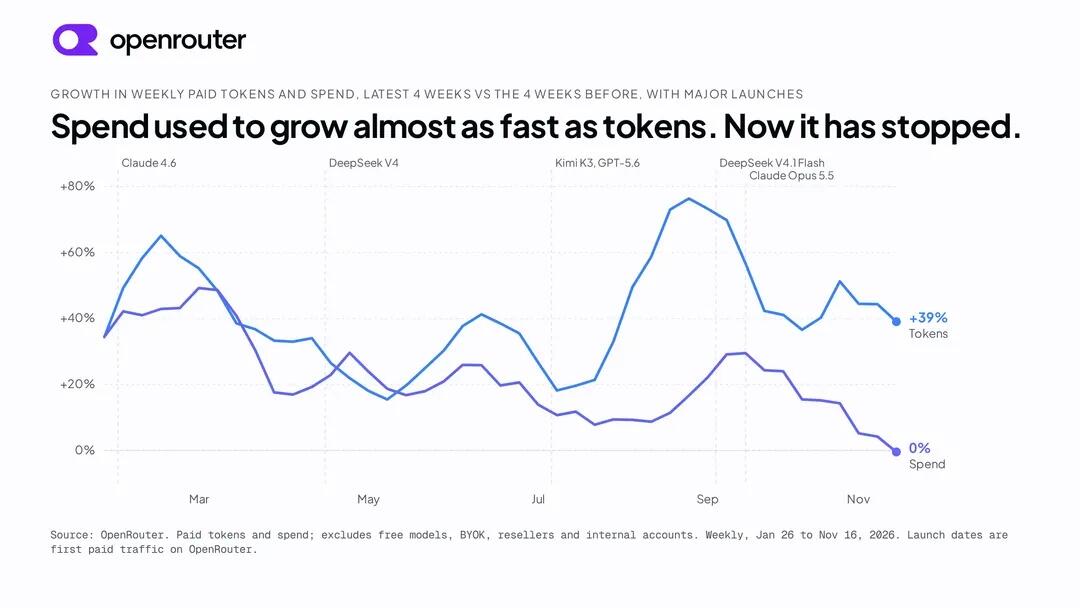
OpenRouter reports that between early January and mid-November 2026, the blended effective price per million paid tokens on its platform drops from $0.84 to $0.15—an 83% decline—while paid token volume rises dramatically. Across the same period, OpenRouter says spending increases far less than token consumption, aligning with a weakening version of “Jevons’ paradox,” where efficiency-driven cost reductions can lead to higher overall usage.
The company attributes most of the price drop not to widely announced list-price cuts, but to caching and how developers use models. OpenRouter says caching accounts for a large share of the decline, alongside workload shifts toward cheaper open-weight models, changes in traffic composition, and other smaller factors. It also indicates that newer model introductions may slightly offset price declines.
Across outlets, the main difference is framing: one emphasizes the notion that “spending has barely increased” despite soaring usage, another focuses on the Jevons’ paradox angle and its apparent softening over time, and a third summarizes the implication for assumptions driving investment in AI infrastructure. All point to OpenRouter data showing consumption growth outpacing spending growth and suggest efficiency is driving demand.