This startup just tested turning an underwater volcano into a power plant
Last month, a startup called Endurance Energy sailed 300 miles off the coast of Oregon to test something new: deploying geothermal power at an underwater volcano.
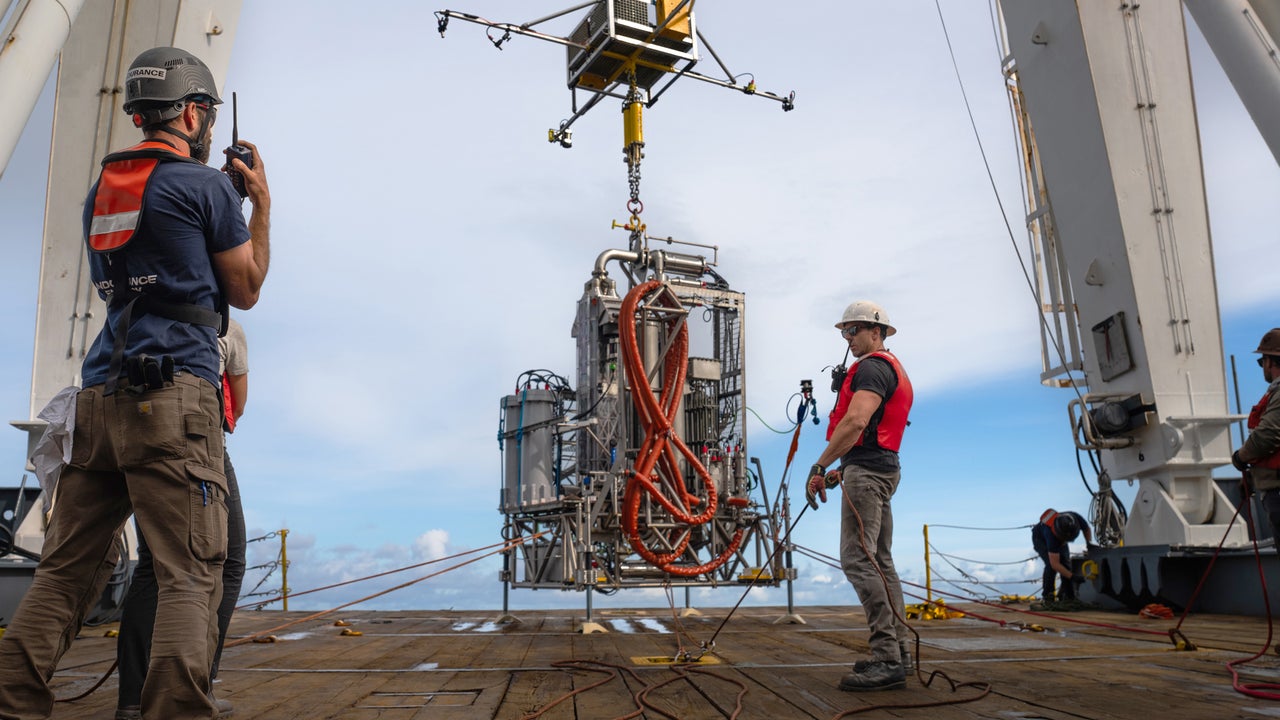
In a vent field around 5,000 feet underwater, they drilled a two-inch-wide, 52-foot-deep well that tapped into 500-degree heat beneath the ocean floor—the first fully encased well of its kind. Later, as 10-foot waves crashed around their ship, they lowered a three-ton generator to the sea floor to test its ability to create electricity from that heat.
[Photo: Endurance Energy]
The full process didn’t work exactly as planned, and the experiment stopped when a power cable failed. But when the team connected the generator to a natural vent in the sea floor, the generator briefly produced power. (For 8.7 seconds, it produced more power than it consumed.) The company says that it’s an important proof point for its ultimate vision: a network of undersea power plants that could provide baseload clean energy.
While tiny experiments happened in the past, that vision is new. “No one’s ever tried this even close to the commercial scale that we’re going after,” says Andrew Redd, founder and CEO of Endurance Energy.
Redd previously worked as an engineer at SpaceX. “I wanted to go after something that was going to be both really good for the world but also extremely compelling from an employee perspective,” he says. “I looked around me and saw all of the hyper-capable people at SpaceX and posed the question, how do you get people like this to work for you?”
The challenge of undersea power was incredibly complex, and had never been done before—the type of problem that engineers love to work on. It also had the potential, he realized, to be a major power source.
[Photo: Endurance Energy]
The Seattle-based startup, which has raised $63 million to date, launched at the beginning of 2025. Already, it’s had five undersea deployments, with the test in September the most complete, deploying the end-to-end steps in the company’s process.
The prototype system, called Adélie, is now back at the company’s Seattle lab, where it’s being tweaked and prepared to relaunch in a few months. It’s still too early to know whether the technology is truly viable. But Redd argues that the approach has advantages. On land, the best sites for geothermal power have permeable rock, hot temperatures, and access to water; all of those things are easily found offshore.
“You’ve got this vast, permeable network on the mid-ocean ridges,” he says. “You’ve obviously got unlimited water for your reservoirs. And then the crustal thickness is very low, so you’ve got this thin, oceanic crust that gives you a really high geothermal gradient.”
There are other questions, including environmental impact. The company, which has been working with the University of Washington in its early tests of prototypes, says that it’s carefully monitoring environmental impact and argues that it’s minimal (the sound of the drilling, for example, is quieter than the ship’s engine.) Still, it’s harder to know what the impact might be over time, and typical move-fast-and-break-things startup culture isn’t aligned with caution. It also isn’t clear what challenges the company might face with permitting when it scales up to full-sized commercial systems.
[Photo: Endurance Energy]
In theory, if it works, it could be a large power resource. Around the Pacific’s Ring of Fire, Redd says that there are around six terawatts of power that could be developed over the next five years—assuming, and it’s a big assumption, that the equipment was available to build it. That’s more power than current global demand.
“Where it’s cost-effective, where there are resources near to shore, we’ll be able to support a significant amount of the upcoming demand for baseload power, and then also start to displace existing power generation from non-renewable resources,” Redd says. “That’s really the mission of the company: to make offshore geothermal the economically obvious choice.”
Endurance Energy is building a modular system designed to be replicated in a factory to get to economies of scale. “That gets you into the realm of solar panel production, where it’s the same thing being built over and over again,” he says.
Now, as it retools the Adélie prototype, the startup is also developing its commercial-size, 2-megawatt generator. The first project is planned in the Kingdom of Tonga, where much of the grid runs on imported diesel. If all goes as planned, the new power plant could be running next year.
4 hours ago