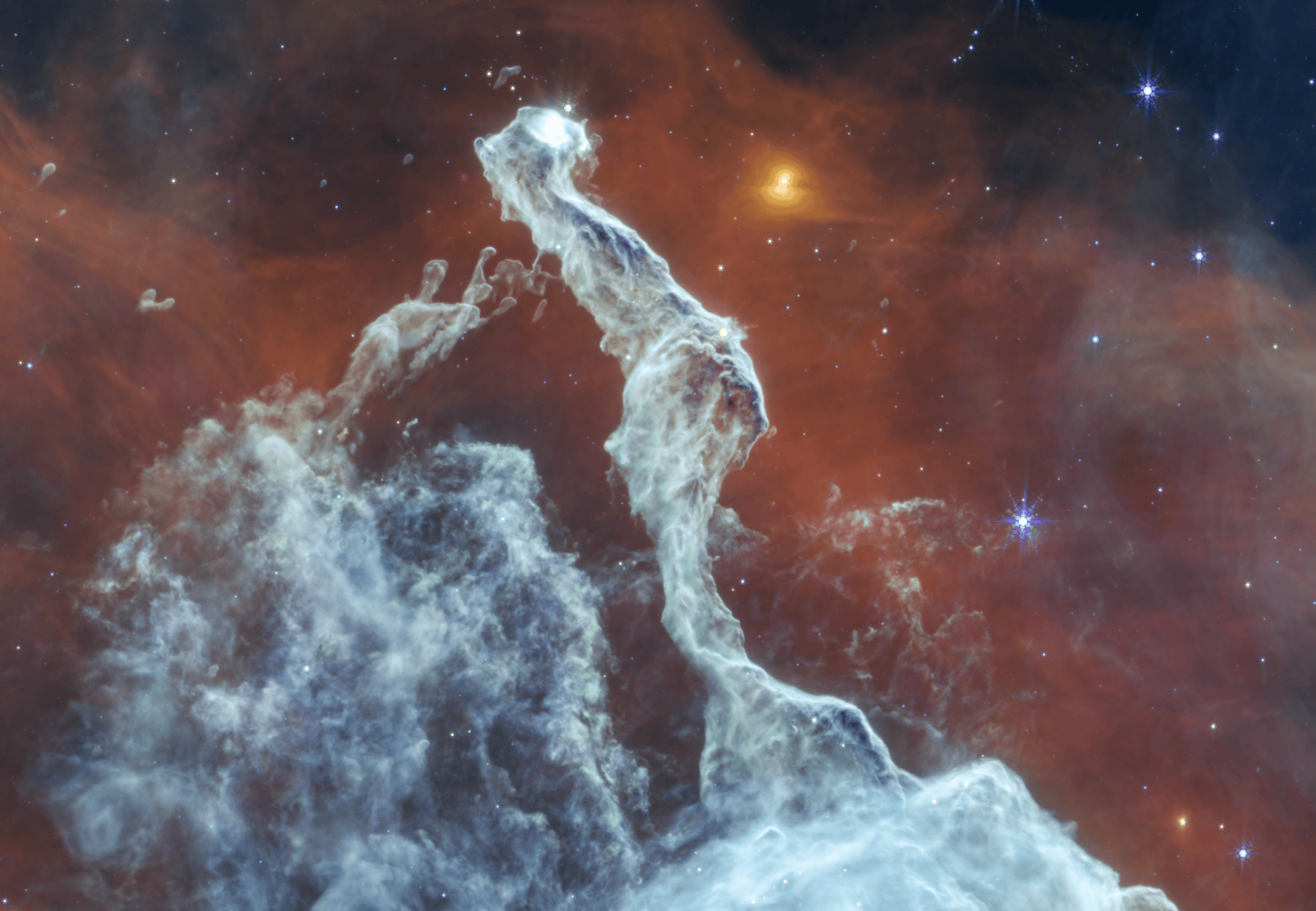
NASA’s James Webb Space Telescope, and in other coverage NASA’s Hubble as well, captures detailed images of a “Cat’s Head” nebula. Outlets describe the feature as resembling a cat sitting with its back toward the viewer, with a turned “head” and a glowing “eye.” NASA News also highlights a mid-infrared view in which intricate structures within the nebula stand out.
The nebula is located within the larger Carina Nebula, described as a vast diffuse star-forming region about 7,500 light-years from Earth. Across the sources, the shape is presented as something sculpted over time by stellar feedback—particularly strong ultraviolet radiation and winds from massive stars in the Carina Nebula. Phys.org and NASA News add that Hubble and Webb observed a small shared area, framing the scene as a dynamic, star-forming landscape.
Overall, the reporting largely agrees on what the images show and the broad physical explanation for the nebula’s form, with differences mostly in how much observational and distance detail is provided and which telescope/view is emphasized.