
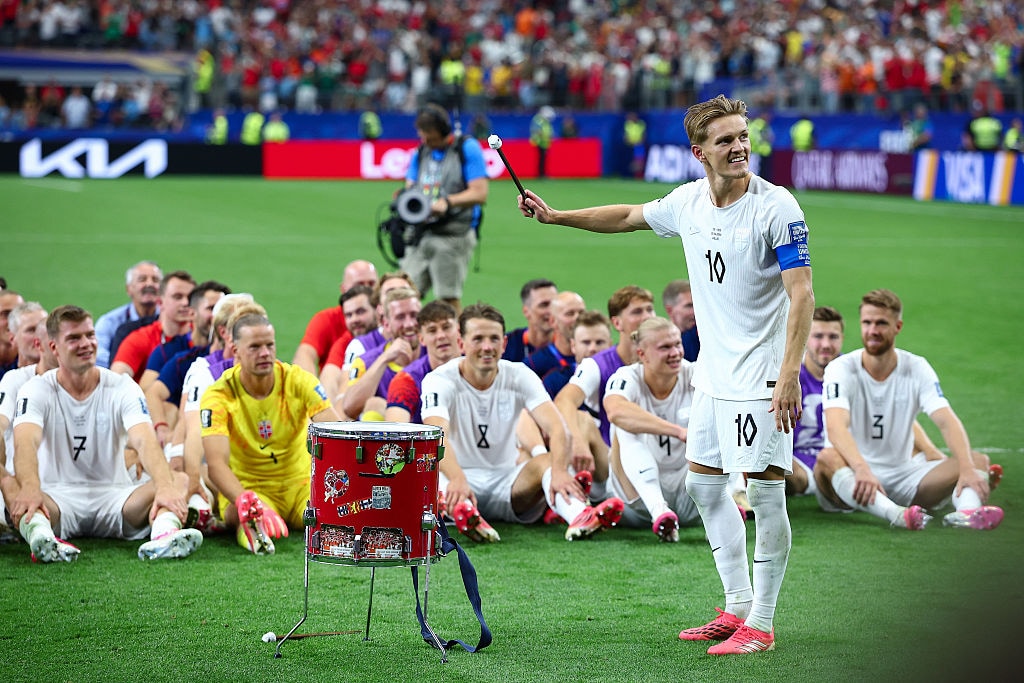
Norway’s men’s national team qualifies for the FIFA World Cup 2026 knockout stage despite losing 4-1 to France in its final Group I match on June 26. France’s Ousmane Dembélé scores a hat-trick as Norway finishes as Group I runner-up and is set to play Ivory Coast in the round of 32, after Ivory Coast also advances as its group runner-up. The defeat follows earlier momentum from Norway’s 3-2 win over Senegal, a result that secured qualification. After that match, Norway’s captain Martin Ødegaard leads the Viking Row celebration with fans in the stands, with teammates including Erling Haaland joining the synchronized rowing-like motion in front of supporters. The Viking Row is a theatrical, drum-led ritual in which large groups sit shoulder-to-shoulder and rock backward and forward in unison while chanting “Ro,” taking inspiration from Nordic seafaring imagery. The celebration is presented as a modern fan creation that spreads rapidly from stadiums into public spaces, including areas such as Times Square in New York. Norway’s widespread adoption extends to public figures and institutions, while some commentary highlights social pressure to conform.
Norway exits Group I after France defeats; players and fans perform Viking Row celebration
Norway’s men’s national team qualifies for the FIFA World Cup 2026 knockout stage despite losing 4-1 to France in its final Group I match on June 26. France’s Ousmane Dembélé scores a hat-trick as Nor...
- Norway loses 4-1 to France in its final Group I match; Ousmane Dembélé scores a hat-trick.
- Norway advances to the round of 32 as Group I runner-up and is drawn to face Ivory Coast.
- Norway’s Viking Row celebration involves thousands of fans and players performing synchronized, drum-led “rowing” motions.
- After Norway’s 3-2 win over Senegal, players including Martin Ødegaard and Erling Haaland perform the Viking Row with fans.
- The Viking Row originated as a modern fan-led ritual and spreads from stadiums to public spaces and social media.
Perhaps the historic French cry On les aura! ('We'll get them!') was the devastating storm needed to capsize Viking Row—the viral Norwegian sensation that had been dominating the tournament.On Friday, June 26, Norway’s high-flying men's national team ran straight into a French buzzsaw, losing 4-1 in their final Group I match, courtesy a ruthless hat-trick by France's Ousmane Dembele.Despite the loss, Norway is safely through to the knockout bracket as the Group I runner-up. Norway will face Ivory Coast in the round of 32 knockout, who secured their spot as the runner-up from Group E. The defeat has simply added a dramatic twist to a cultural phenomenon that has seen everyone from prime ministers to thousands of fans in Times Square sit on the ground and pretend to paddle a longboat.What is the Viking Row?The Viking Row is a highly synchronised, theatrical fan celebration where thousands of supporters sit down shoulder-to-shoulder in the stands—or on the street—and rock backward and forward in unison. According to FourFourTwo, the movement is explicitly designed to mimic historic Nordic oarsmen and is accompanied by a low, collective chant of "Ro!" (the literal Norwegian word for row). We just started rowing @TheVikingRow must go onFriday match between France and Norway will be amazing pic.twitter.com/wfcS1rYqFE— Rostad (@_Rostad) June 24, 2026 The tempo is dictated by a steady, booming drumbeat that gradually builds into a frenzied pace. It has become the definitive visual highlight of the 2026 tournament, drawing immediate comparisons to Iceland's famous "Thunder Clap" from Euro 2016.Who started it and when did it begin?While the ritual looks like something unearthed from a 1,000-year-old burial mound, it is actually a modern invention. FourFourTwo reports that the celebration was dreamed up in 2025 by Ole Froystad, a coordinator for the official Norwegian fan group "Oil Mountain" (Olemobil). Froystad wanted to establish a powerful, uniform stadium identity to celebrate Norway returning to the World Cup stage after a painful 28-year absence.Froystad told Olympics.com that while the timeline is modern, the spirit is old-school. Fans first tested out the routine during a World Cup warm-up match against Sweden on June 1, and it instantly caught fire.Where has the phenomenon spread?The routine has spilled out of the stadiums and completely taken over public spaces. The Financial Times reported that hundreds of travelling Norwegian supporters brought traffic to a standstill by sitting down on the pavement to row in the middle of Times Square in New York City. Similar sights have been caught on social media across host cities like Boston, with fans rowing on public transit, plazas, and escalators.Back home in Norway, a wealthy nation of 5.7 million people, the trend has broken through all social barriers. Members of Parliament have openly rowed in the legislative halls, Prime Minister Jonas Gahr Store has joined in, and even the royal family has been spotted mimicking the oarsmen. The craze has even conquered the music charts. An official anthem titled Vikingblod (Viking Blood) has climbed to the number one spot on Norway’s Spotify chart.How did the football team react?The players haven't just tolerated the craze. They have actively joined the crew. Following Norway’s thrilling 3-2 group-stage victory over Senegal at the New York New Jersey Stadium, which officially sealed their advancement to the next round, the entire team walked over to the stands. Led by captain Martin Odegaard beating a drum, superstars like Manchester City’s Erling Haaland sat flat on the grass and rowed right along with the fans. Ragnhild Ask Connell, director of communications for the Norwegian Football Federation (NFF), told the Financial Times that the federation intentionally leaned into the Viking theme as a rare opportunity to showcase their national identity to a massive US audience.Friction of JantelovenDespite its massive popularity, the rowing craze has hit a few nerves back home. The Financial Times highlighted the story of Emil Anners Lappen, a 24-year-old forestry manager who became an overnight celebrity simply for sitting perfectly still and refusing to row while everyone around him went wild. Cultural commentator Janne Stigen Drangsholt noted that this intense pressure to conform is a textbook example of Janteloven—the famous Scandinavian social code that discourages individuals from standing out. Furthermore, many have pointed out that historical Vikings are associated with plunder and violence, a stark contrast to modern Norway’s global reputation for peace mediation.
1 day agoNorway's players performed an incredible Viking Row with fans to celebrate reaching the World Cup knockout stages for the first time in 28 years after defeating Senegal 3-2 in New York.
4 days agoNorway's players performed an incredible Viking Row with fans to celebrate reaching the World Cup knockout stages for the first time in 28 years after defeating Senegal 3-2 in New York.
4 days agoThe Viking Row has become a popular tradition among Norway fans during the tournament. Supporters sit in a formation resembling a Viking longboat and mimic rowing movements to the beat of a drum, drawing comparisons with Iceland's famous "Viking Clap" from Euro 2016.
5 days agoNorway's celebrations continued long after the final whistle as captain Martin Odegaard led the team in performing the iconic Viking Row alongside thousands of jubilant supporters inside the stadium following their thrilling 3-2 victory over Senegal at the FIFA World Cup 2026.With the players lined up in front of the stands, Odegaard took center stage, beating a drum and setting the rhythm as his teammates joined in the famous rowing motion. The synchronized celebration was met with deafening cheers from the Norwegian faithful, who enthusiastically mirrored the players' movements in a powerful display of unity between the squad and its fans.Norway team doing the rowing celebration with Haaland in front after qualifying pic.twitter.com/V0bD4814PM— 17 (@DxBruyneSZN) June 23, 2026 The Viking Row has become a cherished symbol of Norwegian football culture, representing the country's Viking heritage and the bond shared by supporters and players. Norwegian fans had already brought the tradition to the streets of New York in the days leading up to the match, and the post-game scenes inside the stadium provided another memorable chapter in their World Cup journey.Norway's spirited celebration came after they secured a hard-fought 3-2 win over Senegal, booking their place in the Round of 32. Erling Haaland netted twice, while Marcus Pedersen also found the back of the net in a match that saw Senegal threaten a late comeback through Ismaila Sarr's brace.As the players rowed in unison with their supporters, the jubilant scenes underlined the growing belief surrounding a Norwegian side making its first World Cup appearance in nearly three decades. Led by Odegaard both on and off the pitch, Norway's Viking spirit appears to be carrying them deeper into the tournament.
5 days ago
Messi sets World Cup scoring records as Argentina beat Austria and secure knockout place
Lionel Messi breaks multiple FIFA World Cup scoring records as Argentina move into the knockout stage. In the group stag...
Algeria and Austria qualify for World Cup last 32 after 3-3 draw; Iran eliminated
Algeria and Austria qualify for the FIFA World Cup last 32 after a dramatic 3-3 draw in Group J that also sends Iran out...
Sharks draft Alexander Karmanov, listed at 7-foot-1 and 280 pounds
The San Jose Sharks select Alexander Karmanov with a seventh-round pick in the NHL Draft, according to reports. Multiple...