


FIFA says rainbow flags will be permitted at Lumen Field for the World Cup group match between Iran and Egypt in Seattle, despite objections from both countries’ football federations. FIFA confirmed that it will not bar the symbol from the stadium, explaining that rainbow flags and other flags representing sexual orientation and gender identity are allowed under its stadium code of conduct when used in accordance with tournament rules. The issue is framed by rights organizations and the federations’ prior efforts to limit such symbols. Human Rights Watch reports it has documented abuses of LGBT people in both countries and describes legal and enforcement frameworks in Iran and Egypt that make public LGBT-related symbols sensitive. In contrast, Human Rights Watch highlights the 2022 World Cup in Qatar as an example where rainbow-related items were restricted, including actions such as confiscations and threats related to anti-discrimination messaging. Other reporting also cites FIFA’s stadium policy on restricting “political, offensive, and/or discriminatory” items, and notes that Iran and Egypt both formally raised concerns after Seattle organizers sought to feature LGBTQIA+ communities as part of the event. Ahead of the match, both teams’ media access focused on football rather than the flag controversy.
FIFA allows rainbow flags at Seattle World Cup match between Iran and Egypt
FIFA says rainbow flags will be permitted at Lumen Field for the World Cup group match between Iran and Egypt in Seattle, despite objections from both countries’ football federations. FIFA confirmed t...
- FIFA confirms rainbow flags are allowed inside Lumen Field for the Iran vs. Egypt World Cup match in Seattle.
- Both Iran and Egypt’s football federations object to allowing rainbow flags.
- FIFA states rainbow flags and related sexual orientation and gender identity flags are permitted under its stadium code of conduct if used per the rules.
- Human Rights Watch links the decision to documented LGBT rights abuses in Iran and Egypt and contrasts it with restrictions during the 2022 World Cup in Qatar.
- Reporting ahead of the match says Iran and Egypt’s media remarks focus on football rather than the flag issue.
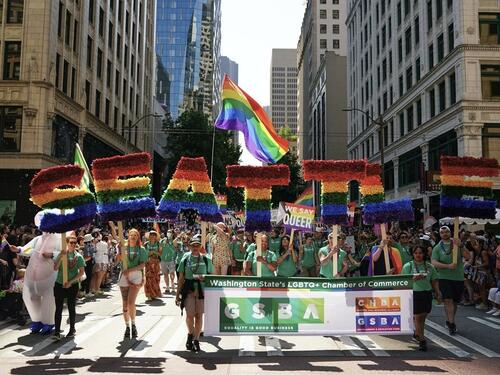
Click to expand Image Marchers with the Greater Seattle Business Association, Washington State's LGBTQ+ and allied chamber of commerce, during the annual Seattle Pride Parade, June 25, 2023. © 2023 Lindsey Wasson/AP Photo When the Egypt and Iran teams meet at Lumen Field in Seattle tonight, soccer fans will be free to wave the rainbow flag. The Fédération Internationale de Football Association (FIFA) confirmedThursday that it would not bar the symbol from the stadium over formal objections from both countries’ football federations. It is the right call. On June 25, FIFA called the tournament “an inclusive event that welcomes people from all backgrounds,” and said rainbow flags and other flags representing sexual orientation and gender identity are permitted under its stadium code of conduct, provided they are used in line with the rules. This announcement is overdue, especially after FIFA shamefully canceled its own anti-discrimination campaign for the 2025 FIFA Club World Cup. Human Rights Watch has long documented human rights abuses of lesbian, gay, bisexual, and transgender (LGBT) people in both of the countries whose teams are playing tonight. In Egypt, which denies the existence of LGBT people, no statute explicitly criminalizes same-sex conduct; instead, a vaguely worded “debauchery” law is used selectively to arrest, prosecute, and torture LGBT people. Iran’s Islamic penal code prescribes punishments ranging from flogging, which constitutes torture, to death sentences for men engaging in consensual same-sex conduct. That is why a simple act like raising a flag is unnerving for these governments. That is the context in which the football federations in Cairo and Tehran told FIFA they wanted to ban rainbow flags from their match.The contrast with the World Cup in 2022 is important. Then, FIFA allowed the host government Qatar, whose government has a record of rights violations against LGBT people, to confiscate rainbow items from fans, detain a journalist over his rainbow t-shirt, and threaten to sanction captains for wearing the “One Love” armband. Since 2016, under its own statutes, FIFA has been bound to respect all internationally recognized human rights.Seattle’s Pride Match Day shows human rights commitments can be honored, when FIFA chooses. The Seattle World Cup host city organizers captured this sentiment perfectly, affirming: “Soccer has a unique power to unite people across borders, cultures, and beliefs. We are honored to host a Pride Match and to celebrate Pride as part of a global football community. This match reflects our ongoing commitment to respect, dignity and unity for all.”
1 month agoFIFA Folds, Allows Rainbow Flags To Fly In Seattle Stadium Despite Objections From Iran, Eqypt Rainbow flags will be allowed inside the stadium in Seattle, where the FIFA World Cup group game between Iran and Egypt is being held on June 26, despite both countries objecting to the standards associated with the LGBT community. Both countries are predominantly Muslim, and homosexuality is illegal in Iran and criminalized in Egypt, but Hana Tadesse, a spokesperson for Seattle’s World Cup organizing committee, said on June 24 that FIFA considers the rainbow flag a statement of human rights and will allow fans to wave it inside Lumen Field. In December 2025, the soccer federations of both Iran and Egypt complained after it became clear that Seattle’s World Cup organizing committee wanted to use the match as a “once-in-a-lifetime moment to showcase and celebrate LGBTQIA+ communities in Washington.” As Chris Summers reports for Epoch Times, under FIFA’s World Cup stadium policy, it is prohibited for fans to bring in certain controversial political items. “Any materials, including but not limited to banners, flags, flyers, apparel, and other paraphernalia that are of a political, offensive, and/or discriminatory nature, containing wording, symbols, or any other attributes aimed at discrimination of any kind against a country, private person, or group on account of race, skin color, ethnicity, national or social origin, gender, disability, language, religion, political or any other opinion, birth, wealth or any other status, sexual orientation, or any other grounds,” according to the policy. When Iran played its first game, against New Zealand in Inglewood, California, on June 15, The Epoch Times reported that FIFA had banned Iranian fans who opposed the regime in Tehran from flying the country’s pre-1979 flag—which bears a lion-and-sun standard—inside the stadium. On June 25, before the Iranian soccer team held a news conference in Seattle, Daniel Marin, FIFA’s executive director of public relations, read a statement on behalf of the Iranian team. “This Islamic Republic of the Iran Football Federation has asked us to inform the media that they are only willing to answer questions in relation to the game,” Marin said. “We fully respect the right of all journalists to ask questions. In this case, we ask you respect the rights of the federation here today to only answer questions in relation to the team, the tactics, the match, and so on.” Iran goalkeeper Alireza Beiranvand makes a save against Belgium during their soccer World Cup match in Inglewood, Calif., on June 21, 2026. Mark J. Terrill/AP But Iran’s coach, Amir Ghalenoei, was still asked a barrage of questions about the issue by journalists, which he declined to answer. If Iran wins, they will advance to the knockout stage of the World Cup for the first time. “I said to you earlier we are here to play football. For nothing else,” Ghalenoei said. “Our entire focus is going to be on tomorrow’s game, on succeeding in tomorrow’s game. And, anything else that is banned ... we don’t want to speak about it.” Soccer Is the ‘Beautiful Game’ “We are only going to speak about football, what a beautiful game it is, and how enjoyable it’s going to be,” Ghalenoei said. Egypt’s players and coach Hossam Hassan also declined to answer questions on the issues during a news conference at Husky Soccer Stadium in Seattle. “We are all focused on football,” Hassan, speaking through a translator, said. “This is all that we think about.” The wearing of rainbow armbands became a controversy in 2024, when several English Premier League soccer players objected to wearing them as part of an “LGBTQ+ inclusion initiative” because of their religious beliefs. Marc Guehi, who is currently playing for England in the World Cup, chose to write over the armband the message, “Jesus loves you.” Sam Morsy, a practicing Muslim who captained Ipswich Town, chose not to wear the symbol on his jersey when he led his team to a draw against Manchester United in December 2024. Morsy played nine times for Egypt—where his father is from—but was not included in their World Cup squad. The Epoch Times reached out to FIFA for comment but did not receive a response by publication time. Tyler Durden Fri, 06/26/2026 - 16:40
1 month ago
Kimi Antonelli to serve grid penalty at Italian Grand Prix after engine change
Mercedes team principal Toto Wolff confirms that championship leader Kimi Antonelli will take a grid penalty at the upco...

Dangote Refinery cuts petrol gantry price, easing pump prices in parts of Nigeria
Dangote Refinery announces a reduction in its ex-gantry price for Premium Motor Spirit (petrol), lowering it by about N7...

Solheim Cup captain Anna Nordqvist announces retirement after this week’s FM Championship
Anna Nordqvist, the captain of Europe’s Solheim Cup team, announces that she will retire from professional playing after...