


South Korea’s government and major companies announce large investments to expand semiconductor and AI infrastructure beyond the Seoul area, focusing on a new semiconductor complex in the southwestern Honam region and parallel AI data center plans. The centerpiece is an 800 trillion won ($585 billion) semiconductor complex led by Samsung Electronics and SK hynix, with each company building two memory chip fabs in the southwest. The government also plans AI data centers backed by 550 trillion won from SK Group, GS Group and Naver, starting with 8.4 gigawatts of capacity and expanding to 18.4 gigawatts by 2035. The plan is part of the “three flagship megaprojects” initiative covering semiconductors, physical AI and AI data centers, aimed at strengthening Korea’s capacity to meet rising AI demand. Reports also note skepticism about whether the southwest has enough electricity supply and broader infrastructure, workforce and utilities to support the new fabs; a presidential official dismisses those concerns and cites the region’s potential advantages, while industry leaders emphasize the need for sufficient power, water and skilled workers. Separately, the tripolar approach includes complementary roles for other regions, such as semiconductor packaging in central Chungcheong and additional industry investment projects in the southeast.
South Korea unveils $585 billion plan for Honam semiconductor and AI infrastructure
South Korea’s government and major companies announce large investments to expand semiconductor and AI infrastructure beyond the Seoul area, focusing on a new semiconductor complex in the southwestern...
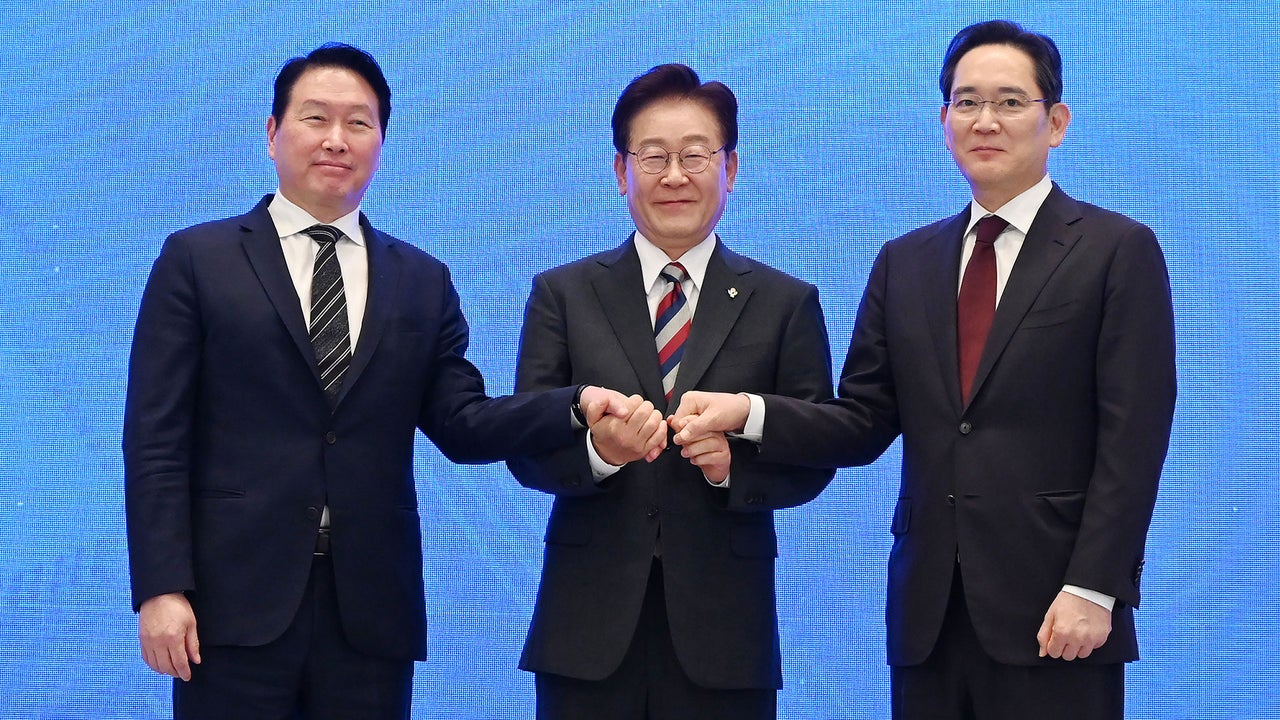
- Samsung Electronics and SK hynix will invest 800 trillion won to build a semiconductor complex in the southwestern Honam region, with each planning two memory chip fabs.
- SK Group, GS Group and Naver will invest 550 trillion won to develop AI data centers, targeting 8.4 GW initially and 18.4 GW by 2035.
- The projects are part of South Korea’s “three mega projects”/flagship initiative covering semiconductors, physical AI, and AI data centers to support AI-driven industrial growth.
- Some skepticism focuses on whether the southwest has adequate electricity, water, workforce, and other infrastructure; officials respond that capacity concerns are being addressed.
- The broader plan follows a “tripolar” regional strategy, with different AI and semiconductor roles across southwestern, central, and southeastern regions.
President Lee Jae Myung on Monday called for the prompt execution of the government-led large-scale chip cluster and AI investment projects by expediting administrative procedures, including streamlining environmental impact reviews. The president made the call at a meeting with senior government officials and top executives of leading chipmakers — Samsung Electronics Co. and SK hynix Inc. — to discuss follow-up measures for the investment projects. Last week, the government unveiled the "three mega projects" initiative, centered on large-scale investments in semiconductors, physical artificial intelligence (AI) and AI data centers, as the country bets big on those advanced industries for its future. In particular, the government plans to establish a semiconductor production cluster in the southwestern Honam area, with Samsung and SK pledging to invest a combined 800 trillion won ($522 billion). "The world is witnessing very intense competition, while an entirely new future is being shaped around AI," Lee said in his opening remarks. "At a time when all-out competition that will deter
1 month agoKorean conglomerates will roll out a combined 312 trillion won ($201.7 billion) in investments across cutting-edge industries, such as artificial intelligence (AI) and small modular reactors (SMRs), in the southeastern region, the finance ministry said Friday. The business groups — Hanwha, Hyundai Motor, Samsung and SK — unveiled a set of projects to foster the chip, electronics and space industries in the southeastern Yeongnam region, building on its existing industrial infrastructure, according to the Ministry of Finance and Economy. The drive comes under President Lee Jae Myung's tripolar mega projects, which center on advancing technologies across the country and turning Korea into an industrial powerhouse in the emerging AI era, following similar announcements for the southwestern and central regions earlier this week. In detail, Hanwha Group vowed to invest 55 trillion won in areas including satellites, launch vehicles, and AI data centers for the space and defense sectors, while Hyundai Motor Group will allocate 42 trillion won to build the groundwork for AI-based autonomous
1 month agoA senior presidential official on Friday rejected skepticism that the southwestern Honam region may not have enough electricity supply capacity to power a government-envisioned semiconductor cluster in the region. Kim Woo-chang, presidential secretary for state artificial intelligence (AI) policy, made the remarks in his appearance on a radio program by state-run broadcaster KBS, days after the government announced plans to establish a chip cluster in Honam. Under the plan, the government aims to develop the country's second semiconductor cluster in Honam, in addition to the first one in the capital region, in a bid to preemptively secure chip production capabilities amid intensifying competition in the AI industry. Samsung Electronics Co. and SK Group, the parent group for SK hynix, have committed large-scale investments to the project. The semiconductor investment is part of the government's "three mega projects" initiative, which calls for large-scale investments in semiconductors, physical AI and AI data centers. The chip cluster plan has drawn skepticism that the southwest region mig
1 month agoAn industrywide 392 trillion-won ($252.5 billion) investment will be injected into the central Chungcheong area, including high bandwidth memory (HBM) fabs and packaging facilities by Samsung Electronics and SK hynix, as part of the government's drive to spread artificial intelligence (AI)-led growth, the industry ministry said Thursday. It is a follow-up plan to the government's tripolar mega projects, unveiled by President Lee Jae Myung earlier this week, aimed at advancing technologies across the country and turning Korea into an industrial powerhouse in the emerging AI era. According to the Ministry of Trade, Industry and Resources, Samsung Group pledged to invest a total of 140 trillion won in Chungcheong Province to build an HBM fab and packaging facility by Samsung Electronics, as well as an organic light-emitting diode and next-generation display production line by Samsung Display. Samsung Electro-Mechanics will construct high-performance package substrate facilities for AI servers and Samsung SDI will build an advanced battery manufacturing factory. SK hynix announced that will
1 month agoKorea’s ambitious plan to build a new semiconductor manufacturing hub in the country's southwestern region and expand artificial intelligence (AI) infrastructure faces growing practical questions over how to secure the workforce and industrial infrastructure needed to support these projects outside the Seoul metropolitan area. The government on Monday unveiled three flagship megaprojects — semiconductors, physical AI and AI data centers — as new growth engines, backed by more than 1,350 trillion won ($872 billion) in planned public and private investment. The initiative includes about 800 trillion won to build four memory fabs, two each for Samsung Electronics and SK hynix in the southwestern region, while strengthening existing manufacturing bases in Yongin, Gyeonggi Province, and other sites around the capital region. SK Group, GS Group and Naver are also expected to invest around 550 trillion won to develop AI data centers with a total capacity of 8.4 gigawatts in the initial phase and expand to 18.4 gigawatts by 2035. Samsung Group and SK Group separately pledged a combined 4,
1 month agoSouth Korean tech giants Samsung Electronics and SK Hynix said Monday they will invest a combined 800 trillion won ($518 billion) in building a new computer chipmaking hub in the country’s southwest region, capitalizing on surging artificial intelligence-driven demand.President Lee Jae Myung joined the companies’ chairs Monday in announcing the plan, which dovetails with the government’s efforts to expand investment beyond the greater Seoul metropolitan area, the country’s economic center and heart of its semiconductor sector.The southwest has been a particular focus, as it lacks major industrial hubs and has historically trailed in economic development. The region has long been a political base for Lee’s liberal Democratic Party.Samsung and SK Hynix, which together produce about two-thirds of the world’s memory chips, said they will each build two fabrication plants in the southwest, expanding beyond their existing manufacturing complexes in Gyeonggi Province, south of Seoul.Samsung Chairman Lee Jae-yong said the company’s new fabs will be built in the southwestern city of Gwangju, where experts have proposed several potential sites, including the grounds of a military air base slated for relocation.The companies didn’t specify when the fabs in the southwest regions would be completed. SK Hynix’s Chairman Chey Tae-won said the project would be a complex, large-scale effort requiring “vast sites, along with sufficient power, water and skilled workers.” He said it took nine years for SK Hynix to establish its major manufacturing cluster in Gyeonggi Province. Still, a significant expansion of manufacturing facilities is needed for the company to keep up with global demand, Chey said.Government officials dismissed questions about whether the southwest has enough power and water to support major semiconductor fabs. They said the region’s strength in renewable energy would give the chipmakers an edge as they face growing global pressure to use cleaner sources of electricity.Samsung and SK Hynix have reported record profits in recent months as soaring global investment in data centers and other AI infrastructure has fueled demand for memory chips. Government officials and business experts expect AI-driven demand to continue increasing as the technology spreads to AI-powered industrial robots and autonomous vehicles. The chipmakers’ existing semiconductor complexes in Gyeonggi Province may reach capacity sooner than expected, they say.During Monday’s event, government officials outlined plans to build what they called a nationwide semiconductor ecosystem, with existing manufacturing hubs in the southeast expanding production of chip components and materials, the central Chungcheong region specializing in chip packaging, while data centers are built across the country.“We must establish the core building blocks of artificial intelligence faster than any other country. Semiconductors, physical AI and AI data centers are the three pillars of our next great leap forward,” the president said. —Kim Tong-Hyung, Associated Press
2 months ago
Apple refreshes the Mac mini with M6 and M5 Pro chips and new pricing
Apple updates its Mac mini lineup with new M6 and M5 Pro configurations, keeping the same compact design. Multiple outle...

Apple is expected to launch first AI-powered smart glasses next year
Apple is expected to debut its first pair of AI-powered smart glasses next year, according to reports. The glasses are d...

NTA schedules AIAPGET 2026 re-exam for 49 Jaipur candidates after power failure
The National Testing Agency (NTA) announces a re-examination for 49 candidates who are unable to complete the AIAPGET 20...