Andy Burnham gives his first major speech since Keir Starmer resigns, laying out a long-term vision for how the UK should be run if he becomes Labour leader and then prime minister. Speaking at the People’s History Museum in Manchester to about 100 supporters, including Labour MPs and regional mayors, Burnham presents the UK as “stuck in a rut” and argues for a “new direction” built around what he calls a “rewiring” of government. He says he would create “No 10 North,” splitting parts of No.10 Downing Street operations so an office in the north acts as a “nerve centre” to redistribute power and resources. His plan includes greater regional control over services such as water, housing, energy and transport, further devolution led by a shift away from Whitehall–region conflict, and a “biggest rebalancing” of power he links to investment, infrastructure and local decision-making. Burnham also promises the biggest council house-building programme since the post-war period, argues for “good growth in every postcode” supported by fiscal “discipline,” and says he wants to shift education policy toward technical routes rather than focusing on university. Both outlets note he does not take media questions after the speech, leaving practical details and policy areas such as immigration unanswered.
Andy Burnham sets out 10-year “rewired Britain” plan in first major speech
Andy Burnham gives his first major speech since Keir Starmer resigns, laying out a long-term vision for how the UK should be run if he becomes Labour leader and then prime minister. Speaking at the Pe...
- Andy Burnham delivers the speech at the People’s History Museum in Manchester, outlining a 10-year vision for government.
- He proposes creating “No 10 North,” with operations split so a northern office helps redistribute power and resources.
- He calls for expanded devolution, reducing Whitehall–region conflict and increasing local/regional control over areas including services like water, housing, energy and transport.
- He pledges large-scale council house building and economic strategy focused on growth in every postcode, alongside maintaining existing fiscal rules.
- Both reports say he does not take questions from journalists and does not provide further details on some policy areas after the speech.
Labour party's Andy Burnham delivers a speech at the People's History Museum in Manchester, England, Monday, June 29, 2026.Andy Burnham has outlined his vision for the country in his first major speech since Keir Starmer announced his resignation.Speaking in front of around 100 supporters, including Labour MPs and regional mayors, Burnham vowed to take the UK – which he claimed is “stuck in a rut” – in a “new direction”.Though leadership nominations have not officially open, Burnham is widely expected to be the only Labour MP with enough support to replace Starmer.If no-one else challenges him, Burnham will likely become the Labour leader on July 17 and prime minister on July 20.But the former Greater Manchester mayor has not been in government for decades and only won the Makerfield by-election earlier this month.While he has insisted he would stick to Labour’s 2024 manifesto, a question mark still hovers over what his time in No.10 might look like.Burnham’s speech today was an attempt to close that vacuum around what he might look like as prime minister (for no less than the next ten years, according to the new MP).Though the PM-in-waiting did not take any questions from the press, here’s what we learned from his speech in Manchester.1. No.10 In The NorthBurnham announced that he would commit to redistributing power away from London by splitting the No.10 operation in two, with one office in the north of England.He said: “No 10 North will be the nerve centre of a rewired Britain.“It will be the conduit through which we redistribute power and resources across the UK.”2. Raising Living StandardsBurnham said his office in the north will support regions across the UK on three tasks: “Reform of essential utilities, re-industrialisation and the regeneration of places.”It would mean regions could take “greater public control of essential services like water, housing, energy, and transport” in a move away from privatisation.He said: “Ours is a 10-year mission to raise people’s living standards.“I know people can’t wait forever for change. I heard on doorsteps in Makerfield how people need a bit extra now to help with rising costs.“I will do my very best to deliver it, and whilst not taking risks with the public finances, will seek to give Britain some breathing space as soon as I can.“People need to be able to look forward to a night out or a holiday with the kids. People need hope.”3. More Devolved PowersBurnham said he would bring about the “biggest rebalancing of power our country has seen” by introducing more devolution.“Let me say this very directly: the days of Whitehall fighting the devolution of power into the regions and nations are over for good,” Burnham continued.“The whole of Whitehall will now be required to get behind our places and work together with them to make quicker, more joined-up decisions.”The Makerfield MP said he wanted to introduce power at ground level along with a clear share vision which investors can back and committing to “decent infrastructure” across the country.He pointed to the work he’s done in Greater Manchester having been the region’s mayor up until earlier this month.He said he gave “businesses the stability and the confidence to invest, increasing their productivity and adoption of new technology.”Burnham promised to make sure British-based companies are in a better position to win procurement contracts, too.4. A More United WestminsterBurnham said he would “reach out to other parties” in a “fragmented, disjointed” Westminster if he were to get into No.10.He also suggested he would avoid using the whipping system to force MPs to back the government in parliamentary votes.It comes after Starmer was heavily criticised by removing the whip from his own backbenchers after they rebelled against his government.He said: “I will work hard to change that culture, leading from the front and showing how things can be different, letting MPs be authentic representatives, and not using the whip system to create fear or close down debate, involving more people in the work of the government and drawing on the breadth and depth of talent and expertise our party has to offer.“While the political direction I set is not up for negotiation, I will build an inclusive team at the very highest level, so that all parts of the party and the country can see themselves reflected and represented in it.”5. A Boost In Council House-BuildingBurnham promised to oversee the “biggest council house building programme since the post-war period.”“We will use public land, vacant public land, to reduce costs,” he said. “Let me just take you back to the 1970s.“When we were growing up here amongst the friends we had at school, there were two things that were the foundations of working class aspiration: a council home, a secure home that was the foundation for everything, and then good technical education.“Those things have been taken away in the decades since, so no wonder so many young people struggle to make it work… don’t blame them, blame ourselves.”6. No More ‘Trickle-Down Economics’Burnham said he would end “trickle-down economics” and instead offer “good growth in every British postcode”.He claimed he would achieve that through the “stability that comes from sound public finances” and the “discipline of our current fiscal rules”.“The change will be the biggest change in our lifetimes to the way the country is run and it is consistent with the 2024 manifesto,” he said.“We will create a more streamlined state with a clearer purpose to power up all parts of the country and put a laser-like focus on growth and regeneration, good growth.”7. End The Focus On The University RouteBurnham said he takes Alan Milburn’s May review into youth unemployment “very seriously”, after the former health secretary found more than a million 16-to-24-year-olds are not in education, employment or training.“We need a complete rethink of how we support the next generation to succeed, and it has to start with the education system.“The days of a school system configured entirely around the university route will be brought to an end.“University is great for those who want it, but when are we going to focus on the life chances of those kids who want something different? The country hasn’t done that for a long, long time.“People have argued over many years for an education system based on parity between academic and technical, and that is what we will build, giving every young person growing up here a clear path into a re-industrialised Britain.”Listen to Commons People, the podcast that makes politics easy. Every week, Kevin Schofield and Kate Nicholson unpack the week’s biggest stories to keep you informed. Join us for straightforward analysis of what’s going on at Westminster.Related...Analysis: Andy Burnham's Big Speech Left Big Questions He Refused To AnswerBurnham Vows 'Biggest Change To Way Country Is Run' As He Sets Out His Vision For BritainKemi Badenoch Slammed After Calling Andy Burnham's Female Allies His 'Handmaidens'
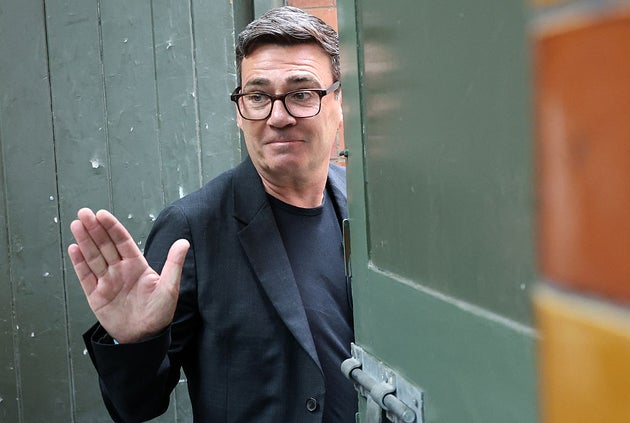
2 hours agoBurnham leaves after his speech without taking questions from waiting journalists.Andy Burnham today showed exactly why Labour MPs are desperate for him to replace Keir Starmer as prime minister as he laid out his vision for the country.The former mayor of Greater Manchester was pretty much everything the current PM is not.From the smart-casual clothes he wore to the easy charm with which he delivered his speech, this was clearly a man who – unlike Starmer – is very comfortable in his own skin.His remedy for the UK’s ills also stand in marked contrast to the man who he will replace in 10 Downing Street in less than a month’s time.Burnham was clear that he wants nothing less than the complete “rewiring” of the way Britain is run, with a huge shift of power away from Westminster to local communities and regions across England.That, he said, would lead to the biggest council house building programme of the post-war period, economic growth “in every postcode”, lower energy bills and prices coming down in the shops.He also signalled a massive change in education policy, with a greater focus on technical qualifications rather than the drive to get more young people to go to university.“I am going to do things differently,” Burnham declared. “I am going to break with the ‘more of the same’ approach that has got us here.“I am going to give Britain the circuit-breaker it needs by building a more collaborative politics in Westminster, by taking power out of the centre and putting it in the hands of the people and places who can use it best.”A bit like motherhood and apple pie, there was little in the speech that any reasonable person could, in good faith, take exception to.But for all the soaring rhetoric about putting “hope in every heart”, it lacked one important thing: an explanation of how it will all work in practice.Burnham failed to explain how putting more power in the hands of local politicians rather than those in Whitehall will magically improve the lives of everyone in the country was not explained.It was therefore unfortunate, to put it mildly, that the many journalists who had been invited to watch the speech were not then given the opportunity to ask him questions about it.Because let’s not forget, this is a man who was not even an MP a month ago, and yet stands on the threshold of assuming the highest office in the land without even having to go to the trouble of winning a leadership contest, let alone a general election.What’s more, he is a man who – for all his previous ministerial experience from 20 years ago – has not even been an MP for the best part of a decade.If this is not the time for him to answer detailed questions about what exactly he plans to do with the reins of power, then when till it be?How does he plan to stop the small boats crossing the English Channel, for instance, or get to grips with the ballooning welfare bill?And that’s before we even come to how he plans to deal with the threat posed by Vladimir Putin or repair the UK government’s relations with Donald Trump’s White House.Which brings us to another – more worrying – difference between Andy Burnham and Keir Starmer.For all his faults, the soon-to-be-former PM would not have made a speech like that and then refused to take any questions on it.Listen to Commons People, the podcast that makes politics easy. Every week, Kevin Schofield and Kate Nicholson unpack the week’s biggest stories to keep you informed. Join us for straightforward analysis of what’s going on at Westminster.Related...Burnham Vows 'Biggest Change To Way Country Is Run' As He Sets Out His Vision For BritainKemi Badenoch Slammed After Calling Andy Burnham's Female Allies His 'Handmaidens'Andy Burnham Wants 10 Years In Power To 'Lift Britain Back Up To Where It Should Be'
5 hours agoTo view this video please enable JavaScript, and consider upgrading to a web browser that supports HTML5 video Up Next Previous Page Next Page Andy Burnham had a big smile on his face as he stepped up to the lectern at the People’s History Museum in Manchester, for obvious reasons. He was standing in front of a supportive crowd who roared with approval when he bounded up the steps and set his speech in front of him – and he surely knew this speech would be an absolute barnstormer in the room. It was clear from the beginning that this would be a radical change from the kinds of thing we heard from Keir Starmer… starting with the fact Burnham was willing to literally call for ‘radical change’. When I spoke to Starmer just under six months ago, he told me directly he is ‘fed up’ with politicians who use that phrase. He said: ‘Liz Truss thought she’d have a radical change by taking no notice of the financial institutions that create stability. ‘Everybody paid the price, and I’m not going to inflict that kind of experiment on people ever again.’ Everything is changing, all the time Cut through political noise and understand how the Westminster chaos actually affects your life with Metro's politics newsletter Alright, Gov? Sign up here. I remember thinking at the time that this felt like a misreading of the public mood – the rise of Reform UK and the Green Party shows people think the country has fundamental issues that require a drastic solution. Compare that with Burnham’s words today: ‘Westminster and Whitehall are set up for conflict, and they require radical change if the country is to get back on track.’ This would involve no less than the ‘biggest rebalancing of power our country has seen’, through an ambitious programme of devolution. To view this video please enable JavaScript, and consider upgrading to a web browser that supports HTML5 video Up Next Previous Page Next Page Under Burnham, that effort would be led from an ‘extended operation’ of No 10 Downing Street based in Manchester – which he dubbed No 10 North, but I think deserves the name of the most famous northern Number 10: The Kabin. Just as that newsagent is one of the nerve centres of Coronation Street, Burnham described this new office as the ‘nerve centre of a rewired Britain’. The Kabin will be responsible for the creation of a ‘more streamlined state’, putting a ‘laser-like focus on growth and regeneration’, heading up the delivery of promises like a significant ramping up of council house construction. This is another reason why Burnham presumably knew his speech would go down well in the room. The front row was taken up by his fellow Labour mayors, who are set to be handed a raft of new powers. Burnham delivered his speech at the People’s History Museum, which he called ‘one of my favourite places on Earth’ (Picture: Reuters) So, that’s the stuff Andy Burnham did say today. What did he not say? We didn’t hear the presumptive PM answer any questions from the media. When he finished speaking, he stepped back down from the stage and headed off – reportedly to London, where he will meet more MPs. That meant we did not hear any hints about who he might put in his Cabinet when he is set to enter No 10 (South) in a mere three weeks’ time. Burnham joked about this, saying people should ‘feel free to discount the wild speculation in circulation’ as he would not announce any decisions on appointments ‘until the end of the process’. He laughed as he aimed a jab at BBC Political Editor Chris Mason after this line – but I doubt many journalists in attendance, hoping for a chance to grill the man who will soon be leading the country, were smiling along. Nor was there any talk about immigration, which is consistently listed by voters as one of their top issues. We know Burnham is supportive of Home Secretary Shabana Mahmood’s reforms, but we’ll need more details of his plans. The speech was rather light on details in general, something that could perhaps have been remedied with a few questions from the gathered press. But there’s no doubt Burnham told a clear story about where he thought the country had gone wrong and provided a clear vision of how he thought it should change. Compared to the two years with Starmer in charge, that feels like a radical change indeed. All that remains now is making it happen. Get in touch with our news team by emailing us at webnews@metro.co.uk. For more stories like this, check our news page. Comment now Comments Add Metro as a Preferred Source on Google Add as preferred source
5 hours agoRadio-tagged white-rumped vulture dies after electrocution in Nilgiris
A radio-tagged white-rumped vulture dies after electrocution in the Nilgiris district, according to reports. The bird ha...
South Africa increases police security ahead of June 30 anti-migrant ultimatum
South Africa is increasing police deployments and security measures ahead of a June 30 “deadline” set by anti-migrant gr...
Maharashtra extends monsoon fishing ban until August 15
Maharashtra extends its annual monsoon fishing ban until August 15, a state fisheries official said. The decision is int...