


Shares in the “Magnificent Seven” technology companies slide in June, with multiple outlets reporting that the group loses about $2.3 trillion in combined market value over the month. Euronews and Bloomberg frame the move as a broader shift in investor sentiment, suggesting the AI-driven trade is spreading beyond the biggest companies and that markets are moving toward capital rotation rather than concentrated bets on the largest tech platforms. Quartz and NDTV report that the pullback is sharp for the group, pointing to a June decline of roughly 10% and a worst month in over a year or similar recent timeframe. Several sources connect the selloff to growing impatience about whether major AI infrastructure spending will translate into near-term financial returns, including concerns about very large and ongoing capital expenditure. Times of India and The Economic Times add that some companies fund AI spending through debt in addition to cash reserves, and that higher costs and attention to free cash flow and profitability are affecting valuations. Across coverage, the pressure is described as not uniform across all seven firms, with investors differentiating among business models and AI monetisation potential. Upcoming earnings are highlighted as an important test for whether spending leads to measurable revenue growth and improving cash generation.
Magnificent Seven stocks fall as investors question AI spending returns
Shares in the “Magnificent Seven” technology companies slide in June, with multiple outlets reporting that the group loses about $2.3 trillion in combined market value over the month. Euronews and Blo...
- The Magnificent Seven—Apple, Microsoft, Alphabet, Amazon, Meta, Nvidia, and Tesla—lose about $2.3 trillion in combined market value in June.
- Investors increasingly question whether large AI infrastructure spending will generate sufficient returns.
- Several outlets describe the selloff as part of a broader rotation away from the biggest “AI builders” toward other parts of the AI ecosystem.
- Multiple sources link the move to concerns about capital spending, free cash flow, and profitability rather than AI announcements alone.
- Upcoming earnings are expected to be a key test of whether AI spending improves revenue, margins, and cash generation.
For years, the Magnificent Seven tech giants commanded investors’ attention, dominating the S&P 500 Index and determining which way the overall stock market was headed. Those days are over.
1 month agoThe seven largest technology companies, collectively known as the Magnificent 7, had about $2.3 trillion erased from their combined market value in June as investors question their massive spending on AI infrastructure. The post ‘Magnificent 7’ Tech Giants Lost $2.3 Trillion in Value in June as AI Concerns Mount appeared first on Breitbart.
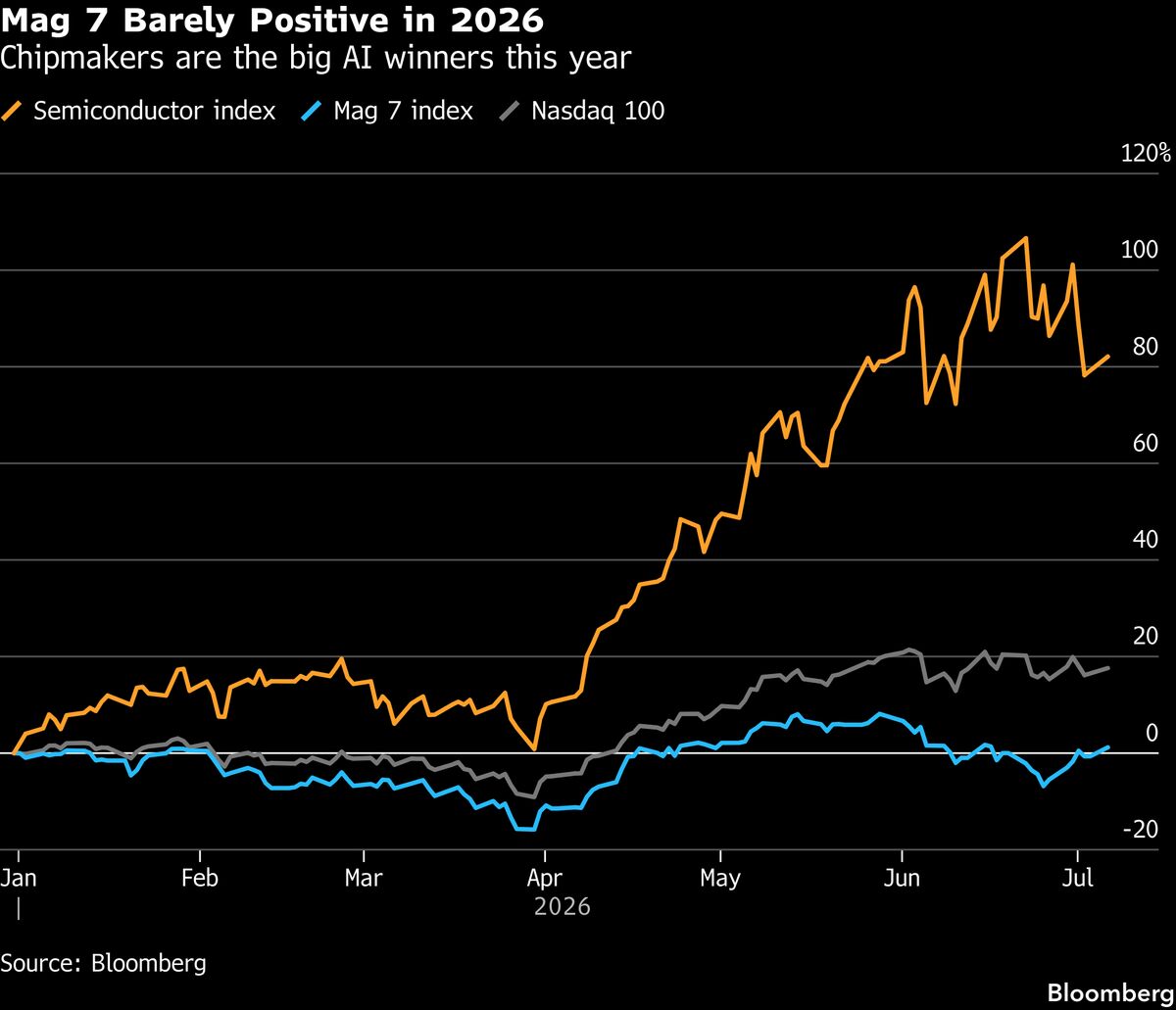
1 month agoThe dominance of the Magnificent Seven technology stocks (Apple, Microsoft, Alphabet, Amazon, Meta Platforms, Nvidia and Tesla) is facing its biggest test since the artificial intelligence rally began. After leading global markets for nearly three years, the world's largest technology companies are now underperforming as investors question whether the enormous amounts they are spending on AI will generate enough returns.The shift has become visible in recent weeks. According to deVere Group, nearly $2.3 trillion has been wiped off the combined market value of the Magnificent Seven during June.The correction comes after a strong run that was driven by expectations that AI would transform the technology industry and create a new wave of corporate profits. That optimism is now giving way to a more cautious approach as investors wait for evidence that the spending is translating into higher earnings.The upcoming June-quarter earnings season is expected to be an important test for the sector.Nigel Green, chief executive of deVere Group, said markets are entering a more demanding phase for AI investments.The Pakistan connection that helped Donald Trump make $1.4 billion crypto jackpot"The easy phase of the AI investment story is over. Investors were willing to support massive spending when expectations were high and stock prices kept rising. Now they want proof that these investments will deliver returns," he said.The biggest concern is the scale of spending. Microsoft, Amazon, Alphabet and Meta are investing hundreds of billions of dollars in AI infrastructure, including data centres, advanced chips and cloud computing capacity. Instead of slowing, these investments continue to rise.Reports suggest that spending by the largest technology companies on AI infrastructure could exceed 700 billion this year, around 70% higher than last year. This has started affecting free cash flow, as companies spend more cash on expansion instead of generating higher profits.An Apollo Global Management presentation released in June points to the same trend. The report says investors are beginning to rotate away from companies with heavy capital expenditure towards businesses with stronger free cash flow. It also shows that free cash flow among hyperscalers has started declining while capital expenditure as a share of operating cash flow continues to rise.The Magnificent Seven index has fallen more than 13% from its recent peak, while the broader S&P 500 and Nasdaq have seen much smaller declines. Investors who treated the seven companies as one trade are now beginning to differentiate between them based on business models, profitability and AI monetisation.The pressure is not uniform across all seven stocks. Amazon, Microsoft, Alphabet and Meta are facing questions over whether their massive AI infrastructure spending will eventually produce enough revenue. Apple is dealing with rising memory and storage costs, which recently forced the company to increase prices on several products. Nvidia, despite remaining the biggest AI beneficiary so far, is also facing increasing competition in the semiconductor market.At the same time, investors are shifting towards companies that supply the AI ecosystem rather than those building it. Chipmakers, memory manufacturers and computing infrastructure providers have continued to perform well even as the technology giants have struggled.Green believes this reflects a broader change in investor thinking. "The companies supplying chips, memory and computing power are performing much better than those spending hundreds of billions building AI systems. Owning an AI strategy and owning the economics of AI are two different things," he said.The shift also reflects concerns over financing. With interest rates expected to remain elevated, borrowing to fund AI projects becomes more expensive. Several large technology companies are increasingly relying on debt markets despite holding significant cash reserves.Reports suggest investors are no longer rewarding AI announcements alone. Instead, they want to see measurable revenue growth, expanding margins and improving cash generation.Macquarie said in a recent strategy note that AI adoption continues to grow much faster than previous technology cycles. Annualised AI revenues are already estimated at around $175 billion, while investment in AI is expected to reach about $850 billion this year. The brokerage noted that adoption rates remain strong even though concerns over valuation and spending have increased.Apollo also does not view the recent correction as the end of the AI cycle. Instead, it argues that markets are becoming more selective and placing greater emphasis on profitability rather than growth alone.Green believes the biggest change will be in how investors view the Magnificent Seven. He expects the market to stop treating them as a single group and instead reward only those companies that successfully convert AI investments into sustained earnings growth.(Disclaimer: Recommendations, suggestions, views and opinions given by the experts are their own. These do not represent the views of Economic Times)
1 month agoBig Tech's mega-cap leaders suffered their worst month in years this June as investors fled the AI-spending trade and capital quietly rotates elsewhere.
1 month agoThe Magnificent Seven - comprising Nvidia, Meta, Apple, Microsoft, Alphabet, Amazon and Tesla - are headed for their worst month in over a year.
1 month agoTech's 'Magnificent 7' stocks have seen a significant market value drop of $2.3 trillion this month, with some giants experiencing double-digit percentage declines. This sell-off follows massive AI investments funded partly by debt, as investors now demand tangible financial returns. Analysts suggest this marks a shift from 'asset-light' to 'infrastructure-heavy' businesses, with upcoming earnings reports crucial for validating AI's revenue potential.
1 month ago
Visa expands AI cybersecurity tools to include vulnerability remediation and validation
Visa announces enhancements to its cybersecurity portfolio aimed at helping organizations manage AI-related cyber risks....

Nepal police detain men seen stealing earrings from flood victim’s body
Nepal police detain two men after a video circulating on social media shows earrings being removed from a deceased woman...

Tim Cook hosts Pikachu and Pokémon executives at Apple Park ahead of John Ternus transition
Apple CEO Tim Cook shares a video of Pikachu exploring Apple Park during a visit by the Pokémon team, including meetings...