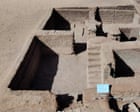
Archaeologists in Egypt’s western desert uncover a well-preserved Byzantine-era city dating to the fourth century, according to multiple reports. Excavations in the Dakhla oasis reveal a mix of residential and religious areas, including structures identified as domestic quarters and a basilica-style church. The findings are described as providing evidence of how people live and how the settlement develops during the late Roman/Byzantine period.
Researchers also report recovering everyday and economic materials from the site. These include coins, pottery fragments, and tools, which are cited as indicators of daily life and local activity. The articles describe the discovery as significant because the urban layout and the combination of civic, religious, and household spaces help researchers interpret the functions of different parts of the settlement.
While details of the exact extent of the city are not specified across the reports, all sources agree on the central points: the time period, the location in the western desert/Dakhla oasis, the presence of a basilica church, and the recovery of artifacts such as coins, pottery, and tools.