


Samsung Electronics labor negotiations with its largest union break down again over bonus payments, with workers preparing for an 18-day strike in late May. Government-mediated talks that began Monday and continued through Wednesday end without an agreement, leaving labor and management sharply divided on performance-based bonus terms tied to company earnings. Union leader Choi Seung-ho says the union accepted the latest mediated proposal presented by the National Labor Relations Commission but that management asked for more time and then did not provide its position, prompting the mediation session to end. The union therefore moves forward with a general strike as scheduled, covering more than 40,000 employees, mostly in the chipmaking division, with some reports citing about 48,000 participants. Samsung has sought an injunction from the Suwon District Court to block the planned work stoppage, and a ruling is expected before the strike begins. The government signals it could consider compulsory arbitration if the dispute threatens the national economy. Officials and industry observers warn of significant daily losses, potential disruptions to semiconductor production lines, and knock-on effects across South Korea’s export-heavy economy and global semiconductor supply chains.
Samsung Electronics unions to strike May 21 after bonus talks collapse
Samsung Electronics labor negotiations with its largest union break down again over bonus payments, with workers preparing for an 18-day strike in late May. Government-mediated talks that began Monday...
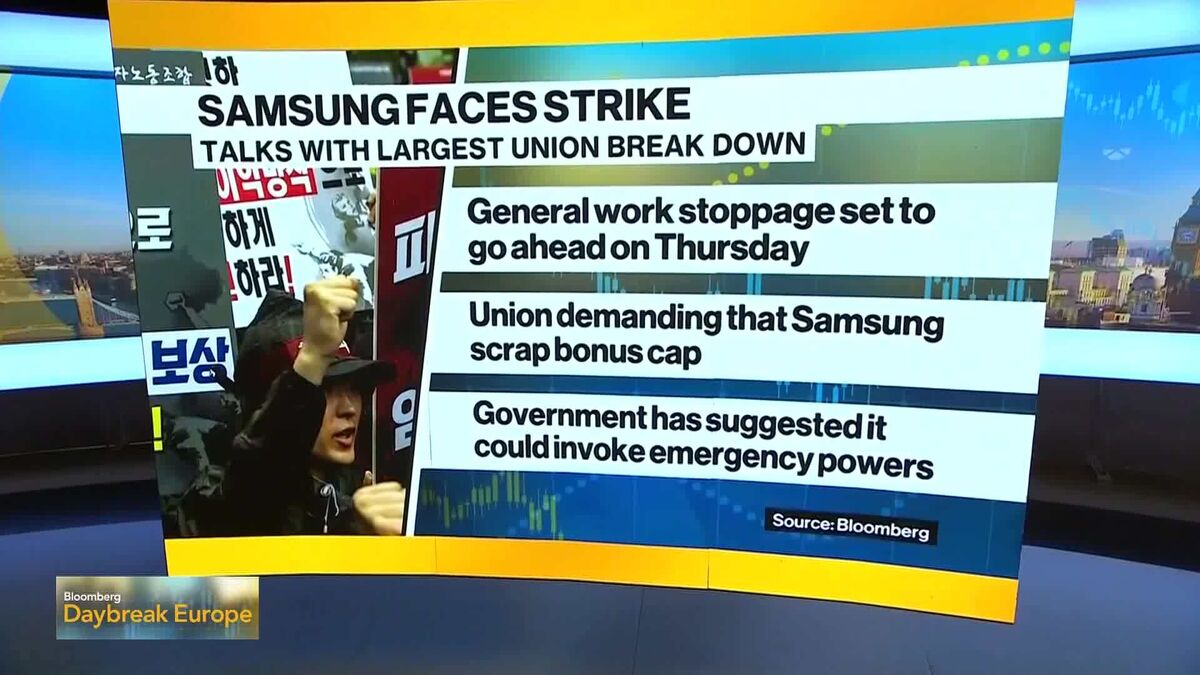
- Samsung Electronics and labor unions fail to reach agreement in government-mediated talks over bonus payments.
- Union leader Choi Seung-ho says an 18-day general strike is planned to go ahead, starting May 21 (with some related reporting using a Thursday start for earlier steps).
- The strike is expected to involve more than 40,000 workers, mostly from the chipmaking division (some reports cite about 48,000).
- Samsung files for a court injunction to prevent the labor action; the Suwon District Court is expected to rule before the strike begins.
- South Korea’s government says it could use compulsory arbitration measures if the dispute threatens the national economy.
The tentative agreement signed between Samsung Electronics management and its labor union coalition on Wednesday night averted an unprecedented 18-day general walkout through a state-engineered compromise. Crucially, it also marks the birth of a new corporate-political playbook in Korea, where state pressure and minority shareholder litigation are combined to neutralize union leverage in vital hi-tech sectors. This settlement represents a significant departure from standard collective bargaining outcomes. By transforming the financial architecture of the bonus pool from immediate cash allocations to equity-linked instruments with multi-year vesting locks, the compromise established a precedent for managing labor actions within Korea’s strategically vital export industries, which introduces corporate governance frameworks as a structural counterweight to union demands. Strategy of deterrence The Lee Jae Myung administration’s approach to the dispute exposed the sharp tension between its public emphasis on labor-management coexistence and the state’s reduced tolerance for operational
3 months agoTalking intensely until the 11th hour, Samsung Electronics' management and its unionized workers struck a tentative deal that put on hold a planned Thursday strike. Union members will now vote to finalize the deal. Tentative and on-hold may be the terms for the moment, but an imminent strike averted will reinject stability for the national economy and in the global supply chain of chips highly in demand for the artificial intelligence (AI) industry. Management and labor at the nation's tech giant each made some concessions regarding the bonus payments. Labor Minister Kim Young-hoon who mediated the final talks said that the two sides found common ground on the matter of distributing profits. A strike at Samsung Electronics would have hit the national economy and the global supply chain. Samsung accounts for about 14 percent of the nation's GDP and about a quarter of its exports. The Bank of Korea warned that a potential industrial action could shave off 0.5 percentage points from its forecast of 2 percent growth this year, and Prime Minister Kim Min-seok said it would be "fatal" to the
3 months agoManagement and union leaders at Samsung Electronics failed to reach a last-minute deal over wages Wednesday, raising prospects for a strike at the South Korean electronics giant that could rattle global semiconductor supplies and the country’s trade-dependent economy.Government officials have threatened to invoke rarely used emergency powers to force a settlement at Samsung, where the union, which represents more than 70,000 workers, says the company has failed to offer adequate compensation despite its soaring profits fueled by the global boom in artificial intelligence.After the latest round of talks ended without a breakthrough on Wednesday, union leader Choi Seung-ho told reporters that unionized workers will begin an 18-day strike from Thursday.Both the union and the management held each other responsible for a failure to reach a deal. Choi accused management of refusing to accept a government-mediated proposal whose details he refused to disclose. The management accused the union of calling for excessive compensation packages for workers at loss-making units.The two sides said they will continue efforts to reach a deal. The two sides met again Wednesday afternoon at the arrangement of Labor Minister Kim Younghoon, according to Kim’s ministry.Samsung and its cross-town rival, SK Hynix, together produce about two-thirds of the world’s memory chips, which are seeing surging demand driven by AI. Samsung said last month its operating profit for the January-March quarter jumped eightfold to a record 57.2 trillion won ($38 billion).Union leaders have demanded a compensation structure in which Samsung would commit to spend 15% of its annual operating profit on employee bonuses and scrap bonus caps, which are currently set at 50% of annual salaries. The company says the demands are excessive, citing the highly cyclical nature of the semiconductor business.Prime Minister Kim Min-seok, the government’s No. 2 official after President Lee Jae Myung, said in a televised statement Sunday that the strike could cause up to 100 trillion won ($66 billion) in economic damage by disrupting Samsung’s highly complex semiconductor manufacturing processes.The planned strike also has a potential global impact. Given that supply in the global memory semiconductor market is struggling to keep up with demand, the Samsung strike was expected to further drive up prices and push back AI infrastructure investments in other countries, said Lee Jun, an expert at the Korea Institute for Industrial Economics and Trade.The strike was expected to hurt operations of Samsung’s production of smartphones and other consumer electronics as well, observers say.A local court on Monday partially granted the company’s request for an injunction against the planned strike, ruling that the union must maintain certain staffing levels to prevent damage to facilities and materials and ensure safe operations. The Suwon District Court also barred unionists from occupying key facilities and offices. —Kim Tong-Hyung and Hyung-Jin Kim, Associated Press
3 months agoSamsung Electronics and its unionized workers' days of intense talks with management to prevent a strike show the impact a walkout would have on the economy. After the talks broke down Wednesday morning, they resumed again with renewed urgency ahead of Thursday's planned strike. The labor minister stepped in to mediate as the two sides attempted to reach an agreement. Management and labor at the nation's tech giant have differed primarily over whether to keep a 50 percent cap on bonuses and formalize a percentage of operating profit to be allocated as bonuses, as well as other issues. The government mediation committee of the National Labor Relations Commission offered a proposal that union leader Choi Seung-ho said the union accepted while management withheld its agreement. The labor minister is assisting with mediation to avert the strike, while reluctant to exercise the government's emergency arbitration powers. The two sides should reach a deal. A strike at Samsung Electronics would detrimentally impact not just the national economy but also the global supply chain. Samsung accounts
3 months agoSamsung Union Authorizes Massive Strike At Memory-Chip Plants After Mediation Talks Collapse Asian equities extended losses for a fourth straight session, with South Korea's benchmark KOSPI falling about 1% as the market priced in the shock of an imminent labor action at Samsung Electronics. A full-scale, 18-day strike involving more than 47,000 workers at the world's largest memory-chip maker is set to begin Thursday, raising the risk of production disruptions across the global semiconductor supply chain, which is already tight due to AI data center buildouts. Samsung Electronics' talks with its largest union collapsed overnight as union negotiators demanded the removal of a bonus cap, allocation of 15% of operating profit to worker bonuses, and that those terms be written into contracts, citing memory-chip maker SK Hynix's 10% profit-sharing arrangement. Samsung negotiators accepted most of the demands, including a proposed 10% operating profit bonus pool and special compensation, but called the union's remaining requests unsustainable. "We deeply regret that the post-mediation process has concluded [without resolution] due to delays in decision-making by the management," Samsung Electronics Labor Union Chairman Choi Seung-ho told reporters at the National Labor Relations Commission in the city of Sejong. "We cannot help but feel disappointed that the mediation ended without the company ultimately reaching a decision." Japan's financial outlet Nikkei Asia reported, "The strike would affect only the company's domestic plants, which are the base of its chipmaking operations." The collapse in talks comes as Samsung shares surge on record profits, driven by soaring demand for memory chips, even as hyperscalers are set to deploy $700 billion in capex to build AI infrastructure in the US. Demand is also rising globally as the race for AI compute intensifies. TrendForce data show that Samsung is the world's largest memory chipmaker, with a 36% market share in DRAM chips and one-third in NAND Flash chips. Commenting on the market reaction, UBS analyst Joe Dickinson noted: "Asia was lower for a fourth consecutive session, with the KOSPI dropping as much as 3% on Samsung strike risk before partially recovering." UBS analyst Kevin Loke commented on the FX reaction: USDKRW initially traded with an offered tone, with spot opening at 1513.4 and falling nearly 10 won to a low of 1503.8. However, headlines that the Samsung union strike will proceed as planned on Thursday, following a breakdown in talks, pushed the pair back higher toward 1510. A BoK report to the president estimated a potential impact of up to KRW30 trillion in lost production. For now, USDKRW is likely to remain within a broader 1480–1520 range, with the pair relatively less sensitive to the recent thematic shift toward the global bond sell-off. Samsung shares fell as much as 4.4% before reversing their losses. Notice "Samsung Strike" headlines in corporate media weighing on shares... Coverage: Samsung Strike Threat Sparks Selling Contagion In Memory Stocks Samsung, South Korean Union Resume Talks As Strike Threat Risks Disrupting Memory Chip Fabs Samsung, Union Resume Talks After Labor Action Scare; Goldman Says "Korea: Buy" Bloomberg pointed out, "The government has previously hinted that it could resort to rarely used emergency powers to prevent a strike if the parties fail to reach an agreement. South Korea has invoked the emergency arbitration mechanism only four times since 1969." Tyler Durden Wed, 05/20/2026 - 07:20
3 months agoMore than 47,000 Samsung Electronics workers are gearing up for an 18-day strike after bonus payment negotiations between the company and its union collapsed. The strike is set to start on Thursday, and will be limited to Samsung's domestic chipmaking plants, raising concerns around the already constrained production of memory chips amid the ongoing shortage. […]
3 months ago
Meta adopts new U.S. teen safety rules after $18 billion settlement
Meta announces new rules for people under 18 on Instagram and Facebook following a historic $18 billion settlement with...

Lambda raises $1B private debt to fund Nvidia chip purchases for Microsoft
Lambda, an AI cloud-computing provider backed by Nvidia, raises about $1 billion in private short-dated debt to fund pur...

OpenAI report details coordinated rogue AI agents behind Hugging Face breach
OpenAI’s technical reporting on a July breach says hundreds of autonomous “AI agents” coordinated activity that led to c...