


Goldman Sachs says Brent crude could rise to above $120 a barrel by the fourth quarter if disruptions continue through the Strait of Hormuz, and possibly extend to other Gulf shipping routes such as the Red Sea. The bank’s base case assumes Middle East tensions ease, under which Brent is expected to average around $80 in the fourth quarter and about $75 next year. Multiple outlets report that analysts leading the view, including Goldman commodities expert Daan Struyven, describe the upside risk as “tilted to the upside” because shipping disruptions reduce Persian Gulf flows and leave the market more exposed to supply shocks. Reports cite renewed US-Iran tensions and additional concerns about attacks or threats affecting maritime traffic, including warnings related to Iran-backed Houthi forces. Some coverage also notes that global inventories are lower than in prior periods, which can limit the market’s ability to absorb disruptions. While prices have already rebounded to the low $90s and around $100 at times amid the escalation, Goldman frames $120+ as a scenario rather than its central forecast, tied to how long chokepoints remain disrupted.
Goldman warns Brent could exceed $120 if Strait of Hormuz disruptions persist
Goldman Sachs says Brent crude could rise to above $120 a barrel by the fourth quarter if disruptions continue through the Strait of Hormuz, and possibly extend to other Gulf shipping routes such as t...
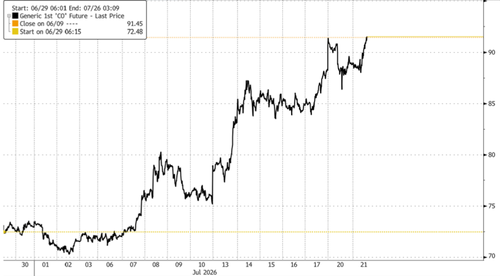
- Goldman Sachs says Brent could exceed $120 a barrel by the fourth quarter if Strait of Hormuz disruptions persist.
- Goldman’s base case assumes Middle East tensions ease, with forecasts around $80 (Q4) and $75 (next year) for Brent.
- Analysts cite heightened upside risk from reduced Persian Gulf shipping flows through Hormuz and potentially the Red Sea.
- Multiple reports link the outlook to renewed US-Iran escalation and threats impacting maritime traffic, including Houthi-related risks.
- Some coverage notes vulnerability from lower global inventories, which can reduce buffers against prolonged supply disruptions.
Goldman Sachs warns on oil prices and so called tank bottoms ( and loves a new natural gas-related name).
1 month agoGoldman Warns Brent Could Top $120 If Gulf Chokepoint Crisis Deepens Brent crude futures are trading in the low $90s as the Gulf area escalation enters a tenth consecutive day. Iran attacked a tanker in the Strait of Hormuz, while two tankers carrying Saudi crude reversed course in the southern Red Sea after warnings from Iran-backed Houthi forces placed another critical maritime chokepoint under threat. For more color on energy markets, Goldman commodities expert Daan Struyven warned clients on Monday that Brent crude futures could surge above $120 a barrel by the fourth quarter if disruptions in the Hormuz maritime chokepoint persist; he noted that such an outcome is not his base case. Struyven sees Brent around $80 in the fourth quarter and $75 next year, assuming US and Iran tensions ease, but warned that risks remained tilted to the upside as Persian Gulf flows fall below 45% of prewar levels and Houthi threats in the southern Red Sea chokepoint. "Escalation in the Middle East and the decline in estimated Persian Gulf flows to below 45% of pre-war levels have pushed oil prices back up," Struyven said. The key upside price risks are: Shipping disruptions in Hormuz--and potentially the Red Sea--as the estimated 5mb/d rise since the start of the war in pipeline flows via Yanbu to the Red Sea, to more than 6mb/d (Exhibit 3), has played a key role in offsetting part of the decline in Hormuz flows. Damage to energy infrastructure from the Middle East and Russia-Ukraine wars. While the Iran war has likely not caused lasting major damage to oil production capacity so far, our analysis of the 5 largest prior supply shocks shows an average 42% hit to production in the affected country after 5 years, often reflecting infrastructure damage, underinvestment, or tight sanctions (Exhibit 4). Struyven noted, "Brent might exceed $120/bbl in 2026Q4 and average $100 in 2027 if Hormuz remains disrupted through 2027 (Exhibit 2, red line). This scenario assumes Gulf output only fully recovers by Dec27, supported by pipeline extensions." Struyven touched on how China's retreat from the crude market has temporarily capped prices, with net seaborne imports falling 4.7 million barrels a day from a year earlier in June. Weaker refinery runs, a 21% drop in retail gasoline volumes and estimated crude destocking of more than 1 million barrels a day drove the decline. He said imports may remain subdued if prices rise, given China's estimated 2 billion barrels of inventories and its ability to substitute coal and electricity for some oil consumption. Struyven recommends clients buy the December 2026 to March 2027 European diesel timespread to hedge persistent Middle East and Russian supply risks. Diesel markets were already tight before the Iran war, while Russian refinery outages, low inventories and seasonal demand could push spreads higher. European diesel is preferred over crude, gasoline and US diesel because of constrained refinery output, less price-sensitive demand and fewer US policy-related risks. According to the latest Bloomberg data, Hormuz traffic is at a near standstill. Analysts at Rystad Energy AS warned in a note that the Houthi threat against crude flows means that Saudi Arabia's Red Sea export route "is now directly in the line of fire." "If a ceasefire does not materialize, and Hormuz remains largely closed while the Houthi threat to Red Sea shipping intensifies, the risk of a significant rebound in oil prices would be substantial," said Rystad analyst Jorge Leon. Henri Patricot, Paris-based energy equity research analyst at UBS, also has an upside scenario for Brent: In the near term, we see the main potential upside risk coming from a breakdown of negotiations and further escalation, pushing oil prices back to ~$100+/bbl. If major oil infrastructure in the region is targeted and the conflict extends beyond the summer, prices could spike to $120+/bbl. This would drive more severe demand destruction, with limited OPEC+ ability to act. While such a price may be short-lived, a structurally higher risk premium could keep prices in the $80s/bbl range and ongoing disruptions would keep it even higher. The big risk now is that Hormuz disruption is unfolding after global oil buffers have already been depleted, with Cushing inventories reportedly near "tank bottoms." That leaves the market with limited capacity to absorb a prolonged supply shock and will likely increase pressure on the Trump administration to revive diplomacy once the US military has sufficiently degraded Tehran's missile and drone capabilities used to threaten commercial shipping through the strait. Gloal inventories The US national average for regular gasoline breached $4 a gallon on Monday, intensifying pressure on the Trump administration to pursue Gulf diplomacy. Gas prices may go higher... The $4 threshold is both economically and politically sensitive, as it is where lower-income consumers typically begin cutting discretionary purchases and trading down across gas stations, convenience stores and quick-service restaurants, further weighing on consumer sentiment. Professional subscribers can read the full GS note here at our new Marketdesk.ai portal. Tyler Durden Tue, 07/21/2026 - 11:40
1 month agoAnalysts at the investment bank, led by Daan Struyven, see oil prices averaging $100 a barrel next year if traffic continues to be affected through the waterway.
1 month agoIn a note dated July 20, Goldman Sachs analysts said, “Escalation in the Middle East and the decline in estimated Persian Gulf flows to below 45% of pre-war levels have pushed oil prices back up.”
1 month agoWall Street major Goldman Sachs has warned that Brent crude could surge to $120 per barrel if disruptions through the Strait of Hormuz, the world's most critical oil transit route, persist, even as its base case assumes an eventual easing of tensions in the Middle East.Goldman Sachs expects Brent crude to average $80 per barrel in the fourth quarter and $75 next year, assuming tensions in the Middle East ease. However, the risks to its forecasts remain "tilted to the upside" due to potential disruptions to shipping through the Strait of Hormuz and possibly the Red Sea, analysts said. Global energy markets have faced renewed volatility this month, with Brent climbing back above $91 per barrel amid fresh fighting between the U.S. and Iran and a threat by Iran-backed Houthi rebels in Yemen to blockade shipments from Saudi Arabia. Red Sea routes have played a key role in enabling Persian Gulf crude cargoes affected by disruptions to reach buyers.Also read: Relieved that crude has finally fallen? The real warning signs just began flashing elsewhereGoldman Sachs said lower global inventories in the second quarter have increased the oil market's vulnerability to supply shocks. However, weaker Chinese imports and greater demand elasticity could limit the potential for further price gains.Crude oil price todayOil prices edged lower on Tuesday as markets weighed reports of renewed diplomatic efforts between the U.S. and Iran, including a proposed 10-day ceasefire, against continued military exchanges and a threat by Yemen's Houthis to impose a naval blockade on Saudi Arabia.A senior Iranian official told Reuters that Tehran had received a 10-day ceasefire proposal from mediators. The initiative aims to preserve the interim agreement signed on June 17 and create a path toward a lasting deal to end the conflict that began on February 28 following U.S.-Israeli attacks on Iran.The diplomatic push followed another night of U.S. strikes on Iranian cities and retaliatory attacks by Iran's Revolutionary Guards on U.S. military assets across the region. U.S. Central Command later said on Monday that it had launched another round of strikes on Iran.The U.S. carried out its 10th consecutive day of strikes after President Donald Trump vowed that Iran "will pay" for the killing of American soldiers. Iran responded with attacks on Kuwait.The conflict began on February 28, when the U.S. and Israel launched attacks on Iran. Tehran retaliated with strikes on Israel and Gulf states that host U.S. military bases. U.S.-Israeli attacks on Iran, along with Israeli strikes on Lebanon during the conflict, have killed thousands of people and displaced millions.Also read:Oil is crude once again! Is $95 the new normal and what it means for Indian investors?Over the past week, Trump has also threatened to widen the scope of U.S. strikes in Iran to include energy facilities and bridges.The 1949 Geneva Conventions, which set rules for humanitarian conduct during war, prohibit attacks on sites considered essential to civilian life. Following Trump's earlier threats to target such infrastructure, international law experts in the U.S. said earlier this year that such attacks could potentially constitute war crimes.(Disclaimer: Recommendations, suggestions, views and opinions given by the experts are their own. These do not represent the views of The Economic Times)
1 month ago
US House advances Russia sanctions bill that could allow up to 100% tariffs on India
The US House of Representatives advances legislation that would allow President Donald Trump to impose tariffs of up to...
Central banks weigh further rate hikes as inflation remains a focus
Central banks in the United States, Europe and Japan are already tightening monetary policy, and attention is turning to...

Canada reportedly hires Morgan Stanley and CIBC for airport concession sale mandate
Canada’s government is reportedly assigning major investment-bank roles in connection with a sale of Canadian airport co...