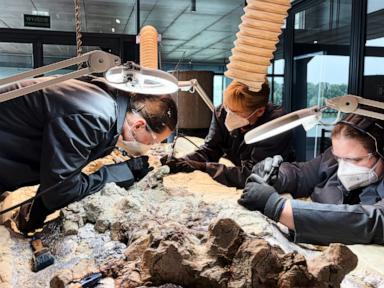
More than 2,000 volunteers are taking part in a large restoration project led by Polish scientists to uncover and repair a massive Mastodonsaurus skeleton. Reporting from multiple outlets describes volunteers working in a controlled laboratory setting at the Copernicus Science Centre in Warsaw, where the fossil remains are encased in rock. Using tools such as chisels and brushes, along with protective goggles, participants carefully chip away and clean the material around the bones to reveal the specimen without damaging it.
The fossil is identified as belonging to Mastodonsaurus, a prehistoric amphibian that lived roughly 240 million years ago during the Middle Triassic period. Sources describe it as an underwater ambush predator that primarily hunted fish and smaller amphibians.
Across the coverage, the effort is presented as a painstaking, time-consuming process that combines scientific expertise with public participation, bringing many volunteers together to carry out detailed conservation work on the skeleton.