


NASA’s MAVEN mission reports new findings on how certain auroras form on Mars, showing that they can develop through a process similar to an established “magnetic engine” that drives some Earth auroras. According to results published in Nature Communications, MAVEN observations and analysis indicate that a comparable mechanism circulates and accelerates charged particles into the atmosphere on Mars. The study focuses on specific types of Martian auroras and describes a mechanism that functions in a way analogous to how charged particles are energized and guided in Earth’s near-space environment. By identifying the shared particle-driving process, the research aims to improve understanding of how Mars’ upper atmosphere interacts with the solar wind and the planet’s space environment. NASA and the related reporting highlight the significance of matching an Earth-based framework to Martian aurora formation, offering a clearer explanation for how these emissions arise and helping scientists refine models of Mars atmospheric dynamics and magnetosphere behavior.
NASA MAVEN finds Earth-like mechanism behind some auroras on Mars
NASA’s MAVEN mission reports new findings on how certain auroras form on Mars, showing that they can develop through a process similar to an established “magnetic engine” that drives some Earth aurora...
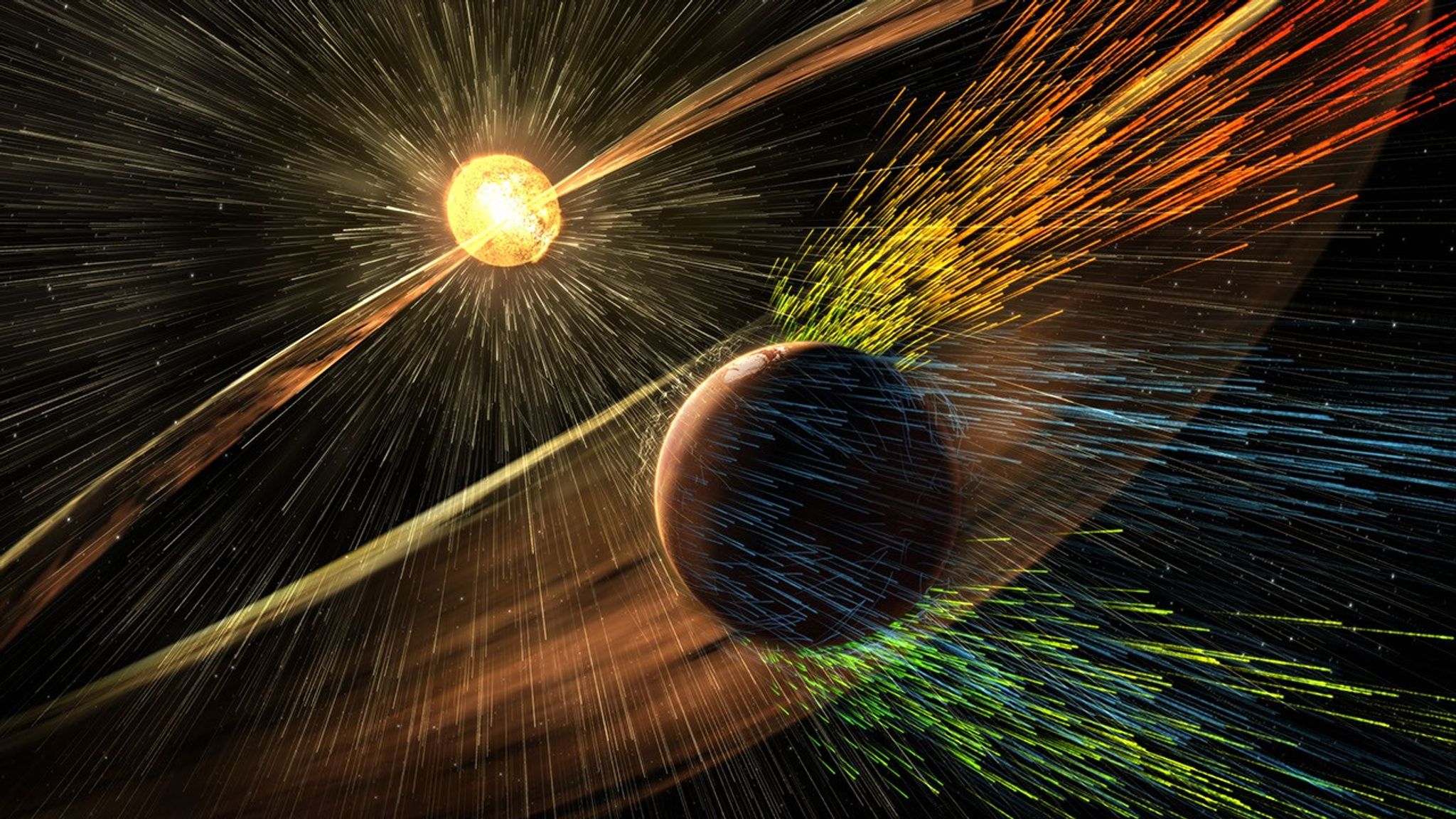
- NASA’s MAVEN mission studies auroras on Mars using observations and analysis.
- A Nature Communications paper reports that some Martian auroras form through a mechanism similar to Earth’s aurora process.
- The mechanism described circulates and accelerates charged particles into the planet’s atmosphere.
- The findings support a shared particle-driving “magnetic engine” concept between Mars and Earth for certain aurora types.
- The results are presented as a new step toward understanding how Mars’ upper atmosphere interacts with space conditions.
NASA MAVEN (Mars Atmosphere and Volatile Evolution) mission scientists have uncovered a key puzzle piece in understanding certain types of auroras on Mars, finding that they form in a similar way to Earth–based auroras.
2 hours agoNASA MAVEN (Mars Atmosphere and Volatile Evolution) mission scientists have uncovered a key puzzle piece in understanding certain types of auroras on Mars, finding that they form in a similar way to Earth-based auroras. Results published Thursday in Nature Communications show the same mechanism that circulates and catapults charged particles into Earth’s atmosphere is happening at […]
7 hours ago
Study explains how sperm whales use bubble blowing for vertical rest
Research from the University of St Andrews and Université de Neuchâtel reports how sperm whales achieve a distinctive ve...

Students seek Supreme Court order to stop SALEx-related tree cutting in Manila
Five college students file a petition with the Supreme Court seeking a temporary environmental protection order to halt...

Houthi attacks threaten oil shipping route at Bab al-Mandeb strait
Yemen’s Houthi rebels, described by multiple outlets as pro-Iranian, say they carry out attacks in the Red Sea that disr...