


A federal appeals court in the First Circuit rejects the Trump administration’s effort to reinstate a planned $100,000 fee for new H-1B visas. The three-judge panel does not overturn a lower-court decision issued June 8 that blocks the fee, finding that it is an unlawful tax because Congress did not authorize it. Multiple outlets report that Democratic state attorneys general challenged the fee, arguing the administration created a new charge without congressional approval. The lower court agreed, ruling the executive branch exceeded its authority in imposing the fee. When the government asked the appeals court to stay or revive the policy while the case continues, the panel declined. The courts’ reasoning, as described by the reporting, focuses on whether the government is likely to succeed in overturning the “unauthorized tax” determination. As a result, the block remains in place during the ongoing litigation, and the fee is not allowed to take effect as the case proceeds.
Appeals court leaves block on Trump’s $100,000 H-1B visa fee
A federal appeals court in the First Circuit rejects the Trump administration’s effort to reinstate a planned $100,000 fee for new H-1B visas. The three-judge panel does not overturn a lower-court dec...

- A First Circuit appeals court declines to lift or stay a June 8 ruling blocking a $100,000 fee for new H-1B visas.
- The lower court finds the fee constitutes an unlawful tax because Congress did not authorize it.
- The challenge is brought by Democratic state attorneys general, who argue the administration exceeded its authority.
- The appeals court says the government has not shown it is likely to prevail on its challenge.
- The block remains in effect while the legal dispute continues.
BOSTON — The First Circuit rejected a motion to stay a Massachusetts federal court’s order invalidating the Trump administration’s $100,000 fee for all H-1B visa petitions. The administration has not made a sufficient showing that it is likely to succeed on the merits under the Administrative Procedure Act.
1 month agoA federal appeals court rejected the US government's proposed $100,000 H-1B visa fee. The court found the government failed to prove its authority to impose the charge. This ruling upholds a lower court's decision blocking the fee introduced in 2025. The proposed fee would have significantly increased costs for hiring skilled foreign workers. The decision means the lower court's ruling remains in effect during the appeal.
1 month agoWashington, July 25, 2026: A US federal appeals court has refused to let President Donald Trump's administration enforce a $100,000 fee on new H-1B visas, dealing another setback to the government's immigration policy.The Boston-based First US Circuit Court of Appeals on Friday upheld a lower court's decision that blocked the fee. The three-judge panel ruled that the administration had not shown it was likely to succeed in proving that it had the authority to impose the charge, allowing the earlier order to remain in effect.Court Questions Legal AuthorityThe appeals court's decision follows a June ruling by a lower court judge, who struck down the fee after a lawsuit was filed by 20 Democratic state attorneys general. The judge found that the charge amounted to an unlawful tax that had never been authorised by Congress.Notably, the three judges on the appeals panel were all appointed by Democratic presidents. In its ruling, the court said the Trump administration had failed to demonstrate that it acted within its legal powers when it introduced the fee, The Guardian reports.H-1B Policy Under ScrutinyTrump announced the higher fee through a presidential proclamation in September, arguing that the H-1B programme had been "deliberately exploited to replace, rather than supplement, American workers with lower-paid, lower-skilled labour."The H-1B visa programme allows US employers, particularly technology companies, to hire highly skilled foreign workers. Every year, 65,000 H-1B visas are made available, along with another 20,000 for applicants holding advanced degrees. These visas are generally valid for three to six years.Before the new fee was introduced, employers typically paid between $2,000 and $5,000 to sponsor an H-1B worker, depending on various factors. The $100,000 charge did not apply to foreign nationals already in the US on student visas, a group that makes up a significant share of new H-1B recipients.Also Watch: 'American Jobs Should Go To American Workers': JD Vance Warns Of H-1B Visa Fraud As Trump Administration Launches Major ProbeAppeal RejectedThe administration's policy has seen limited use, with few employers paying the new fee since it was introduced. Following the appeals court's decision, the White House did not immediately respond to a request for comment.To get details on exclusive and budget-friendly property deals in Mumbai & surrounding regions, do visit: https://budgetproperties.in/
1 month agoUS appeals court refuses to stay order striking down Trump's $100K H-1B fee; relief for sponsoring employers
1 month agoAppeals court leaves in place a June 8 ruling blocking the policy, preserving existing costs for employers and skilled workers.
1 month ago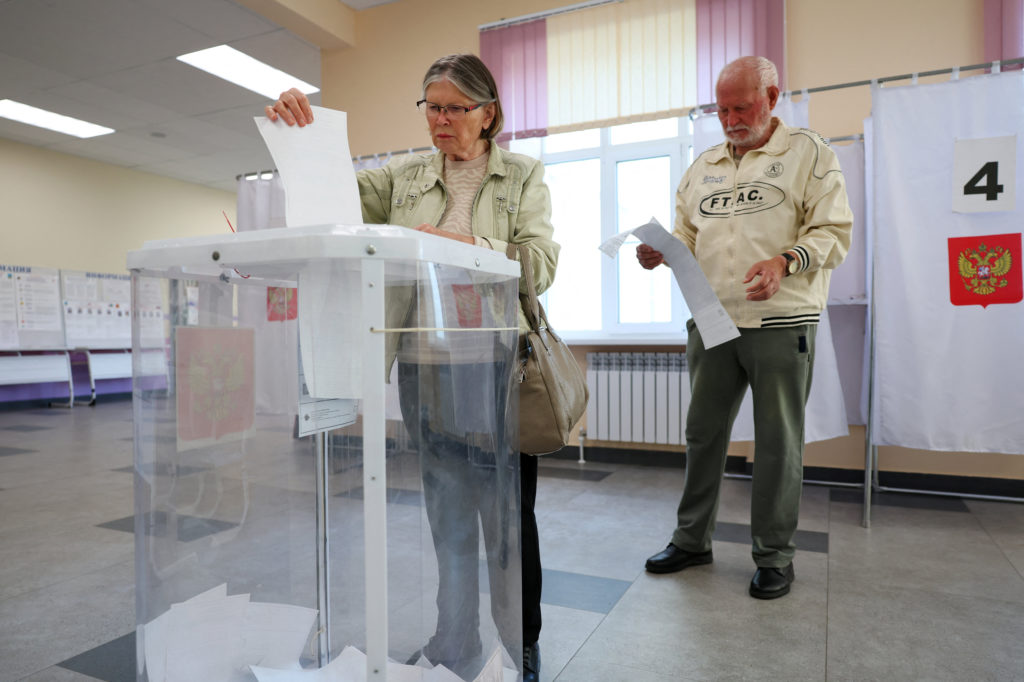
Russians vote in three-day parliamentary election with limited opposition
Russians begin three days of voting in a parliamentary election that takes place amid the country’s war context, with re...

US airman rescued after being shot down over Iran; photos show condition during transport
A US airman who was reportedly shot down over Iran is being rescued and transported back to safety after a prolonged per...
U.S. grants visas for smaller Iranian delegation to attend UN General Assembly
The United States approves visas for an Iranian delegation to attend next week’s United Nations General Assembly in New...