


A two-paper arXiv study presents a multi-probe modelling framework intended to separate dark matter from baryonic components in massive galaxy clusters. Using Abell S1063 as a test case, the first paper focuses on constructing the observational mass-constraint datasets required for the modelling. The researchers measure light profiles for 289 cluster galaxies, including the brightest cluster galaxy (BCG) and the intra-cluster light (ICL), using Hubble Space Telescope HST/F160W imaging. Their analysis accounts for contamination from foreground and background galaxies. Stellar masses and velocity dispersions are estimated using multi-band HST photometry and VLT/MUSE integral-field spectroscopy, with stellar masses derived from three different spectral energy distribution models and velocity dispersions measured from line-of-sight dispersions at or near half-light radii (with elliptical annular apertures for the BCG and ICL). The second paper applies a multi-probe parametric mass model that combines constraints on total mass and the baryonic components, including kinematic and X-ray data for the intra-cluster gas. The best-fitting model reproduces multiple-image positions with an RMS of 0.50″ and matches BCG/ICL kinematic profiles and X-ray surface brightness within uncertainties, while requiring an additional 35 km/s scatter for cluster member dispersions. The derived stellar-to-subhalo relation agrees at the 1σ level with predictions from large-scale simulations, and the ICL stellar mass is consistent with stellar population estimates.
Two-part study models dark matter and baryons in galaxy cluster Abell S1063
A two-paper arXiv study presents a multi-probe modelling framework intended to separate dark matter from baryonic components in massive galaxy clusters. Using Abell S1063 as a test case, the first pap...

- The study models Abell S1063 to disentangle dark matter from baryonic components (cluster galaxies, BCG, and ICL, plus intra-cluster gas).
- HST imaging in the F160W filter is used to build light profiles for 289 cluster members, while the BCG and ICL are modelled with a single multi-Gaussian component.
- Stellar masses come from multi-band HST photometry using three spectral energy distribution models; velocity dispersions use VLT/MUSE spectroscopy measured via line-of-sight dispersions.
- The mass model reproduces multiple-image positions with an RMS of 0.50″ and matches BCG/ICL kinematics and intra-cluster gas X-ray surface brightness within observational uncertainties, requiring 35 km/s scatter for member dispersions.
- The inferred stellar-to-subhalo relation agrees at the 1σ level with large-scale cosmological simulations, and the ICL stellar mass matches stellar population modelling estimates.
arXiv:2509.07762v2 Announce Type: replace Abstract: In this two-part series, we present a multi-probe mass modelling method for massive galaxy clusters, designed to disentangle the contributions of individual mass components (Dark matter, intra-cluster gas, stellar masses). In this first paper, we focus on recovering the mass constraint datasets required for the modelling approach introduced in the second paper. Specifically, we measure the light distribution, stellar mass, and kinematics of the cluster members, the brightest cluster galaxy (BCG), and the intra-cluster light (ICL) in Abell S1063. To that end, we developed a new method to extract the light profiles of the cluster members, BCG, and ICL, while accounting for contamination from nearby foreground and background galaxies in \textsc{Hubble Space Telescope} (HST) imaging. We obtained light profiles for $289$ cluster members using a dual Pseudo-Isothermal Elliptical (dPIE) model based on the HST F160W filter, while the BCG \& ICL is modelled as a single component using a multi-Gaussian expansion. To estimate stellar masses and velocity dispersions, we rely on multi-band HST photometry and \textsc{VLT/MUSE} integral field spectroscopy, respectively. Stellar masses are derived using three different spectral energy distribution (SED) models. We measure the line-of-sight velocity dispersions of the cluster members at their half-light radii, as determined from their light profiles, while for the BCG \& ICL components, we use elliptical annular apertures. Thanks to these measurements, we will be able to constrain the cluster stellar mass content, which is detailed in the second paper of the series. We publicly release these measurements with intermediary data products.
2 hours agoarXiv:2509.07777v2 Announce Type: replace Abstract: In the first paper of this series, we derived mass constraints on the total mass and the baryonic components of the galaxy cluster Abell S1063. The main focus was to recover stellar masses and kinematics for cluster members, the brightest cluster galaxy (BCG) and the intra-cluster light (ICL). In this second paper, we introduce a multi-probe mass modelling approach that incorporates constraints on both the total mass and the individual baryonic components. We obtain comprehensive mass models of Abell S1063, in which the dark matter distribution is disentangled from the baryonic mass at both cluster and galaxy scales. The best-fitting mass model achieves an RMS of $0.50"$ on the multiple image positions. The kinematic profiles of the BCG \& ICL, as well as the X-ray surface brightness of the intra-cluster gas, are accurately reproduced within observational uncertainties. However, a $35~\mathrm{km/s}$ scatter is required for the cluster member line-of-sight dispersions. This method yields the most complex parametric mass model with consistency among almost all available mass constraints. We find a $1\sigma$ agreement between the inferred stellar-to-subhalo mass relation and that predicted by large-scale cosmological simulations. The ICL stellar mass derived from our model is consistent with estimates from stellar population modelling. We present the first multi-probe mass modelling method capable of disentangling the dark matter from the baryonic mass distributions in massive galaxy clusters. Its results, such as the stellar-to-subhalo mass relation or the distribution of each mass component, can be directly compared to hydrodynamical cosmological simulations such as illustrisTNG.
2 hours ago
CXMT shares surge about 470% in Shanghai trading debut
China-based memory chipmaker ChangXin Memory Technologies (CXMT) sees a sharp jump in its share price on its first day o...
Weekly economic calendars list upcoming U.S. releases and key events
The provided articles from Seeking Alpha are “economic calendar” briefs for multiple weekdays (Monday through Friday). T...
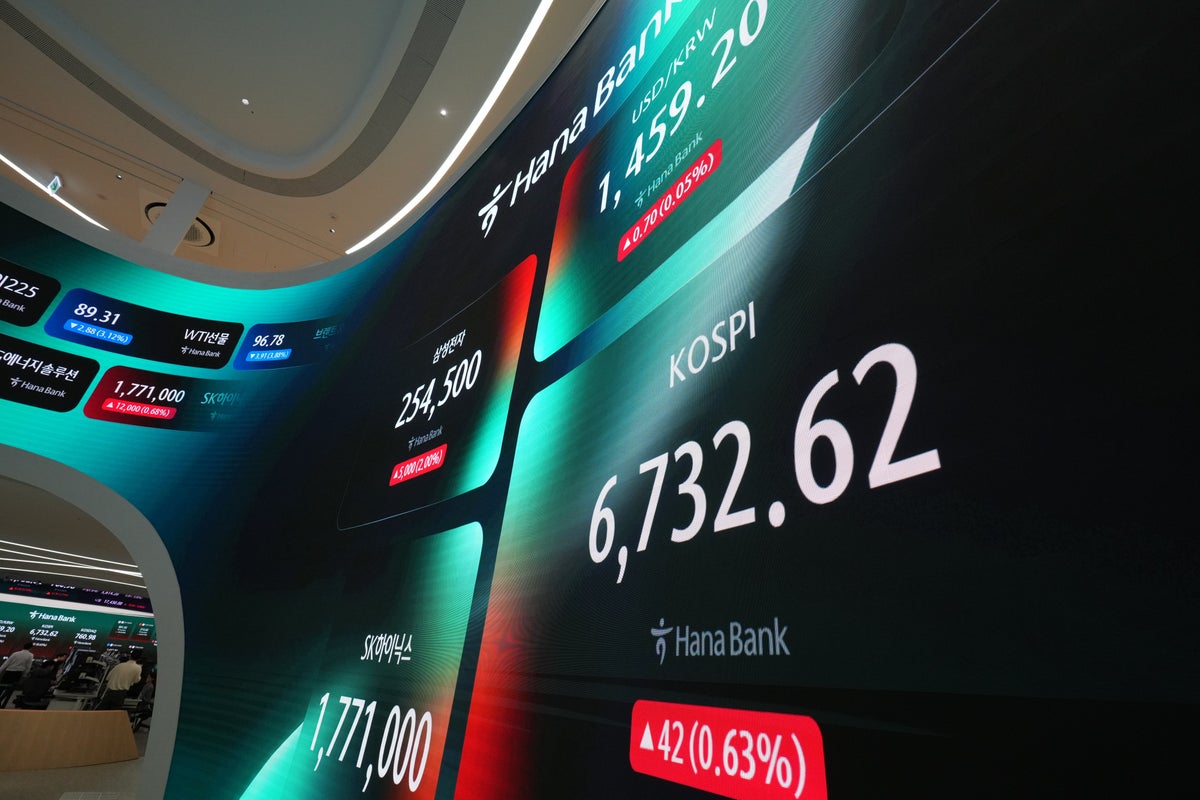
Oil falls 4% as Asian shares rise after U.S.-Iran pause; CXMT jumps in Shanghai debut
Oil prices drop about 4% as trading sentiment improves and geopolitical tension eases. Both outlets report that prices f...