


NASA’s Psyche spacecraft performs a close flyby of Mars as it travels to a rare, metal-rich asteroid, using the planet’s gravity to gain speed and adjust its trajectory. Multiple outlets report that during the encounter the spacecraft takes thousands of images, using the moment both as a gravity-boost maneuver and as camera testing ahead of its primary mission. NASA News says the spacecraft completes its closest approach on May 15, coming about 2,864 miles (4,609 kilometers) from the planet’s surface. ScienceDaily and other reports describe the resulting images as detailed views of heavily cratered Martian terrain, including the double-ring Huygens crater. Space.com and other coverage also emphasize the practical role of gravity assists: they allow spacecraft to change course and increase velocity while conserving fuel. The flyby sends Psyche deeper into space toward its ultimate target, with the main encounter planned for 2029. Across the sources, the central points are consistent: Psyche uses Mars for a gravity assist, photographs the planet during the high-speed pass, and continues on to its asteroid mission without requiring extra onboard propellant for the orbital adjustment.
NASA’s Psyche spacecraft flies past Mars for gravity assist en route to metal-rich asteroid
NASA’s Psyche spacecraft performs a close flyby of Mars as it travels to a rare, metal-rich asteroid, using the planet’s gravity to gain speed and adjust its trajectory. Multiple outlets report that d...
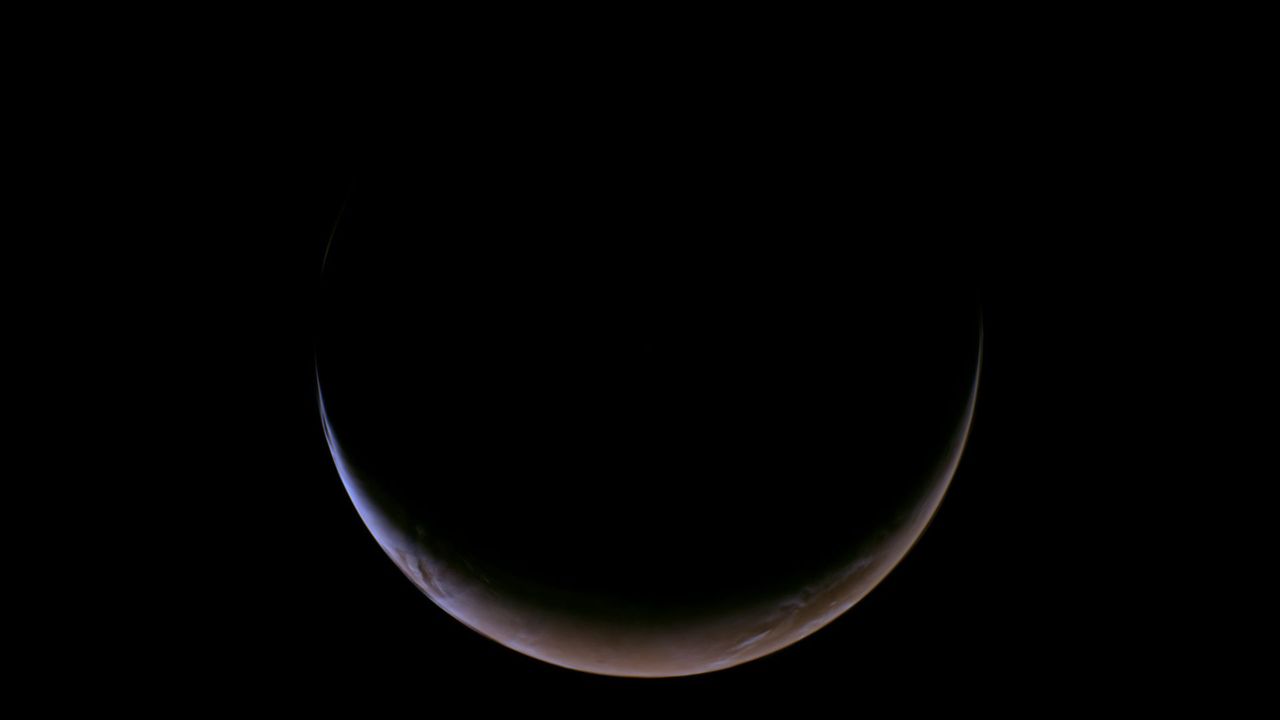
- NASA’s Psyche spacecraft flies past Mars to use a gravity assist on its way to a metal-rich asteroid.
- The spacecraft captures thousands of images during the close approach, serving as both science observations and camera practice.
- NASA reports the closest approach occurred on May 15, at about 2,864 miles (4,609 kilometers) from Mars’ surface.
- Images include heavily cratered Martian terrain, including the double-ring Huygens crater.
- The main Psyche encounter is planned for 2029, and the flyby increases speed and adjusts the spacecraft’s orbital path while conserving fuel.
NASA’s Psyche spacecraft just used Mars as a giant gravitational slingshot to continue its journey toward a strange metal rich asteroid. The close flyby boosted the spacecraft’s speed by about 1,000 mph while also producing rare crescent images of Mars glowing through its dusty atmosphere.
3 months agoNASA took advantage of the recent close approach of the Psyche probe to Mars to calibrate its observation instruments.
3 months agoOn its way to a metal asteroid, NASA's Psyche probe tested its cameras as it got a gravity assist from the Red Planet.
3 months agoNASA’s Psyche spacecraft skimmed past Mars in a precision flyby that helped catapult it deeper into space toward its ultimate target: the bizarre metal-rich asteroid Psyche. During the encounter, it snapped detailed images of heavily cratered Martian terrain, including the striking double-ring Huygens crater. The flyby gave the spacecraft a critical gravity boost without using extra fuel.
3 months agoSpacecraft often use planets for gravity-assist or "slingshot" maneuvers. NASA's Psyche mission used Mars for that purpose during a May 15th flyby. The flyby accelerated the spacecraft and aimed it at its eventual destination, the asteroid 16 Psyche. The flyby was also an opportunity to take some pictures of Mars, and to test and calibrate the spacecraft's science instruments.
3 months agoThe spacecraft used Mars for a gravity assist on its journey toward a metal-rich asteroid.
3 months ago
Delhi auto unions demand fare hike after CNG price rises, threaten Sept 9 strike
Delhi auto-rickshaw and taxi unions demand an increase in fares after CNG prices rise in the city. On Saturday, CNG pric...

Huawei named a leader in Gartner’s 2026 Magic Quadrant for enterprise storage platforms
Huawei is recognized as a leader in Gartner’s 2026 Magic Quadrant for Enterprise Storage Platforms. Multiple outlets rep...

Chandigarh University researchers patent device to reuse kitchen wastewater
Chandigarh University biotechnology researchers receive a patent for an innovative device designed to reuse kitchen wast...