Middle East Eye
'Brent will shoot up': US energy executives warn of massive oil supply crunch
'Brent will shoot up': US energy executives warn of massive oil supply crunch
Submitted by
Sean Mathews
on
Thu, 05/28/2026 - 21:31
Energy executives say the world is weeks away from oil hitting $150 per barrel, with government and private industry reserves depleted
Iranians drive past a billboard featuring US President Donald Trump and the Strait of Hormuz, erected in Valiasr Square in Tehran, Iran, on 28 May 2026 (AFP)
Off
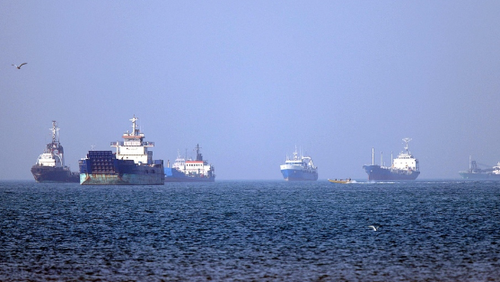
Executives from the largest US energy companies warned on Thursday that oil prices are likely to spike this summer, as the buffers the US and other western countries used to mitigate the impact of the closure of the Strait of Hormuz run dry.
“We're approaching unheard of inventory levels. I mean, really, really low levels. You can debate whether that's going to hit those really low levels in two weeks or three weeks. Once you get to that point, then you'll see [the] price shoot up,” Neil Chapman, a senior vice president at ExxonMobil, said on Thursday at a conference organised by the investment bank, Bernstein.
“I think dated Brent, most people, well, a model would say dated Brent will shoot up. Once you get to that really low inventory level, up to $150, $160,” he added.
Chevron chief executive Mike Wirth warned at the same event that the “buffers and the shock absorbers” that have kept oil prices in check “are being steadily drawn down”.
“Over the next few weeks, we’re likely to see those pressures flow through more directly to physical prices, and there’s more upwards pressure that I would expect as we get into June and certainly into July,” he said.
“If this goes on for long, it tips us into an economic slowdown or a recession,” he added.
Brent, the international benchmark, was trading at around $93 per barrel on Thursday.
Brent has fallen about 16 percent this month amid optimism that the US and Iran can strike a deal to end the war.
Impending deal
The White House said on Thursday that it had reached a 60-day ceasefire extension to reopen the Strait of Hormuz that is awaiting US President Donald Trump’s approval, as well as that of senior Iranian officials. There have been a series of reports in the US and Israeli media that the two sides are close to a deal that has failed to materialise.
Iran will control Strait of Hormuz 'forever', former senior US official says
Read More »
Many energy experts expected a bigger bump in prices as a result of Iran and the US’s competing blockades of the Strait of Hormuz, through which around 20 percent of global energy flowed before the war.
The market has been cushioned by a sizable drop in Chinese oil imports, freeing up barrels of oil, and a massive release of inventory from the US Strategic Petroleum Reserve.
The US has drawn down 172 million barrels of oil from the reserve, bringing it to its lowest level in forty years. Industry reserves have also dropped to record lows.
“Commercial inventories of crude oil, of liquids, think petroleum, gasoline, diesel, jet fuel, they've all run down. And running down those inventories has mitigated or offset…the impact,” Chapman said, according to a transcript of his talk on social media.
Even with the releases, US gas prices have surged by about 50 percent since the US-Israeli attack on Iran. And the US, due to its massive energy industry, has been less impacted.
East Asian countries are facing a severe supply crunch because they are more dependent on Gulf energy. The price paid for a barrel of oil in Asia is far above the spot price, and is hovering around $150 per barrel, experts say.
Georges Elhedery, the CEO of HSBC Bank, said last month that the price paid for a barrel of oil has reached as high as $286 in Sri Lanka.
Even if the Strait of Hormuz reopens, Gulf states like Bahrain and Qatar have sustained damage to their energy facilities. Wirth, the CEO of Chevron, said that repairing infrastructure in the Middle East would cost billions of dollars.
War on Iran
News
Post Date Override
0
Update Date
Mon, 05/04/2020 - 21:19
Update Date Override
0
2 months ago