


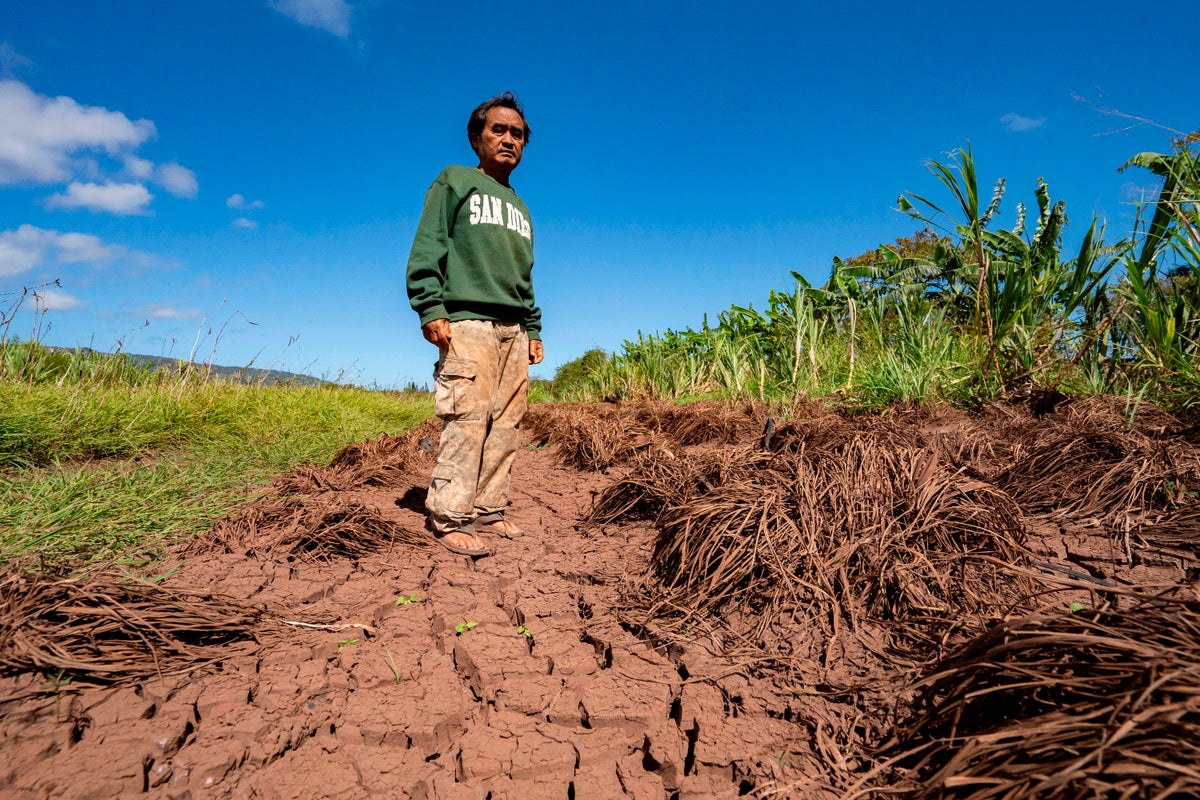
Recent catastrophic flooding in Hawaii, described by multiple outlets as the worst in about 20 years, damages farms and disrupts local food production. On impacted farms, floodwater brings heavy mud and debris that smother crops and leave irrigation infrastructure tangled and unusable. One farmer’s fields are shown with hardened mud covering areas where vegetables such as lemongrass, cucumbers, and okra had been growing, while irrigation tubes lie displaced after the flooding. The damage leaves farmers struggling to recover and replant, with the full extent of losses affecting both household and commercial production. As a result, fewer vegetables are expected at local markets in the aftermath of the flooding. The reports focus on the immediate agricultural impacts—crop destruction, operational disruption, and the challenge of restoring farming capacity—while highlighting how the flooding affects supply beyond individual farms. No specific casualty figures or storm details are provided in the excerpts, but the consensus is that the flood event has significantly harmed agricultural production across affected areas of the state.
Hawaii flooding causes major farm damage and reduces produce availability
Recent catastrophic flooding in Hawaii, described by multiple outlets as the worst in about 20 years, damages farms and disrupts local food production. On impacted farms, floodwater brings heavy mud a...
- Hawaii experiences catastrophic flooding described as the worst in about 20 years.
- Flooding causes extensive damage to farms, including crops smothered by mud.
- Irrigation systems are disrupted, with tubes left tangled or displaced on some farms.
- Farmers report difficulty recovering after the flooding.
- Local markets are expected to have fewer vegetables due to reduced supply.
The reddish-brown mud that smothered Bok Kongphan's Hawaii farm has hardened in the tropical sun. Irrigation tubes lie in a tangle where his lemongrass, cucumber and okra once flourished.
3 months agoHawaii's recent catastrophic flooding has devastated local farms, leaving many farmers struggling
3 months ago
Abby Seaman reaches 30km stage with support as she continues running and reporting
Abby Seaman is continuing her run and reporting from along the course, reaching the point where she has 30 kilometres le...

Officer dies, another injured in South Carolina park shooting
A police officer dies and a second officer is injured in a shooting at a park in South Carolina’s capital city, police s...

Russian drone strike hits warehouse west of Kyiv, killing 37
Russia launches a drone attack that hits a warehouse west of Kyiv, killing at least 37 people, which all outlets describ...