Middle East Eye
Five years of Taliban rule: A state has survived, but at what cost?
Five years of Taliban rule: A state has survived, but at what cost?
Submitted by
Zia Ur Rehman
on
Thu, 08/13/2026 - 18:03
Economic despair, social repression, and regional friction have preserved Afghanistan as an enduring catalyst for crises
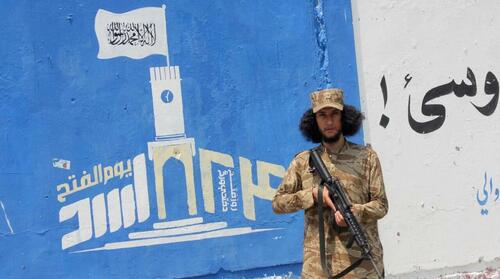
A security personnel stands guard next to a mural depicting the Taliban flag, along a street in Jalalabad, Afghanistan, ahead of the fifth anniversary of the Taliban's takeover of the country, on 12 August 2026 (Aimal Zahir/AFP)
Off
Five years after the Taliban’s return to power on 15 August 2021, Afghanistan has transformed from a chaotic battlefield into a functioning but deeply authoritarian state.
Foreign troops are gone, and fragmented opponents have failed to mount a significant challenge to Kabul’s centralised control. The movement has established a degree of internal security unimaginable under the previous government.
However, this stability rests on systematic exclusion, most notably of women, leaving the nation economically fragile and politically isolated. While the Taliban have proven they can govern without western support, they remain an international pariah managing a historic humanitarian crisis.
Afghanistan today is quieter than before 2021, but it is also poorer, more isolated, and severely repressive towards half its population.
The regime’s primary achievement in its first five years was territorial consolidation. The next five will test whether it can survive mounting internal and external pressures.
Inside the Taliban’s administration
The central story of the last five years is the patient, quiet accumulation of power by the Taliban’s reclusive supreme leader, Hibatullah Akhundzada, who operates from Kandahar. Since his appointment in 2016, Akhundzada has transitioned the movement from an insurgency to a rigid governing authority.
Akhundzada has built a powerful network, ensuring key state positions, including the premiership, the central bank, and the chief justiceship, sit in Kandahari hands. This is reinforced by a massive patronage system of roughly 15,000 registered madrassas, in which students receive stipends and teachers receive graded salaries. This network secures the loyalty of the provincial clergy, the movement’s core constituency, by granting them both status and sustainable resources.
'Hardline elements within Taliban ranks view Pakistani militants as historical comrades-in-arms'
- Taliban official in the interior ministry
In Kabul, high-profile figures such as Mullah Abdul Ghani Baradar, Sirajuddin Haqqani, Maulvi Yaqoob, and Amir Khan Muttaqi manage daily governance, economic policy, and foreign diplomacy.
However, real power resides in Kandahar, where a 119-article criminal procedure code was quietly approved in early 2026 to cement absolute obedience and criminalise public criticism.
“Hibatullah’s influence reaches far beyond religious affairs: major political, judicial, and administrative decisions increasingly reflect the preferences of the Kandahar leadership,” Muhammad Israr Madani, an Islamabad-based analyst and co-author of a book on state-building in the Taliban-led Afghanistan, told Middle East Eye.
This centralisation of power in Kandahar has “strengthened the Taliban’s ability to prevent internal fragmentation” while creating “resentment among commanders who believe that power is becoming excessively concentrated in one faction”, a mid-level Taliban leader who oversaw Khost told MEE in early 2024.
Yet he emphasised that internal disagreement should not be mistaken for imminent collapse; top leaders recognise that unchecked conflict could cause the regime to crumble.
Ultimately, the Taliban have learned a crucial state-building lesson: durable control requires more than military force - it depends on patronage, financial leverage, ideological alignment, and the institutional capacity to systematically reward loyalty.
Economic void
Afghanistan faces a multifaceted economic crisis defined by structural dependency and extreme isolation.
Following the 2021 takeover, Afghanistan lost international grants that previously covered 75 percent of public expenditure. The financial void was exacerbated by the freezing of $7bn in central bank assets and the suspension of US humanitarian funding in early 2025, which previously accounted for about 45 percent of the country’s aid lifeline.
While the Taliban have managed the economy better than many observers expected, expanding revenue collection through more effective customs duties and mining royalties, this has not translated into recovery for ordinary Afghans.
Today, about 75 percent of Afghans cannot meet their basic needs.
Economic expansion slowed from 2.3 percent in fiscal year 2023/2024 to 1.9 percent in 2024/2025, according to a May report by the United Nations Development Programme (UNDP).
Rapid population growth, fuelled by the expulsion of over five million Afghans from Iran and Pakistan since 2023, has outpaced these minimal gains. Consequently, real GDP per capita fell by an estimated 2.1 percent in 2025/2026, straining communities with scarce jobs and overstretched infrastructure, the UNDP added.
Compounded by natural disasters, particularly earthquakes, diplomatic isolation, and severe international banking restrictions, Kabul remains cut off from World Bank and IMF support, locking the nation into an unsustainable cycle of forced self-reliance.
Even the regime’s most touted achievement, an opium ban that reduced poppy cultivation by 95 percent, has functioned as economic self-immolation for the poor.
While landowning farmers reaped capital gains from soaring prices on existing stockpiles, the ban decimated the livelihoods of land-poor rural households who relied on opium for their income.
Women: the defining cost of Taliban rule
The suppression of women and girls remains the most globally condemned aspect of Taliban rule, with international organisations such as Human Rights Watch framing the system as “gender apartheid”.
A relentless succession of decrees from the Ministry for the Propagation of Virtue and the Prevention of Vice has stripped women of fundamental freedoms, such as restrictions on movement, employment, and public life.
Exclusive: ICC issued two secret arrest warrants for Taliban members for gender persecution
Read More »
Girls remain barred from secondary education, and women are prohibited from attending or teaching at universities. Enforcement has intensified sharply, with authorities detaining women for “improper hijab” or travelling without a male guardian.
Reflecting this crisis, the International Criminal Court issued secret arrest warrants for Supreme Leader Akhundzada and Chief Justice Abdul Hakim Haqqani, citing gender-based persecution as a crime against humanity.
Beyond its human toll, this policy represents severe economic self-sabotage. Barring women from the workforce deprives the nation of vital human capital while accelerating brain drain.
The United Nations estimates that restricting female labour force participation costs Afghanistan up to $1bn annually, or nearly six percent of its GDP.
The structural fallout, particularly acute shortages of female healthcare workers, teachers, and civil servants, has been “crippling basic health and education delivery for a generation,” said a Kabul-based humanitarian expert working for a UN body.
By sacrificing half its population to enforce ideological purity, the regime is “dismantling the country’s prospects for sustainable economic recovery and long-term development”, he told MEE.
The bitter divorce with Pakistan
The relationship between the Taliban and their historical sponsor, Pakistan, has undergone a catastrophic collapse, shifting from strategic partnership to “open war” by early 2026.
Initially, Islamabad celebrated the Taliban’s August 2021 return to power as a major geopolitical victory that would secure Pakistan’s western border and eliminate Indian influence. Then-Prime Minister Imran Khan declared that Afghans had broken “the shackles of slavery”, while current Defence Minister Khawaja Asif posted a photograph of a Taliban leader with former US Secretary of State Mike Pompeo, captioned, “God is great.”
However, that initial optimism quickly unravelled.
The Taliban administration’s refusal to suppress the militant group, Tehreek-e-Taliban Pakistan (TTP), known colloquially as the "Pakistani Taliban", transformed the border between the countries into an active flashpoint.
Why Pakistan and the Taliban are at war with each other
Read More »
Islamabad accused the Taliban administration of granting the TTP safe havens and access to abandoned US weaponry, driving a sharp escalation in cross-border attacks.
A recent UN Security Council report reinforced these concerns, reiterating that the “terrorist threat emanating from Afghanistan remained largely unchanged”, and warning that militant sanctuaries pose an enduring risk to neighbouring states and Central Asia.
In response, Islamabad deployed aggressive coercive measures, deporting around 2.6 million Afghans since late 2023, repeatedly closing vital border crossings, and launching retaliatory air strikes inside Afghan territory.
Publicly, Taliban officials reject allegations that they harbour TTP fighters, dismissing the violence as an internal Pakistani security crisis.
Privately, however, managing the TTP has exposed deep ideological fractures within the regime.
“Hardline elements within Taliban ranks view Pakistani militants as historical comrades-in-arms, making any forcible disarming politically unthinkable,” said a Taliban mid-level official now working with the interior ministry.
He said that shielding the TTP is deepening Afghanistan’s international isolation, while taking aggressive action against it risks driving disaffected fighters directly into the ranks of Islamic State Khorasan Province (ISKP).
Minority marginalisation
The fifth year of Taliban rule has accelerated the systematic exclusion of Afghanistan’s religious and ethnic minorities, particularly Shia and Hazara populations, who comprise 15 percent of the country.
The Taliban 'are systematically working to remove our sect from the country’s legal and educational landscape'
- Quetta-based Hazara Shia cleric
Despite early promises of inclusivity, Shia jurisprudence has been erased from legal systems, universities, and schools, stripping away protections won under the former republic.
Local Shia leaders highlighted a recent Taliban decree shuttering two vital cultural institutions, the Khatam al-Nabieen Educational Centre and Tamadon TV. Furthermore, Supreme Leader Akhundzada has excluded Shia scholars from new provincial ulema councils, even in Shia-majority provinces like Bamiyan and Daykundi.
The Taliban "are systematically working to remove our sect from the country’s legal and educational landscape,” warned a Quetta-based Hazara Shia cleric connected to the Afghan Shia community, who chose to remain anonymous for safety concerns.
Beyond the Shia population, the Taliban launched a sweeping crackdown on the Salafi minority under the guise of severing ISKP’s ideological pipeline, severely restricting access to mosques and seminaries.
Analysts warn this heavy-handed repression risks alienating local communities and driving radicalised youth directly into ISKP’s ranks, exacerbating national instability.
Outlook
Five years after returning to power, the Taliban regime appears militarily entrenched yet structurally fragile. No organised opposition possesses the foreign backing, territory, or unified leadership needed to threaten Kabul.
Armed groups like the National Resistance Front remain fragmented, incapable of challenging the regime’s centralised security apparatus.
However, the regime’s greatest threat lies within its political architecture.
Internal rifts continue to widen, prompting rare warnings from Akhundzada that discord could dismantle the government from within. While these political failures have not yet triggered a power crisis, an outright collapse would likely plunge Afghanistan into a civil war, devastating civilians and destabilising its neighbours.
Demographics present an equally existential hurdle. With a stagnant economy and a population projected to double by 2050, long-term survival hinges on delivering livelihoods, food, and employment - a mandate current policies fail to meet.
Internationally, pragmatic ties with Russia, China, and Central Asian neighbours provide economic lifelines without western recognition. Yet by governing through an extreme ideological police state, the leadership risks complete public alienation.
The coming years will test whether the Taliban can transition from ruling through coercion to sustainable governance.
Given their trajectory, this evolution remains improbable. Instead, persistent economic despair, social repression, and regional friction threaten to reignite systemic instability, preserving Afghanistan as an enduring catalyst for regional crises.
Afghanistan
News
Post Date Override
0
Update Date
Mon, 05/04/2020 - 21:19
Update Date Override
0
21 hours ago