ZeroHedge
Iran's Economy On The Ropes Amid Hyperinflation And Widespread Gas Shortages, As Trump Blockade Bites
Iran's Economy On The Ropes Amid Hyperinflation And Widespread Gas Shortages, As Trump Blockade Bites
Bessent is on a roll: first his attempt to send yields sharply lower by announcing an aggressive TSY buyback expansion, failed spectacularly, and then today, the US “economic D-Day” against Iran and unviled by Bessent, turned out to be "less Normandy and more Grenada", according to Bloomberg. But maybe, just like in the case of last week's "failed intervention", Bessent doesn't actually have to do much - in that case, all the Treasury secretary needs to do is spark a short squeeze (as noted earlier, Treasury CTA shorts are the highest on record), while Iran appears to be having some big problems of it own without Bessent even having to do much.
According to Bloomberg, Iran is facing mounting fuel shortages as the US squeezes its access to imports, stretching supplies of a commodity that previously sparked bouts of unrest in the country.
The state-run Hamshahri newspaper on Sunday reported long queues at petrol stations in Tehran because of fears of price hikes, with many drivers filling up tanks before they’re even half empty.
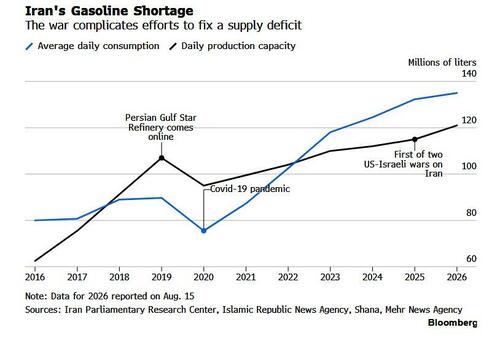
A top official in charge of domestic energy supply said the gasoline market had a daily deficit of 14-15 million liters due to record demand, damage incurred in the war and “changes in the national budget’s priorities.”
“We have to do something to bring consumption down to domestic production levels,” Esmaeil Saqab Esfahani, head of the Energy Optimization and Strategic Management Organization, said last week, according to the semi-official Iranian Students’ News Agency.
Needless to say, growing fuel shortages - and mounting popular unrest - will test Iran’s ability to keep the economy moving as the US launches what Treasury Secretary Scott Bessent described on Monday as “the single greatest financial offensive ever marshalled against an adversary.”
People line up to fill up their cars at a gas station in Tehran on Feb. 28.
As Bloomberg notes, gasoline prices are a highly sensitive issue in oil-rich Iran, where state subsidies mean consumers benefit from some of the cheapest petrol in the world. Or should.
Past efforts to raise prices have led to deadly protests, most notably in 2019, when hundreds of Iranians were killed by security forces. Throw in rampant inflation and a worsening currency crisis now crushing millions of ordinary households in Iran, and a spike in gasoline prices could be the lit match that sparks a new explosion in public anger, similar to the deadly protests in January.
For their part, Iranian officials have been warning the public for months that price hikes may be inevitable because Israeli and US strikes on fuel storage sites and other energy facilities have compounded a longstanding supply-demand imbalance. Trump's blockade on Iranian ports has only made the situation worse by preventing imports that Iran normally relies on to offset shortages.
President Masoud Pezeshkian, who has become an impotent figurehead, appealed to the public for support as far back as May, as he mooted the possibility of rationing and urged people to use public transport where possible. But the warnings don’t appear to have worked.
Last week, Iran’s parliament speaker and lead negotiator in the war, Mohammad Bagher Ghalibaf, said the US and Israel planned to exploit any rise in gasoline prices as part of their military operations against the Islamic Republic. Officials previously blamed an unspecified “foreign country” for a 2021 cyberattack on the country’s fuel network.
In an attempt to mitigate the shortage, the government has tried to encourage drivers of the roughly 4.5 million dual-fuel cars on the road to switch to using compressed natural gas. Iran’s biggest oil processing plant, the Persian Gulf Star Refinery, also said it was using methanol to boost gasoline production, ISNA reported on Sunday. Esfahani, the energy official, said the government is looking at three possible ways to manage the shortage.
The first is to distribute a fixed 121 million liters of fuel per day to gas stations before “switching off” forecourt nozzles once it runs out.
The second is to continue sales beyond that level but at a higher price
the third is to allocate quotas to individuals rather than cars.
Currently, Iran has a tiered quota system that provides each car with a monthly allowance of discounted gasoline. The first 60 liters costs 15,000 rials ($0.008) per liter, followed by 30,000 rials each for the next 50 liters and 50,000 rials for sales beyond that.
Last week the government abruptly abandoned a pilot program in the southern city of Kerman that would have increased the overall quota but applied a much higher price of 872,000 rials per liter ($0.46) for purchases above it.
Officials blamed mismanagement of the pilot for its failure, but the higher rate had also triggered widespread alarm in Kerman and stoked fears that the government was planning similar price hikes for the rest of the country.
And speaking of surging prices, Iran’s currency plummeted to new lows on Monday as the US announced further sanctions on the Islamic republic, whose citizens are now rushing to exchange lines to save their cash.
The rial dropped to 2.02 million to one US dollar when the currency markets opened on Monday, meaning the currency is now worth about half of what it was at the start of the year.
The continued plunge during nearly six months of war has led Iranians in Tehran to sprint for the exchange markets in hopes of getting US bills before their rial falls even further.
“There is no hope for a deal and peace,” Sadegh Mahmoudi, 73, told the Associated Press as he waited at an exchange line in downtown Tehran.
Iran’s rial has been in a free fall since last November due to years of Western sanctions and persistently high inflation, factors that have only gotten worse during the war.
Iranian hyperinflation has led to a collapse in the rial.
While Iran’s official Central Bank rate stands at 1.5 million rial to the dollar, the market rate is what the average Iranian pays.
“President Trump decimated Iran’s economy to a point where the rial has never been weaker and inflation has rarely been higher,” US Treasury Secretary Scott Bessent wrote Sunday in an opinion piece in the Financial Times.
“The regime’s final refuge now lies in the self-deception of fearful nations that still believe accommodating aggression can secure a durable peace,” he added.
Bessent warned that the additional financial penalties to come would effectively “collapse the regime,” with Trump echoing the same threat on social media.
“IRAN IS COMPLETELY COLLAPSING!!!” the president wrote on Truth Social.
In a tweet later in the day, Bessent said that "Iran’s currency keeps plummeting: today, crashing through the exchange rate of 2 million rials to the U.S. dollar. Over the weekend, Iran's Central Bank Governor Abdolnaser Hemmati said that the simultaneous drop in Iran’s oil revenues, tax income, and social security contributions has affected every part of Iran's economy. 3 million, here we come!"
Iran’s currency keeps plummeting: today, crashing through the exchange rate of 2 million rials to the U.S. dollar.
Over the weekend, Iran's Central Bank Governor Abdolnaser Hemmati said that the simultaneous drop in Iran’s oil revenues, tax income, and social security… pic.twitter.com/ZjOczci1Xi
— Treasury Secretary Scott Bessent (@SecScottBessent) August 24, 2026
With the United Arab Emirates, Iran’s largest trading partner, suspending all trade with Tehran, officials within the Islamic republic have threatened retaliation over the economic blows.
“Any escalation of this situation will undoubtedly bring about consequences,” Iranian Foreign Ministry spokesperson Esmail Baghaei told reporters on Monday. “Our hands are not tied.”
Tyler Durden
Tue, 08/25/2026 - 06:55
1 day ago