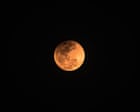
A near-total lunar eclipse occurs on Thursday night, with Earth’s shadow covering most of the Moon and making it appear reddish, often called a “blood moon.” Coverage indicates the event will darken about 96% of the Moon at its peak, when the alignment is closest.
The eclipse is visible to skywatchers across large parts of North and South America, with additional visibility reported in other regions. The reddish color results from sunlight passing through Earth’s atmosphere, where shorter wavelengths are scattered while longer wavelengths reach the Moon. Different outlets focus on where the eclipse can be seen and describe the visual effects, but all describe the same basic astronomical sequence: Earth moves between the Sun and Moon and casts its shadow across the lunar surface.