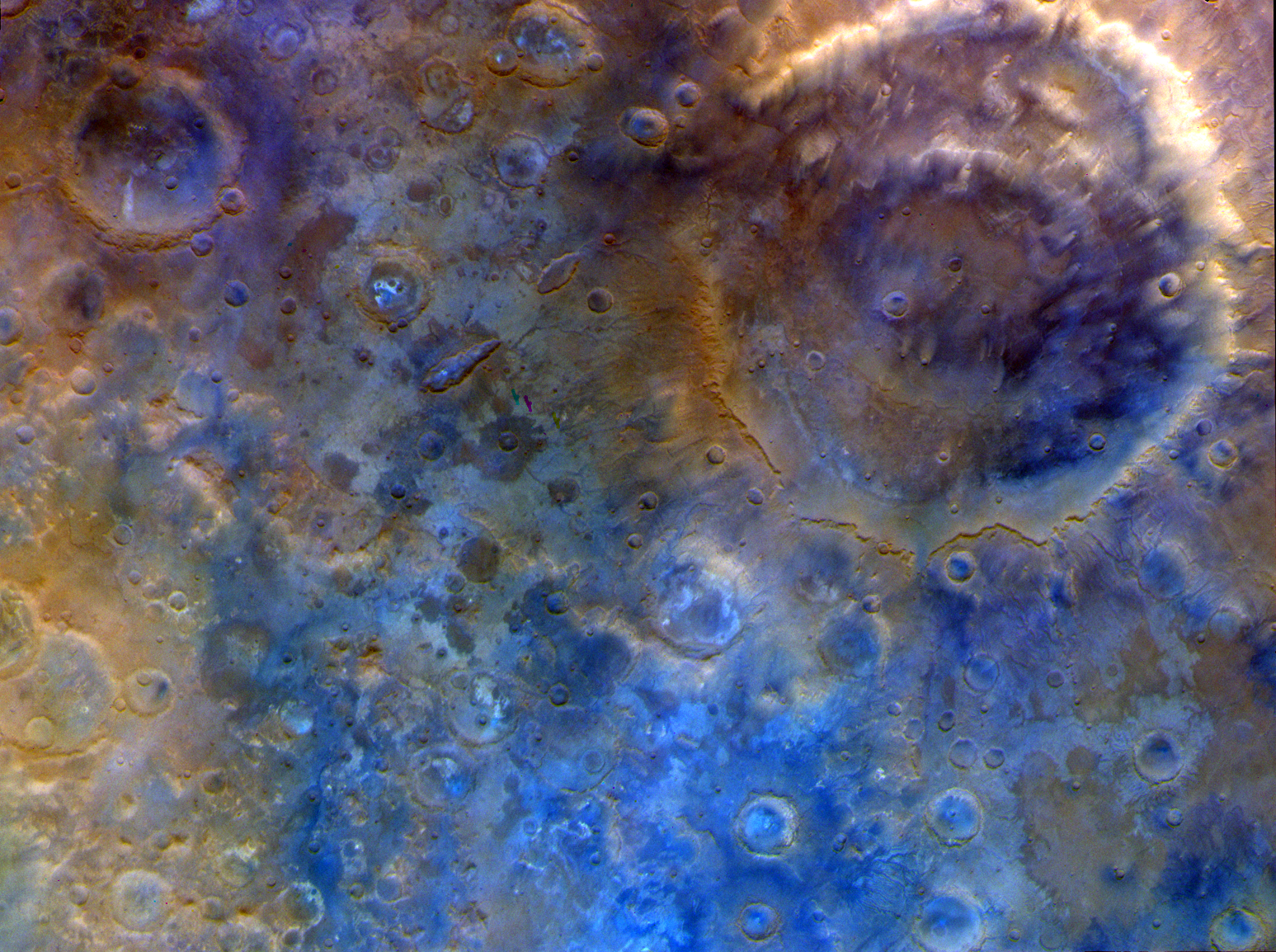
NASA reports that its Psyche spacecraft captures an enhanced-color image of Mars’ Huygens crater and nearby southern highlands. The view is produced using the mission’s multispectral imager, which records data across multiple wavelengths and combines them into an enhanced-color representation. The crater is described as a large double-ring structure, about 290 miles (470 kilometers) in diameter, located in the southern highlands near roughly 15 degrees south latitude. Surrounding areas show heavily cratered terrain consistent with ancient Martian surfaces.
Both sources describe the image’s color variation as likely reflecting differences in composition and surface materials. In particular, the colors are attributed to changes in the properties of dust, sand, and exposed bedrock across the crater and its surroundings. The Phys.org account adds that the image’s scale is approximately 2,200 feet (670 meters) per pixel, indicating the level of spatial detail in the captured scene.
NASA’s release focuses on the crater’s morphology and location, while Phys.org emphasizes the instrument method and the likely compositional basis for the color differences.