‘A win for diplomacy…gaps’: How editorials read BRICS and the Delhi declaration
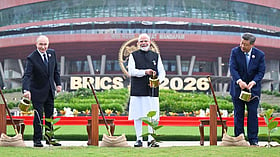
Somewhere between the mushroom kebabs and the millet pulao, Indian coverage of the 18th BRICS summit developed a parallel track. On one, there were 11 heads of government and a 45-page declaration. On the other, there was a tote bag and a menu card.The Ministry of External Affairs had curated media kits for visiting delegates as part of telling the “India Story”, and a certain amount of unboxing footage duly appeared. Then came the counter-argument from journalists: reporters are at a summit to cover it with objectivity and depth, and the only thing a press kit needs is “a programme schedule and relevant text”. Journalists are at events to cover them with suitable objectivity & depth, not to gush over goodies. The ONLY thing a journalist’s kit should contain is a programme schedule & relevant text. https://t.co/oJKHVH03Er— Ruhi Tewari (@RuhiTewari) September 11, 2026
Then there was controversy over food. The gala dinner was entirely vegetarian: khandvi mille-feuille and pan-grilled mushroom kebabs to start, paneer lababdar and Himalayan morels in the main course, shahdoot firni and jalebi with fruit cream to close. The Congress read this as the BJP exporting vegetarianism.At the same timeWe see great tyranny against movement of cattle, sale of meat in this era. 1.All of this culminates in this kind of menu that’s so bad that foreign visitors will avoid.https://t.co/4Zif24pldV any case I imagine Putin and Xi have their own cooks and diets. But… https://t.co/LKApOWdAqu— Saba Naqvi (@_sabanaqvi) September 13, 2026
Questions were raised over the actual economic prowess of BRICS members. Economist Surjit Bhalla pointed out that BRICS rose from 21.9 per cent of world income in 2011 to 28.9 per cent in 2025, but that with China removed, the remaining ten members went from 11.9 per cent to 11.5 per cent. His verdict: “They did not rise. They fell.” But what linked garnish, seating and arithmetic is the main event and its declaration, which according to some “was boring”. C Raja Mohan made the point most precisely in The Indian Express, arguing that Delhi’s diplomatic success lay in keeping BRICS “boring” amid the rhetorical excess that usually surrounds these summits – a declaration that reaffirmed the forum’s political diversity rather than staging the ideological crusade against the West that its cheerleaders want and its critics assume. The Chinese participation was a substantial moment, with foreign media outlets, including The Guardian noting the “public display of thawing relations” at a moment of shaky American dominance. However, further down the food chain, the projection got sillier. An Indian journalist detected a Pakistan angle in the declaration; a Chinese analyst detected a Taiwan angle in the same document. There is no mention of Pakistan in this statement, which is exactly what China would have pressed for and got. Meaning, India conceded on the wording to ensure everyone signs on it. And China had used similar words to condemn the attack right after it happened. So no narrative… https://t.co/o3kigYFZ0W— Angshuman Choudhury (@angshuman_ch) September 13, 2026
No, the Indian read out doesn’t mention Taiwan. https://t.co/LudgO3jGHq— Sana Hashmi | 胡莎娜 (@sanahashmi1) September 13, 2026
Meanwhile, at home, the editorials converged on the verdict and then split on what it meant. Almost all scored the summit as a procedural success. The Hindu offered three yardsticks – participation at the highest levels, attention to intra-BRICS trade mechanisms, and consensus forged in a time of war – and credited India’s fourth chairship with reinforcing its standing as a “Global South balancer with easy access to both sides of a divided world”. (Saudi Arabia’s foreign minister arrived after the session at which the statement was adopted, which is its own kind of position paper.) Business Standard filed under the headline “showy summitry” and still conceded the outcomes exceeded expectations. Hindustan Times reached past the summit for Sallust: “Through harmony, small things grow; through discord, the greatest fall.” The Indian Express stated the declaration’s strength lay in “the spectacular headlines it did not make”.The disagreement is over what the silences signify. The text left out the US-Israeli strikes on Iran, the killing of Ali Khamenei, Iran’s retaliation against its Gulf neighbours and Russia’s war in Ukraine, while taking a notably strong line on Israel's conduct in Palestine and Lebanon and hammering unilateral sanctions and coercive measures at length. The Economic Times read the pattern as design, that the Global South was demonstrating that it, too, can pick and choose its moral crusades, and recast sanctions from rules-based order into plain coercion. The Hindu BusinessLine noticed the same asymmetry more drily: BRICS called out the United States over Palestine without naming it as an aggressor anywhere else. The Tribune granted the diplomatic achievement and then called it “a reminder of the limits of consensus in a deeply divided world”.Business Standard declined to be impressed by the destination: the New Development Bank remains small and dependent on the western financial system, and had to suspend loans to founding member Russia after the 2022 sanctions; the alternative-currency project has foundered; and beyond representing the Global South, discernible gains are hard to identify. Hence its closing verdict, that “Brics remains a benign grouping in search of an objective”.On China, the caution was near-universal.Business Standard treated Xi Jinping’s attendance – after seven years away, and after his conspicuous absence from the G20 Delhi hosted in 2023 – as a genuine advance in cooperative diplomacy, then warned that expectations must be tempered by China’s past conduct on the ground. The Telegraph placed the Xi meeting in a set with Putin and Pezeshkian and drew the wider lesson: “In a fluid world, keeping options open is smart foreign policy.” India’s real product at this summit was its own optionality. Business Line called BRICS “a fractious grouping, with China exercising overweening influence”, and hedged even its endorsement of local-currency settlement: the arrangement helps India only if third-party demand grows for currencies other than the yuan.1/ BRICS went from 21.9% of world income in 2011 to 28.9% in 2025.Now take out China.The other ten members went from 11.9% to 11.5%.They did not rise. They fell. pic.twitter.com/rq18XYMIA1— Surjit Bhalla (@surjitbhalla) September 13, 2026
Business Line cited BRICS at 40 per cent of global GDP and 26 per cent of world trade; Bhalla’s numbers described who inside that total is generating the momentum.Together they pose the question no editorial took up directly, whether 10 economies whose combined share of world income has barely moved in 15 years can build institutions that don’t end up denominated in another currency.
3 hours ago