


The average U.S. long-term mortgage rate climbs this week to 6.51%, the highest level in nearly nine months, increasing borrowing costs for homebuyers during the spring peak season. Freddie Mac reports the benchmark 30-year fixed rate rises to 6.51% from 6.36% the prior week. Although the rate is up sharply week to week, it remains below the 6.86% level from a year ago and below the threshold seen around early February when rates briefly hovered near 6%.\n\nBoth outlets link the increase to higher long-term bond yields. They point to investor expectations for inflation and economic growth, alongside the 10-year Treasury yield as a key benchmark for mortgage pricing. The 10-year Treasury yield rises as crude oil prices move higher after renewed strain in the Middle East, with the closure of the Strait of Hormuz cited as a driver of energy-market volatility and inflation concerns.\n\nThe higher mortgage rates also affect other products. The average 15-year fixed rate increases as well, and mortgage applications decline, with some borrowers shifting toward adjustable-rate mortgages. Overall, the change is associated with continued softness in homebuying and housing activity.
30-year fixed mortgage rate rises to 6.51%, highest in nearly nine months
The average U.S. long-term mortgage rate climbs this week to 6.51%, the highest level in nearly nine months, increasing borrowing costs for homebuyers during the spring peak season. Freddie Mac report...
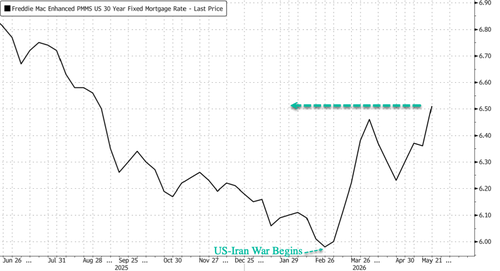
- Freddie Mac reports the average 30-year fixed mortgage rate rises to 6.51% from 6.36% in the prior week.
- The 6.51% level is the highest for the benchmark 30-year fixed rate in nearly nine months (since Aug. 28, per one report).
- The increase is tied to higher long-term Treasury yields, which influence mortgage pricing.
- Oil-market disruptions related to conflict in the Middle East are cited as contributing to higher energy prices, inflation expectations, and bond yields.
- Mortgage applications fall week over week, and some borrowers increase use of adjustable-rate mortgages as rates rise.
Mortgage Rates Hit 9-Month High, Freezing Out Homebuyers In Peak Season The average rate on a 30-year fixed mortgage climbed to its highest level since August, threatening to derail the spring selling season as higher Treasury yields and renewed inflation pressure push loan costs higher and freeze more prospective buyers out of the market. Freddie Mac data released Thursday show the 30-year fixed mortgage rate for the week ending May 21 jumped to 6.51% from 6.36%, the highest rate since Aug. 28, 2025. Soaring mortgage rates stem from turmoil in the Gulf region, with the U.S.-Iran war driving up oil prices, inflation, and bond yields over the last three months. Rates on 10-year Treasuries hit their highest level in one year, while 30-year yields neared 2007 highs. Mortgage rates fell to around 6% in early February, lifting hopes for a housing market rebound after three consecutive years of depressed activity. Yet hopes for a robust selling season were dashed because the conflict in the Middle East began in late February, and once the Hormuz chokepoint closed, energy prices surged, followed by rates. "Each uptick in rates narrows the pool of buyers who can make the numbers work," Realtor.com analyst Anthony Smith told News Corp. The impact of higher rates is significant for buyers: Before the conflict, a buyer with a $2,500 monthly budget and 20% down could afford about a $400,000 home at a 6% mortgage rate, but only about $384,000 at a 6.5% rate. Realtor.com analyst Jake Krimmel told Bloomberg, "We've been surprised so far that we haven't seen deterioration like we did this time last year." "May is where the rubber will meet the road because that's when things tend to really start picking up," Krimmel said. The end result of surging rates over the last few months was flat existing-home sales in April, well below Bloomberg Consensus expectations. The continued housing market slowdown, which feels like an eternity for those in the industry, has pressured businesses tied to housing, such as furniture manufacturers, home builders, mortgage lenders, and real estate brokerages. Home improvement retailers such as Home Depot and Lowe's warned this week that consumers remain reluctant to splurge on big-ticket home improvement items, as elevated mortgage rates, high home prices, energy inflation, weakening sentiment, and broader macroeconomic uncertainty weigh on demand. Lowe's CEO Marvin Ellison warned analysts earlier this week that the housing market is the "most difficult" since the financial crisis. He continued: I think overall this has been the most difficult housing market that I've faced in this business since the financial crisis. And as Brandon mentioned, it's almost exclusively or disproportionately on the DIY customer. That's the majority of where our revenue comes from. And so I look at it from this perspective, you know, we've delivered four quarters of positive comps in an environment where the DIY has faced more economic pressure than I've ever seen before. Housing affordability for first-time homebuyers remains at a four-decade low. "Decisions made during the period of ultra-low interest rates coming out of the pandemic are still shaping behavior," said Torsten Slok, the chief economist at Apollo Global Management, citing the unwillingness of homebuyers with sub-4% rates to move. "The shift to higher rates has fundamentally changed the economics." "If you're looking for relief on 30-year conventional mortgage rates, you're not going to get it anytime soon," said Kevin Flanagan, head of investment strategy at WisdomTree. Nick Barta, a regional manager at Security First Financial, a Colorado-based mortgage company, told Bloomberg that the surge in rates because of the US-Iran war has had a chilling effect on the industry so far. "All you hear about is gas prices and higher interest rates," said Barta, who has worked in the mortgage industry for nearly four decades. "It freaks people out." President Trump has directed Fannie Mae and Freddie Mac to begin buying $200 billion in mortgage-backed securities to pressure mortgage rates lower. "FHFA and the administration are actively evaluating a range of tools and policy options to improve affordability and expand access to homeownership for American families," Federal Housing Finance Agency Director William Pulte said. Sarah Wolfe, a senior economist at Morgan Stanley Wealth Management, warned that higher mortgage rates continue to leave an entire generation of homebuyers stuck in rentals. "They want the same things as the generation before them," Wolfe said, "and the bar to entry is getting higher and higher." Tyler Durden Fri, 05/22/2026 - 06:55
3 months agoThe average long-term U.S. mortgage rate climbed this week to its highest level in nearly nine months, driving up borrowing costs for homebuyers during what’s traditionally the housing market’s busiest time of the year. The benchmark 30-year fixed rate mortgage rate rose to 6.51% from 6.36% last week, mortgage buyer Freddie Mac said Thursday. Despite the sharp increase, the average rate remains below 6.86%, where it was a year ago. Rates have been mostly trending higher since the war with Iran began. The closure of the Strait of Hormuz has roiled energy markets, sending crude oil prices sharply higher — a key driver of inflation. Mortgage rates are influenced by several factors, from the Federal Reserve’s interest rate policy decisions to bond market investors’ expectations for the economy and inflation. They generally follow the trajectory of the 10-year Treasury yield, which lenders use as a guide to pricing home loans. Expectations of higher oil prices and worries about big and growing debts for the U.S. government and others have pushed up long-term bond yields, causing mortgage rates to head higher. The yield on the U.S. 10-year Treasury note, which was at 4.6% in midday trading Thursday on the bond market. A week ago, it was at 4.47%. It was at just 3.97% in late February, before the war broke out. Meanwhile, borrowing costs on 15-year fixed-rate mortgages, popular with homeowners refinancing their home loans, also rose this week. That average rate climbed to 5.85% from 5.71% last week. A year ago, it was at 6.01%, Freddie Mac said. When mortgage rates rise they can add hundreds of dollars a month in costs for borrowers, reducing their purchasing power. As recently as late February, the average rate on a 30-year mortgage had slipped just under 6% for the first time since late 2022. It’s hasn’t fallen below that threshold since. It’s now at its highest level since August 28, when it was 6.56%. While average long-term mortgage rates remain lower than they were at this time last year, their recent increase has helped dampen sales so far this spring homebuying season. Sales of previously occupied U.S. homes were essentially flat last month after declining from a year earlier in the first three months of the year, extending a nationwide housing slump that dates back to 2022 when mortgage rates began to climb from pandemic-era lows. Mortgage applications, which include loans to buy a home or refinance an existing mortgage, fell 2.3% last week from a week earlier to their lowest level in five weeks, according to the Mortgage Bankers Association. Much of the decline was caused by a sharp drop in home purchase applications. The elevated mortgage rates are driving more prospective homebuyers to adjustable-rate mortgages, or ARMs. Such loans, which typically offer lower initial interest rates than traditional 30-year, fixed-rate mortgages, accounted for nearly 10% of all mortgage applications last week, the highest share since October, MBA said. Home shoppers who are undeterred by rising mortgage rates are benefiting from buyer-friendly trends in many markets, including more properties on the market than a year ago and data showing home listing prices have started falling in many metro areas, especially in the South and Midwest. “The spring season still offers real opportunity, though each uptick in rates narrows the pool of buyers who can make the numbers work,” said Anthony Smith, senior economist at Realtor.com. —Alex Veiga, AP business writer
3 months ago
Zohran Mamdani forms business advisory council with executives
New York City Mayor Zohran Mamdani is assembling a new business advisory council and recruiting more than a dozen corpor...

Lisa Cook denies mortgage-fraud claims as Trump weighs firing her Fed role
Federal Reserve Governor Lisa Cook denies wrongdoing after President Donald Trump revives an effort to remove her, repea...

Trump announces Karoline Leavitt’s departure as White House press secretary
Karoline Leavitt is stepping down as White House press secretary, with Trump announcing her exit and reporting placing h...