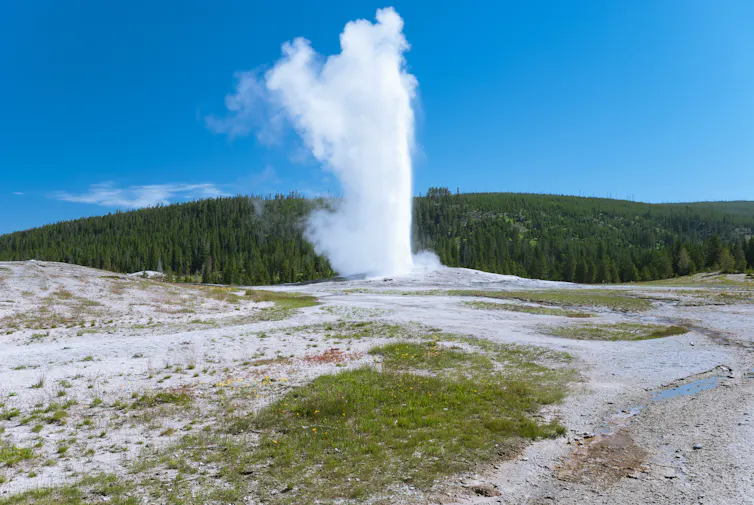
The Conversation and Phys.org both describe what could happen if the Yellowstone supervolcano erupted now, presenting a step-by-step account of direct and indirect hazards. They say people close to the eruption would face immediate lethal effects from blast forces, extreme heat, and asphyxiation from ash, with impacts rapidly escalating within the eruption zone.
Both pieces also place the scenario in a broader geological context, pointing to a past Yellowstone super-eruption and emphasizing how such events can affect far beyond the immediate area. They describe ash dispersal over much of North America and note that the consequences would likely be worldwide, affecting climate and living conditions at a distance. The accounts focus on physical outcomes—how energy, ash, and atmospheric changes propagate—rather than on political or policy responses.
Overall, the outlets converge on the same central idea: a Yellowstone super-eruption would produce catastrophic, likely civilization-altering conditions both locally and globally, with early impacts driven by blasts and heat, and longer-range effects amplified by large-scale ash and atmospheric disruption.