Fast Company
Screens are saturating U.S. classrooms, fueling a backlash on school-issued devices
Just a few years ago, America’s public schools were rushing to get every child a laptop. Los Angeles middle school teacher Anna Soffer remembers it well: “The idea was that technology is the future, so we need to put tech in every child’s hands.”Now, the conversation has flipped. After pouring billions of dollars into laptops, tablets and learning apps, many schools are facing a digital reckoning. Classrooms have become saturated with screens, and a growing number of parents, teachers and school districts are saying it is time to scale back.“The Chromebook is just a world of distraction,” says Soffer, who teaches 6th grade English and history. She favors pen-and-paper assignments but is required to use laptops and online apps for certain activities. “Every day, I’m battling, ‘Who would you rather listen to, Ms. Soffer or Minecraft?'”The Los Angeles Unified School District, where Soffer teaches, recently became the first major school district to say it will stop giving devices to its youngest students. It is part of a new screen-time policy taking effect in the fall across the country’s second-largest school system.A sweeping resolution passed last month by the Los Angeles school board requires the district to eliminate devices until second grade; set daily and weekly screen limits for all higher grades; block YouTube on school devices; and ban the use of devices at lunch and recess in elementary and middle school. The district will also audit its education technology contracts, which the teachers union says amount to $1.6 billion.The Los Angeles crackdown is adding momentum to calls for reform emerging around the country. In many cases, parents lobbied a few years ago for school cellphone bans, which have now become the norm. Realizing phones weren’t the only classroom distraction, they pivoted to a new target: school-issued devices.The campaign for change is becoming a public policy issue. At least 14 states have proposed laws to limit screen time in schools, according to Ballotpedia. The federal government issued an advisory last week warning that excessive screen use among youths is becoming a growing public health concern.
Parents say school-issued devices undermine screen limits at home
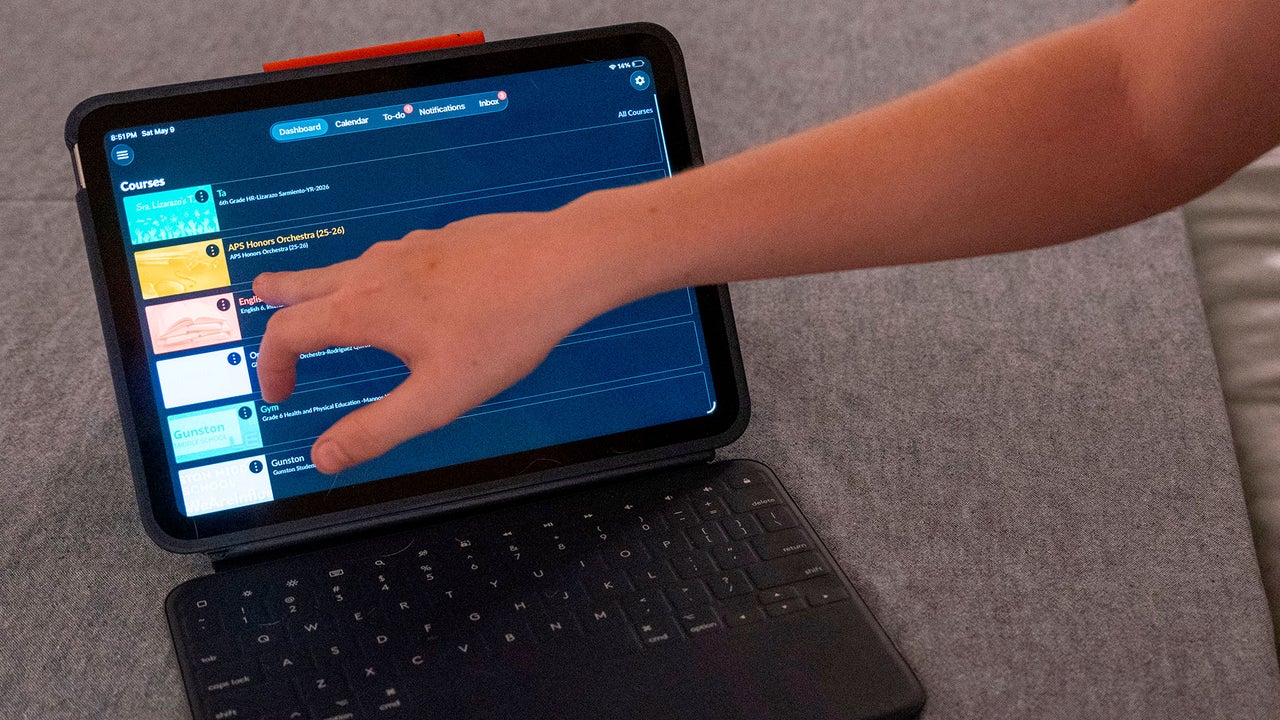
In Los Angeles, concerned parents last year formed a group, Schools Beyond Screens, and pressured the district by speaking out at school board meetings, on social media and in private talks with administrators. Many are frustrated by trying to curb screen time at home, only to have screens mandated by school.As a mother of three, Katie Pace does everything in her power to limit screens. There is one family iPad and one television at home, no screen time during the week and no screens allowed in bedrooms. Her 8th grade daughter, Clementine, does not have a phone.But as soon as Clementine gets on the wifi-enabled school bus, her day takes a turn for the digital.For the 30-minute ride to school, Clementine watches YouTube videos on her school Chromebook.In Spanish class, assignments are on the app Duolingo, but many students use Google Translate for answers, Clementine said. Often, kids are playing games on their phones, which are supposed to be locked away. In algebra, Clementine writes with her finger on a touch screen to solve equations. In history, quizzes, tests and writing assignments are on the computer.Almost all homework is online. Until recently, Clementine would come home and read a book, her mother said, but not anymore. On her daughter’s device history Pace sees she spends hours a day streaming music, making Spotify playlists, and watching makeup tutorials and cat videos on YouTube.“It makes me furious,” said Pace, a member of Schools Beyond Screens. “My daughter went to middle school and was sent home with a screen addiction in her backpack.”
The pandemic supercharged student access to devices
A push to put a device in every child’s hand and close the “digital divide” started over a decade ago but it accelerated during the COVID-19 pandemic.Overnight, education shifted online in March 2020. Schools raced to get kids the devices needed to connect to school. When the 2021-2022 school year started, 96% of U.S. public schools reported they had given digital devices to students who needed them, according to the National Center for Education Statistics.Many schools switched funding away from textbooks, workbooks and paper printouts to digital alternatives. Educational technology, or edtech, exploded into a multibillion dollar industry.“During the pandemic, getting kids devices was a lifeline. Now, it’s time that we reset,” said Nick Melvoin, the LAUSD school board member who drafted the new resolution.Melvoin estimates that few Los Angeles classrooms are using screens effectively in ways that benefit learning. Too often, he said, teachers are replacing instruction with online apps and using screens “as a crutch.”
Some schools are introducing new limits
The challenge, educators say, is that technology has become so entwined with learning, especially for older students, that unplugging from screens at school is complicated.In the affluent Philadelphia suburb of Lower Merion, parents launched a petition campaign for the right to opt their children out of digital devices during school, citing questions about edtech’s benefits. The district has said that opting out is not possible.“If there’s really no evidence that it helps, and in fact there’s evidence that it’s harmful, what are we doing? Test scores are at their lowest point,” said Alex Bird Becker, one of the founders of the group PA Unplugged.Other schools are finding that it makes financial sense to stop sending a device home with every child.Fresno Unified School District, the third-largest in California, is spending $4 million a year to repair and replace laptops. Partly to cut costs, the district has told its 40,000 elementary school students to return their take-home laptops and will shift computer access to in-class only in the fall, spokesperson AJ Kato said.The Simi Valley Unified School District, near Los Angeles, stopped sending devices home for its younger students this year partly because of costly repairs, but also because they were being used for “inappropriate Google searches” and video games, according to a memo to parents. The district now stores the devices in carts at school.A group of parents in Arlington, Virginia, gathered on a recent Saturday night to share their children’s struggles with screen addictions and other side effects of school-issued devices.“None of us are Luddites. I know that technology adds value, but I also don’t want my son on YouTube all the time,” said LuAnn Oliver, who hosted the group in her living room. Her 6th-grade son struggles to keep track of online assignments and resist the temptation the iPad offers for video games. “We get reports on websites he’s visited. He’s visiting a game site in nearly every class.”The Arlington School District has stopped giving iPads out before first grade and is setting new limits in elementary school, but students in 6th to 12th grades will still be required to have school-issued devices.Another mother, Jenny Sullivan, said she has noticed her 4th grade son capitalizing random letters and not getting corrected because there is so little work on paper. She also worries about social implications: Her 6th grader doesn’t want to go to the afterschool program because everyone is on their iPad. “I’d rather be home,” he tells his mother.After a three-hour gathering, the parents made a plan to approach the school in the fall with a unified request to “opt-out of technology and opt-in to textbooks and paper.”“Ten years from now,” said one of the mothers, Kristina Jackson, “I can’t imagine us looking back with any other reaction than: How could we have been so naive that we just handed these devices to our kids.”
Associated Press writer Sharon Lurye contributed to this report.
The Associated Press’ education coverage receives financial support from multiple private foundations. AP is solely responsible for all content. Find AP’s standards for working with philanthropies, a list of supporters and funded coverage areas at AP.org.
—Jocelyn Gecker, AP Education Writer
2 months ago