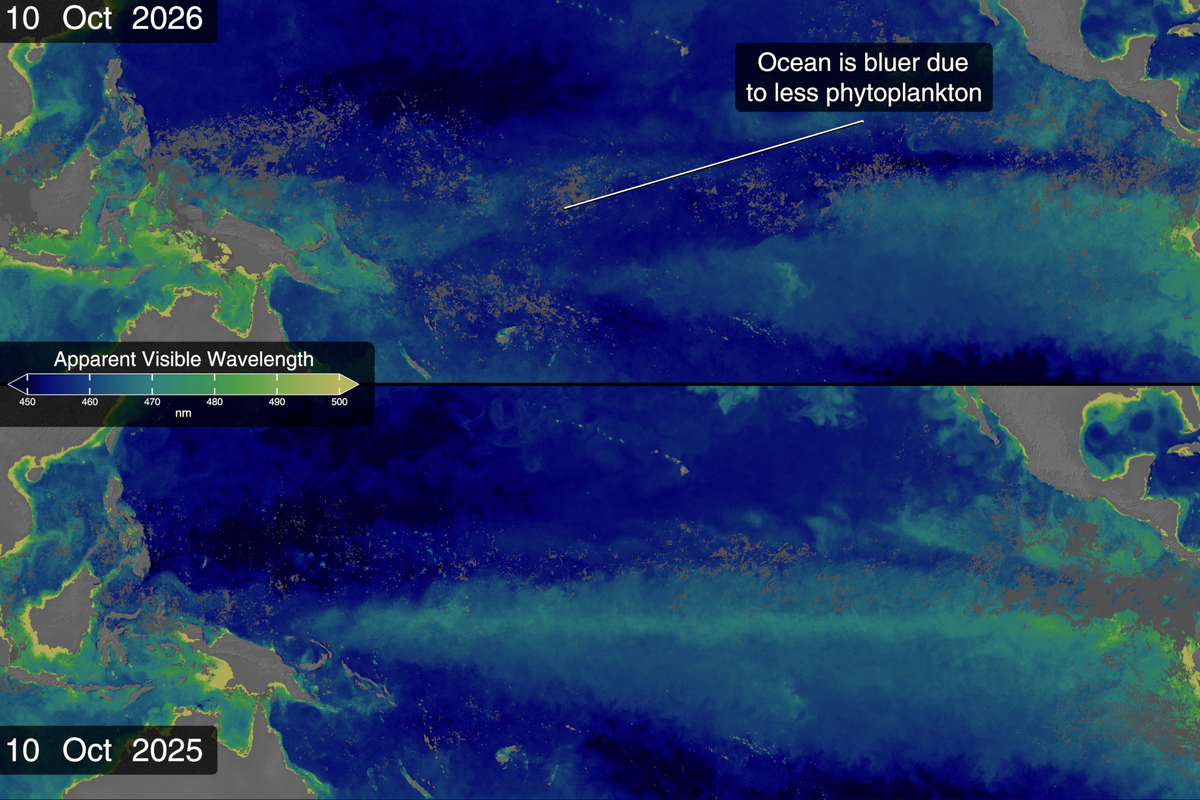
NASA satellite imagery shows that, during the Super El Niño, parts of the equatorial Pacific shift in colour from green to deeper blue. Multiple outlets describe large areas where the sea appears to change from greener tones to more “cerulean” blue over roughly the past year.
The colour change is linked by outlets to ecological impacts associated with the event. They report that billions of microscopic marine plants (phytoplankton) die off, reducing the pigments that typically give surface waters a green hue. With fewer phytoplankton, the remaining water colour more strongly reflects deeper ocean characteristics.
Some coverage emphasizes record-breaking temperatures as the driver, presenting the colour shift as a visual indicator of changing ocean conditions and the risk to marine life. While all sources agree on the observed change and its general association with phytoplankton decline and warming, they differ in how strongly they foreground the marine-life threat versus the satellite-observed colour pattern.