


An international team of astronomers reports that the James Webb Space Telescope (JWST) has detected a dormant black hole in a galaxy more than 10 billion light-years from Earth. The black hole is described as “dormant” because it is not actively emitting detectable light. It sits at the center of the galaxy MRG-M0138 and is largely invisible across conventional observing wavelengths. Researchers infer its presence and determine its mass by using gravitational lensing, where a foreground mass acts like a cosmic magnifying glass to enhance and distort the background galaxy’s signals. The new study, published in Science, identifies this object as the most distant dormant black hole found so far, exceeding the previous record by a wide margin. Live Science reports the mass is comparable to roughly 6 billion Suns, while Phys.org states the measurement corresponds to a mass of about 6 billion Suns as well (describing it as “weighed” by JWST). The result highlights JWST’s ability to find otherwise hidden black holes in the early universe using indirect observational signatures.
JWST detects and weighs a dormant black hole over 10 billion light-years away
An international team of astronomers reports that the James Webb Space Telescope (JWST) has detected a dormant black hole in a galaxy more than 10 billion light-years from Earth. The black hole is des...
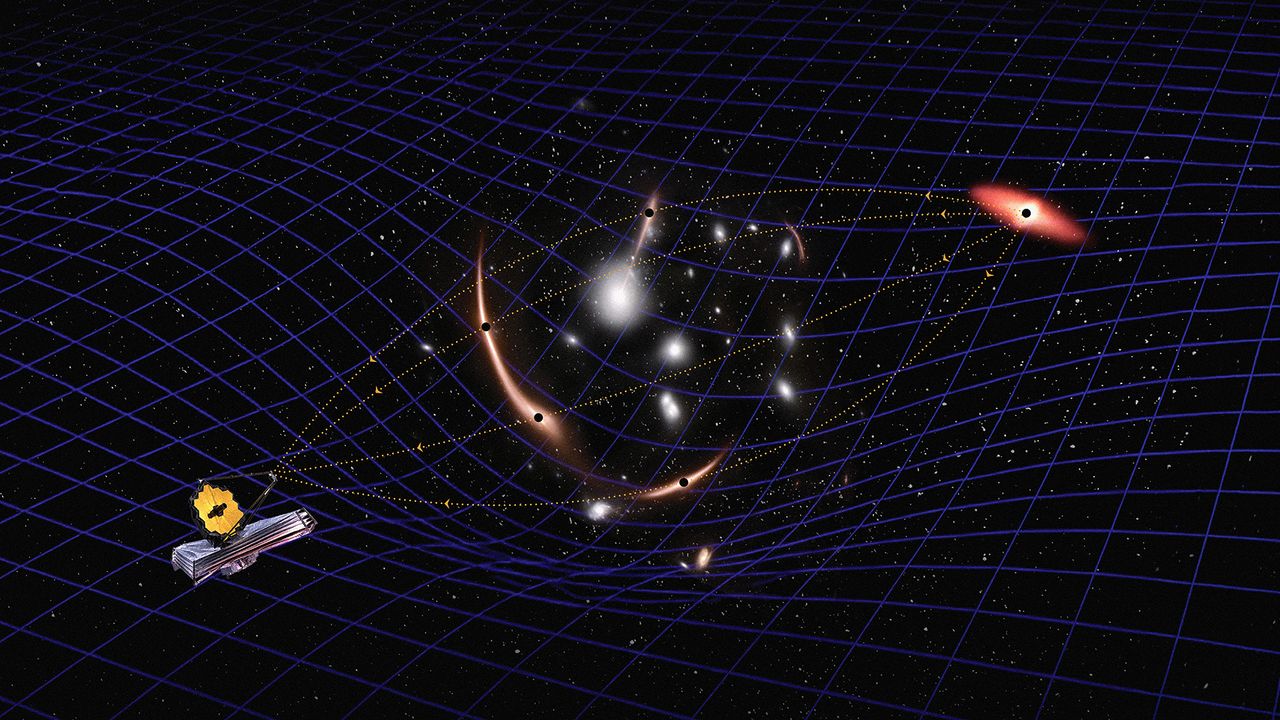
- JWST detects a dormant black hole in the galaxy MRG-M0138 more than 10 billion light-years away.
- The black hole is largely invisible because it shows no clear emission across wavelengths.
- Researchers determine the black hole’s mass using gravitational lensing of the background galaxy.
- The study is published in Science and includes researchers from UCL.
- The object is reported as the most distant dormant black hole detected to date, surpassing the previous record.
The most distant, nearly invisible dormant black hole has been detected and "weighed" by an international team of astronomers that includes researchers from UCL. The study, published in Science, identified a dormant black hole at the heart of a galaxy known as MRG-M0138 located over 10 billion light years away. It is the most distant dormant black hole yet detected, 15 times farther away than the previous record.
2 months agoJWST found a black hole hiding in a galaxy more than 10 billion light-years away from Earth, and used a cosmic magnifying glass to determine its mass.
2 months ago
Trump administration considers land transfer involving a parcel of Yosemite for access to private development
The Trump administration is considering transferring a small parcel of Yosemite National Park to a private developer, re...

Peyton Manning’s son Marshall Manning debuts for Baylor School, then reports injury
Marshall Manning, the son of former NFL quarterback Peyton Manning, makes his high school football debut for Baylor Scho...

Study says many workers remain stuck on zero-hours contracts for years
A new study finds that many workers in the UK spend years trapped on zero-hours contracts, which researchers describe as...