Dawn (Pakistan)
Every monsoon, thousands of seashells wash up on Karachi's shores. Here's why
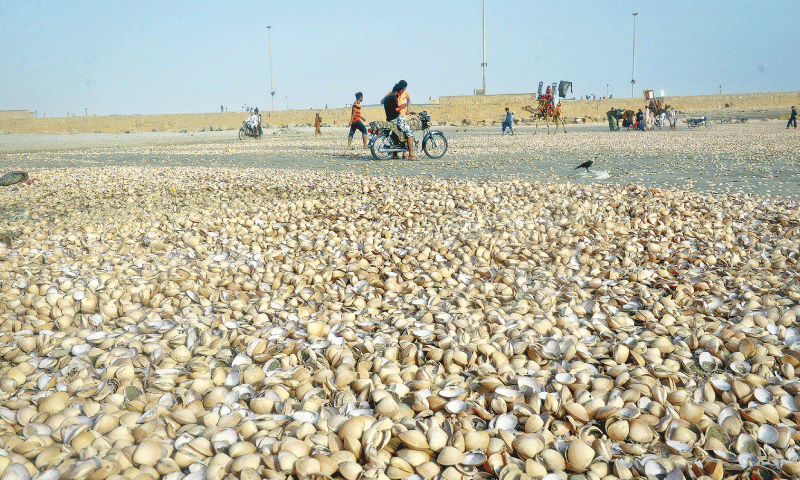
Each year, sometime around June, Karachi’s beaches become crowded — not just with people, but also seashells, hundreds of thousands of them, spread across the shore in dense and clattering drifts. The sight leaves citizens intrigued, with many wondering if something was wrong. The same thing happened this June, as well.
For the past few days, there has been discussion both online and offline regarding why this phenomenon occurs. Was it climate change or nature’s spectacle?
The science and the fishermen tell a more layered story.
A prelude to the monsoon
The phenomenon is not new. A Dawn report dated July 17, 2009, noted that large numbers of white and yellow seashells had appeared on Clifton Beach overnight. Another Dawn report, dated May 21, 2016, reported that wave action dislodges shellfish, particularly Venus clams, locally known as “burgar”, from shallow sub-tidal habitats, carrying them onto beaches where they die and leave behind empty shells.
The same event was also covered by The Express Tribune on May 22, 2016. Both news reports stated that the phenomenon is linked to the arrival of the monsoon.
An Aaj News report dated July 10, 2024, also noted that marine experts continue to identify June and July as the recurring seasonal window for this phenomenon, though it added that rising pollution levels may be contributing to higher rates of marine mortality, leading to larger volumes of shells washing ashore in some years.
Majeed Motani, president of the Pakistan Fisherfolk Forum, who has decades of fishing experience, confirmed this. The phenomenon was not new and was locally known as “aokar”, he said, and similar seashells can be seen along several coastal areas, including Ibrahim Hyderi and other beaches in Karachi.
“We have been witnessing this phenomenon for decades, particularly during June and July,” he said, explaining that water from the deeper parts of the sea rises to the surface and eventually pushes the seashells toward the shore, where they are deposited along the coastline.
What science says
Scientific research on the Arabian Sea provides a clearer explanation for why this happens. When the southwest monsoon arrives around June, strong winds push warm surface water away from the shore, drawing cold water up from the ocean’s depths — a process known as upwelling.
A study published in the Journal of Sea Research explains that this cold, deep water contains very little oxygen, and when it spreads across the seafloor, it proves fatal for bottom-dwelling creatures such as clams and other shellfish that cannot move quickly enough to escape. Their empty shells are then carried onto beaches by powerful monsoon waves.
A separate paper on the Arabian Sea shelf, published in Deep-Sea Research, found that cold, oxygen-depleted water begins appearing off Karachi as early as June and persists through November, precisely the months when citizens observe the highest concentrations of shells along the coast.
Another study stated that the monsoon season coincides with the period when the largest number of marine invertebrates are present in coastal waters near Karachi. In short, shellfish populations are at their peak near the shore just as the harshest ocean conditions arrive, which is why the beaches receive so many shells.
The anomaly
But 2026 may be a different year in at least one respect. Motani told iVerify Pakistan that the number of seashells this year appears higher than usual.
Fatima Yamin, a climate change and disaster management expert, highlighted that the Indian National Centre for Ocean Information Services issued a Marine Heatwave Advisory in April, confirming that parts of the Arabian Sea — including coasts of India, Pakistan and Bangladesh extending towards Oman — are under high alert due to an increase in sea surface temperature anomaly.
“It is yet to be seen if it affects deep waters, but it would impact the continental shelf. This correlates with the accounts of fishermen who have not seen such a large number of marine shell life washed onshore before. Warmer temperatures in the sea surface can also change the oxygen levels, causing marine life to die in the water and causing marine mammals to rise to the surface for oxygen,” she added.
What happens to the shells?
Meanwhile, the shells themselves do not go to waste.
According to Motani, some people — mostly families living near the sea — collect them as part of their livelihood. The shells are cleaned using chemicals and other methods and then used to make jewellery, photo frames, decorative pieces, flower pots, and other handicrafts that are sold in the market.
Beyond handicrafts, seashells also have a broader industrial value that is increasingly being explored by researchers. A study examining sustainable waste management found that seashells can be converted into bio-calcium carbonate through a high-temperature calcination process.
When used as a filler in high-density polyethene (HDPE), a common industrial plastic, the seashell-derived material was found to improve the thermal stability, crystallinity, and tensile strength of the plastic, while only marginally reducing its flexibility.
This explainer was originally published by iVerify Pakistan — a project of CEJ-IBA and UNDP — under its initiative tackling myths and disinformation around climate, supported by Irada and IMS.
2 months ago