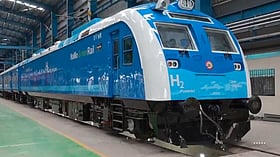
India’s first hydrogen-powered train completes a high-speed trial on the Jind–Sonipat section of Northern Railway in Haryana, reaching speeds of up to 120 km/h. Reports say the successful run is treated as a final high-speed test and a step toward potential passenger service once remaining regulatory and operational requirements are completed. The Deccan Chronicle and Free Press Journal both describe the test as clearing a key phase of the project, monitored by railway officials.
The train is developed by Indian Railways and uses hydrogen fuel-cell technology rather than a diesel engine. The fuel cells generate electricity from a reaction between hydrogen and oxygen, producing water and heat as by-products. Sources also describe planned hydrogen infrastructure at Jind, including production, storage, and refuelling facilities to support operations and maintenance. Safety systems highlighted include hydrogen leak detectors, flame detection equipment, and continuous monitoring. One account adds that trials also cover emergency braking performance and oscillation tests, alongside the speed run. The initiative is framed as part of efforts to reduce emissions and dependence on fossil fuels and to improve environmental performance in rail transport.