The Supreme Court Denies Trump the Chance to Shred the Constitution
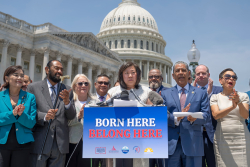
The Supreme Court struck down President Donald Trump’s executive order that sought to curb birthright citizenship on Monday, dealing a crushing blow to the administration’s efforts to redefine a central tenet of the American constitutional order.“Citizenship, then and now, was the right to have rights—to freely participate in our political community,” Roberts wrote for the court in Trump v. Barbara. “The Framers of the Fourteenth Amendment extended that promise to ‘every free-born person in this land.’ We keep that promise today.”Roberts was joined by Justice Amy Coney Barrett, a fellow conservative, as well as the court’s three liberal members: Justices Sonia Sotomayor, Elena Kagan, and Ketanji Brown Jackson. Standing athwart the majority were Justices Clarence Thomas, Samuel Alito, Neil Gorsuch, and Brett Kavanaugh, who all wrote separate dissenting opinions.Thomas, who led the charge, argued that the Citizenship Clause meant to affirm citizenship only for formerly enslaved Black Americans after the Civil War. He leaned heavily on the idea that one’s parents must be “domiciled” in the United States to acquire U.S. citizenship at birth, as well as a burst of right-wing legal “scholarship” that emerged last year to sloppily backfill a legal rationale for Trump’s executive order.“I am not sure that today’s opinion will stand the test of time,” Thomas wrote in his dissent. “The Citizenship Clause ‘added greatly to the dignity and glory of American citizenship.’ Today’s opinion devalues that citizenship.” Alito, who wrote separately, also lamented that the court had “made a serious mistake” in his view in “one of the most important decisions in the history of the court.”Alito is right, if nothing else, about the decision’s significance. By affirming the longstanding rule of birthright citizenship, the Supreme Court prevented the Trump administration from robbing millions of Americans of their constitutional right to live in the only country that they have ever known. In short, as our nation’s 250th anniversary nears, it is a victory worth celebrating.Congress and the states ratified the Fourteenth Amendment in 1868 to resolve a variety of post-Civil War legal disputes, mainly involving the rights of formerly enslaved Black Americans in the South. Among the amendment’s provisions is the Citizenship Clause, which states that “all persons born or naturalized in the United States, and subject to the jurisdiction thereof, are citizens of the United States.”The Civil Rights Act of 1866 had already affirmed the citizenship of formerly enslaved Americans by statute, but Republicans in Congress sought to entrench it even further and place questions of citizenship beyond future political dispute. The Fourteenth Amendment’s ratification also permanently nullified the Supreme Court’s disastrous 1857 decision in Dred Scott v. Sandford that held, among other things, that people of African descent could never become citizens of the United States.The Citizenship Clause’s sole exception was for people who were not “subject to the jurisdiction” of the United States at birth. This language applied, according to contemporaries, to children born to foreign diplomats who possess diplomatic immunity, as well as to Native Americans living under tribal governments beyond U.S. jurisdiction. The former exception is still operative; the latter was superseded by the Indian Citizenship Act of 1924, in which Congress extended U.S. citizenship to all Native Americans by statute.In 1898, the Supreme Court affirmed the clause’s protection of birthright citizenship in United States v. Wong Kim Ark. The plaintiff was born in San Francisco to Chinese parents who had emigrated to California prior to the enactment of the Chinese Exclusion Acts. They returned to China with Wong in the 1870s, where he lived until adulthood before returning to California multiple times. On the second trip, in 1895, customs officials detained Wong and denied him permission to enter the country because, in their view, he was not a U.S. citizen.The Supreme Court reached the opposite conclusion when it ruled on the case three years later. Justice Horace Gray, writing for the high court, held that Wong had acquired U.S. citizenship by virtue of his birth on U.S. soil, even though his parents were not U.S. citizens themselves and later returned to China. As a result, the court affirmed the principle of birthright citizenship for anyone within U.S. jurisdiction. The Nationality Act of 1940 later repeated the clause’s language into statutory law.At odds with this longstanding view of American citizenship is the Trump administration. President Donald Trump has long viewed himself as the arbiter of who is and isn’t an American. His initial entry into the American political scene came in the early 2010s when he falsely claimed that President Barack Obama was born in Kenya and thus not a natural-born citizen. On the campaign trail in 2016, Trump also proposed ending birthright citizenship, but he did not seriously pursue it during his first term.On the first day of his second term, Trump issued an executive order titled “Protecting the Meaning and Value of American Citizenship.” It claimed that the Citizenship Clause only meant to extend citizenship to people of African descent who had been denied it by Dred Scott. Trump ordered the executive branch to deny recognition of U.S. citizenship to children born on U.S. soil whose mother and father were undocumented immigrants or on temporary visas. Legal challenges naturally followed.By the time the case reached the Supreme Court, Trump and his allies had congealed around a few overlapping arguments. They argued that “children of temporarily present aliens” and “children of illegal aliens” were not subject to the United States’ political jurisdiction. Proponents had to add “political” to the clause’s text because the idea that they weren’t subject to the ordinary jurisdiction of the United States is patently absurd: They can be arrested, sued, fined, taxed, and so on.The Justice Department also argued that their interpretation did not clash with Wong Kim Ark by leaning heavily on that decision’s references to Wong’s parents as domiciled in the United States. Again, there was some flubbing here. The administration had to add “lawfully” to “domiciled” to read the concept of illegal immigration into the Fourteenth Amendment. Such a concept did not exist in American law or practice in 1869.Roberts, writing for the court, dispensed with this nonsense handily. He traced the American law of citizenship back to its British roots. (I’ll refer to those origins as “British” for coherence’s sake even though some sources predate the Act of Union 1707.) British subjecthood, Roberts explained, was a reciprocal relationship between king and subject. It did not extend to those born to foreign diplomats, who served another sovereign, or to those born under foreign occupation.That relationship attached at birth under British law. “A foreign mother could enter the British Isles, give birth, and leave with her child the very next day, and that child would remain a British subject,” Roberts explained, citing a famous 1608 decision known as Calvin’s Case. “Why? Because the child owed an implied allegiance to the sovereign who protected him at his birth—no matter how ‘momentary and uncertain’ his presence in the King’s realms.”Even children born to parents “subject to expulsion,” the chief justice wrote, fell under that rule. “For those children, and all others born in Britain, the rule was the same: With protection came allegiance, and with allegiance came the status of a natural-born subject,” he wrote. This rule “crossed the Atlantic with the colonists” and was “adopted with little fanfare after the Revolution,” albeit by changing “subject” to “citizen.”Deviating from this norm were Southern states that held the children of slaves in permanent servitude. “The common law ‘made no distinction on account of race or color” when it came to citizenship, Roberts explained. “But the slave states did.” Dred Scott, the chief justice wrote, “imposed the Southern states’ beliefs onto the nation. […] For them, blood, not soil, was made the rule.” Only through the Civil War and the Fourteenth Amendment’s ratification was the proper rule restored, which endures to the present day.Describing this as a 5-4 ruling or a 6-3 ruling would oversimplify the different positions of the dissenting justices. The only justice who endorsed the executive order in its entirety was Alito. His 39-page dissent is primarily focused on undocumented immigration, writing at length about various policy decisions since the 1970s that led to the current status quo.“As a result of the events of the past 50 years, the United States now has a huge contingent of people who entered or remained in this country illegally, as well as a large group of people who were born here to such parents,” Alito wrote. “The Court’s interpretation of the Fourteenth Amendment makes all the members of this latter group citizens.”Alito disputed Roberts’ account of the rule of citizenship before 1869. In his view, it was “unsettled” and there was “little litigation about the meaning of American citizenship.” He argued that the Citizenship Clause established a new rule that only children who are “not subject to any foreign power.” Alito is also the only justice who took issue with Wong Kim Ark itself, arguing at first that it “showed little respect for precedent” before reconciling himself to a much narrower reading of it.Towards the end of his dissent, with a whiff of desperation, he also claimed there were national-security risks to the majority’s approach due to birth tourism. “Suppose that country is a strategic adversary or enemy of the United States,” he warned. “Suppose the child never visited the United States while growing up and was inculcated with hatred of this country. According to the Court, that person is a citizen of the United States.” One hypothetical person’s imaginary crime does not seem like a very good reason to exclude millions of people from American citizenship.Alito’s position drew the support of no other justice. The only other isolationist was Kavanaugh, who concurred with the majority on the outcome but sharply disagreed on how to reach the result. Kavanaugh disagreed with the court’s interpretation of the Citizenship Clause, but argued that the executive order was still invalid because it ran counter to a provision in federal immigration law known as Section 1401(a).Section 1401 defines those who are “nationals and citizens of the United States at birth,” and Subsection (a) says that one of the categories is “a person born in the United States, and subject to the jurisdiction thereof” In other words, it simply restates the relevant text of the Fourteenth Amendment. If you are baffled by this approach, you are not alone. Both the government and the plaintiffs stipulated at oral arguments that the clause and the statute should be read identically. No other justice adopted this interpretation either.This too-clever-by-half approach allows Kavanaugh to vote with the majority on the outcome, but also propose that Congress could end birthright citizenship by legislation—namely, the legislation that merely repeats the Citizenship Clause. He argued that the clause’s exceptions were not fixed or closed at ratification; instead, Congress or the courts could add new ones to confront new situations.This is not really how the Constitution or citizenship works, either. As Roberts said, citizenship is essentially the “right to have other rights.” Even Thomas, Alito, and Gorsuch highlight its special significance in their own opinions, and they all found constitutional principles to anchor it in, disparate as they may be. Kavanaugh’s approach is simply “we’ll know it when we see it.”The third and most important dissent is by Thomas, which Gorsuch joined. The court’s seniormost justice argued for narrowing the Citizenship Clause by hinging its application on the parents’ domicile status. “Both the Civil Rights Act [of 1866] and the Citizenship Clause guaranteed citizenship to persons born and domiciled in the United States regardless of their race,” he wrote. “Neither guaranteed citizenship to persons who were not domiciled in the United States.”It is worth noting, of course, that the word “domicile” is not present in either the Civil Rights Act of 1866 or the Citizenship Clause. It can be found instead in Wong Kim Ark, where the court frequently noted that Wong’s parents were “domiciled” in San Francisco when he was born. Roberts interprets this language to be merely descriptive; as he noted, this conflation of domicile with citizenship does not follow either historical practice or common understanding.This emphasis on domicile does not take Thomas and Gorsuch as far afield from Roberts’ majority opinion as it may seem. Indeed, in some crucial ways, they are much closer to the majority than to the other dissenters or the government. The greatest gap with Roberts is with children of temporary visa holders and “birth tourists,” where the domicile question is much more cut-and-dry.On undocumented immigrants, however, both Thomas and Gorsuch are much less enthusiastic. Most of their respective dissents are focused on the non-domiciled temporary visitors. When it comes to the children of long-term undocumented immigrants, there is palpable discomfort with excluding them categorically. The two justices’ position was that the government need only prove that the administration’s order was valid to survive a facial challenge like the one brought by the parties. Under his and Thomas’s domicile reading, that held true for children of temporary visa holders, so they voted to uphold it. Nevertheless, they declined to conclude the executive order was constitutional in all circumstances.The Trump administration (and some of its allies) claimed undocumented immigrants could never claim domicile status. “About that, however, I harbor doubts,” Gorsuch noted. “Perhaps Wong Kim Ark does not squarely foreclose the government’s position. After all, that case addressed a child born to parents who lawfully resided in this country. Still, I wonder: Is a child born here to parents who have long chosen to make this Nation their permanent home not a citizen under the Fourteenth Amendment solely because his parents’ presence violates statutory law? If those parents are not domiciled here, then where are they domiciled? And if the answer is nowhere, how can we reconcile that conclusion with this Court’s longstanding recognition that every person is domiciled somewhere?”Thomas also did not view it as a closed question. “That said, many others understandably have suggested that long-term resident illegal aliens satisfy the elements of domicile because they reside here with the intent to permanently remain,” he added, pointing to Gorsuch’s separate dissent. “Such questions are best resolved in the context of as-applied challenges.” Thomas is rarely hesitant to share his thoughts on future legal questions for the court to consider, so his reticence to take a stand here is notable.This distinction might seem arcane, but it could be crucial in a future as-applied case. Imagine a modern-day Wong Kim Ark: a child born to two parents of undocumented Somali immigrants in Minneapolis who lived there for 20 years. The child’s parents returned to their home country during Trump’s mass-deportation campaign, but the child returns to the United States as an adult sometime in the 2030s.A future Republican administration, adopting Alito’s reasoning, tries to challenge Barbara by arguing that immigration agents could exclude the child from re-entry as a non-citizen. Their parents had no allegiance to the United States and therefore the child did not obtain U.S. citizenship at birth. If Thomas and Gorsuch are still on the court, they could consistently hold that this 21st-century Wong Kim Ark was a U.S. citizen by birth by virtue of their parents’ domicile status, no matter their lawful immigration status.To sum up: President Donald Trump and the Justice Department argued that children of undocumented immigrants are categorically excluded from U.S. citizenship at birth. On that proposition, it lost 8-1. Roberts and the other four justices in the majority say those children are always covered by the Citizenship Clause. Thomas and Gorsuch say they might be covered by the Citizenship Clause if their parents are domiciled. And Kavanaugh says they’re covered by statute, at least for now.On whether the children of temporary visa holders and birth tourists are categorically excluded from U.S. citizenship at birth, it’s a 6-3 result. Again, Roberts and the majority say they’re covered by the Citizenship Clause and Kavanaugh says they’re covered by statute. Thomas and Gorsuch say that they aren’t domiciled so the Citizenship Clause does not apply.In an ideal world, Trump v. Barbara would have been a 9-0 decision. It should have been one. In April, I wrote about my concerns that the Supreme Court’s conservative majority might limit or narrow birthright citizenship in some way even when ruling against Trump’s executive order. Fortunately, those fears were unrealized. Roberts’ majority opinion is clear, eloquent, and uncompromising. Future generations will likely rank it among the finest of his judicial career.Whatever the count, Tuesday’s ruling is ultimately a triumph. There is no reward for second place at the high court, and the right-wing legal scholars who claim to have shifted the Overton window must still reckon with their failures, both moral and professional. In an era where the promise and the power of the Reconstruction Amendments is fading once more, any victory is better than a defeat.
3 months ago