


Deutsche Bank economist Jim Reid says the economic impact of artificial intelligence will likely be significant, but any broad productivity gains are still “years away.” Reid argues that while AI could eventually improve productivity, it is not yet clear when those benefits will translate into measurable gains across the economy. Speaking on AI and jobs, he suggests the historical pattern of innovation is that new technologies can ultimately create more work, even if near-term effects differ by sector. Reid also notes that businesses need time to integrate AI into operations, workflows, and business models before the strongest benefits can emerge. In addition to the timeline, investors are closely watching related spending and the performance of technology supply chains, including AI infrastructure and semiconductor stocks, as indicators of how quickly deployment may scale. He also acknowledges risks, including potential market uncertainty, but frames the core view around a longer-term trajectory rather than immediate gains. Overall, the outlets report Reid’s stance that productivity effects are possible, yet not guaranteed in the near term and may depend on adoption speed and execution.
Deutsche Bank’s Jim Reid says AI productivity gains will take years to materialize
Deutsche Bank economist Jim Reid says the economic impact of artificial intelligence will likely be significant, but any broad productivity gains are still “years away.” Reid argues that while AI coul...
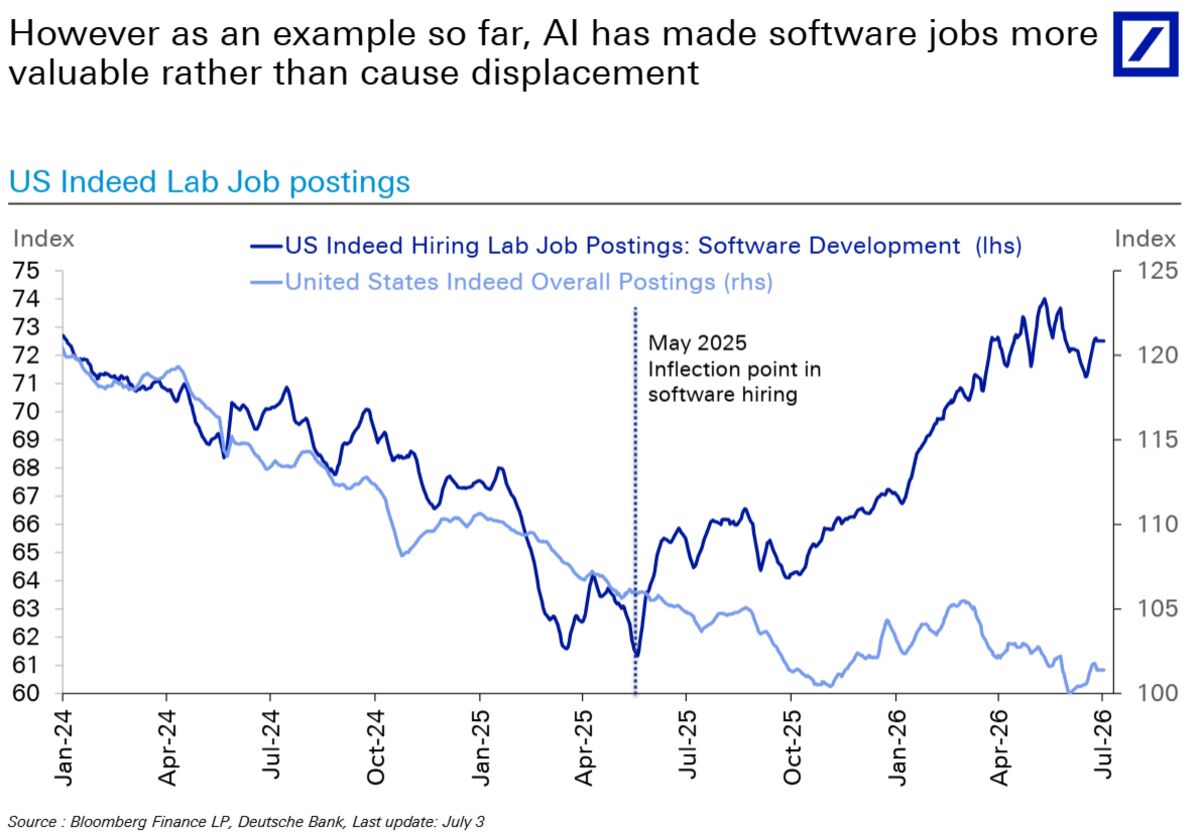
- Deutsche Bank economist Jim Reid says AI productivity gains are likely but will take years to show up broadly.
- Reid links delayed benefits to the time businesses need to integrate AI into operations.
- He argues that historical innovation patterns suggest technology can ultimately create more jobs.
- Sources say investors are monitoring AI infrastructure spending and semiconductor stock performance.
- Reid acknowledges potential risks and uncertainty, but focuses on a longer-term outlook.
Jim Reid was optimistic on AI’s ability to transform the economy, but suggested its benefits were not yet guaranteed.
1 month agoJim Reid of Deutsche Bank sees AI boosting productivity significantly over time. He believes historical innovation shows technology ultimately creates more jobs. Businesses will need years to fully integrate AI for maximum benefits. Investors are watching AI infrastructure spending and semiconductor stock performance. Reid acknowledges potential market risks but points to long-term human innovation.
1 month ago'My view on AI and jobs is slightly skewed by what economic history tells us,' he said.
1 month agoArtificial intelligence is likely to enhance productivity signficantly but any such impact on economies may still be years away, Deutsche Bank analyst Jim Reid said.
1 month ago
Walmart begins rolling out tap-to-pay, adding Apple Pay and Google Pay nationwide
Walmart says it will add tap-to-pay support, including Apple Pay and Google Pay, at checkout. The rollout starts at sele...

Tesla recalls nearly 3 million vehicles in China over door-handle and monitoring issues
Tesla is voluntarily recalling nearly 3 million vehicles in China due to concerns about door-handle safety, with the iss...

Google Health app version 5.07 rolls out with improved manual workout logging
Google is rolling out Google Health app version 5.07 on Android and iOS, updating features related to workout tracking a...