


Australia and India sign a uranium supply agreement during Prime Minister Narendra Modi’s visit to Melbourne. Multiple outlets describe the deal as landmark and the outcome of more than a decade of discussions between the two countries. The agreement is positioned as supporting India’s nuclear power plans for electricity generation. Reports state that uranium from Australia will be exported to India under the terms of the agreement, though the articles provided do not give specific figures on the value, quantities, or contract timelines. Deutsche Welle and Al Jazeera add context on India’s broader nuclear energy goals, including a long-term target of expanding nuclear capacity by 2047. Bloomberg also frames the announcement within the wider expansion of India’s Indo-Pacific partnerships, noting that the uranium agreement follows other cooperation, including defense agreements in the region. Overall, the sources agree on the core point: the two nations reach and formalize an uranium export deal during Modi’s visit to Melbourne.
Australia agrees to sell uranium to India in deal signed during Modi’s Melbourne visit
Australia and India sign a uranium supply agreement during Prime Minister Narendra Modi’s visit to Melbourne. Multiple outlets describe the deal as landmark and the outcome of more than a decade of di...
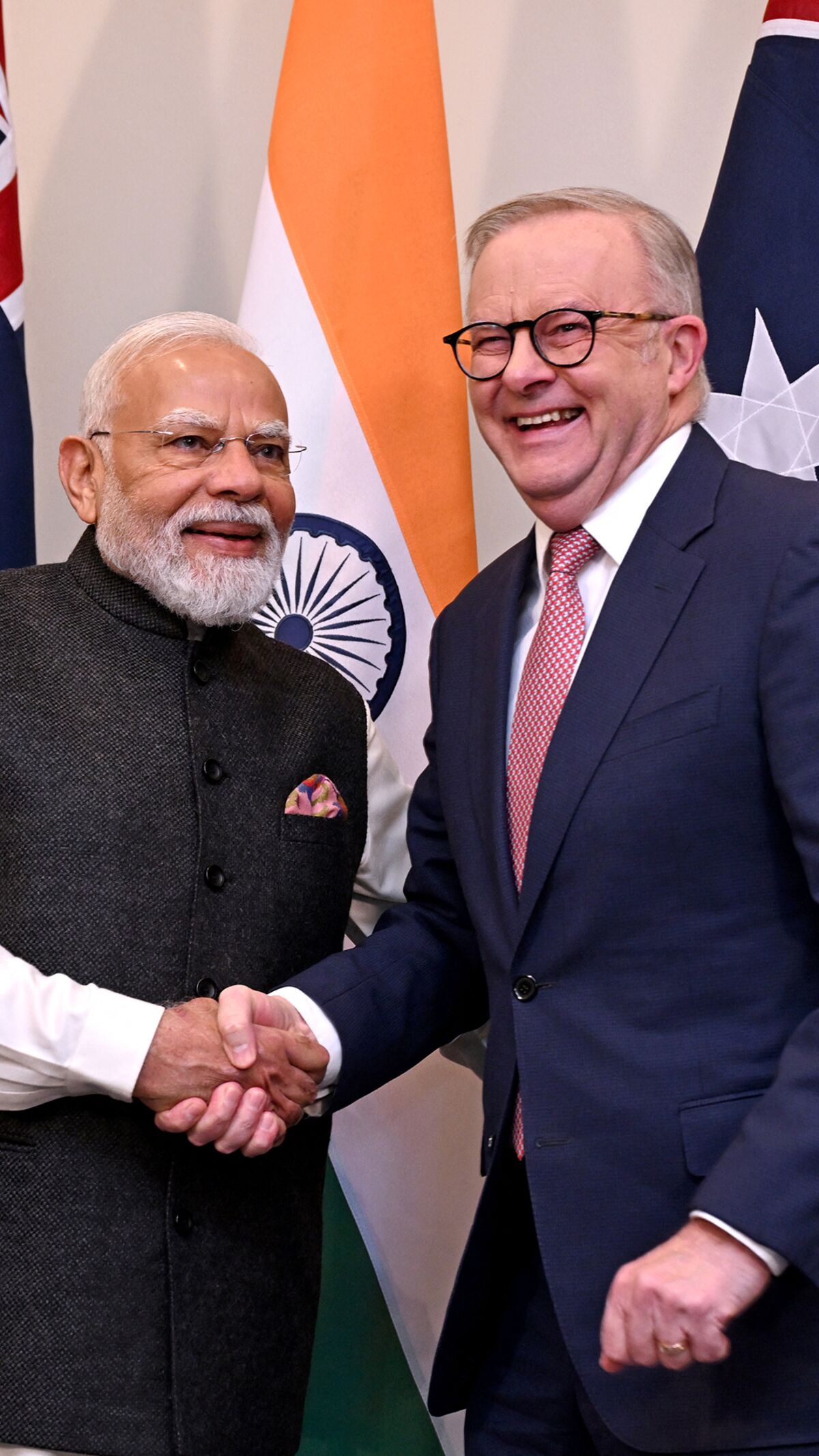
- Australia and India sign a uranium supply/export deal during Prime Minister Narendra Modi’s visit to Melbourne.
- The agreement is described as a landmark deal reached after more than a decade of talks.
- The uranium is intended for use in India’s power generation and supports India’s nuclear energy expansion plans.
- Several outlets cite India’s long-term nuclear capacity target for 2047 as part of the motivation.
- One report links the uranium deal to broader strengthening of Indo-Pacific partnerships, alongside other regional agreements.
The centrepiece of the visit was a fresh push on uranium exports to India, an idea first floated under the 2015 civil nuclear agreement but which failed to gain real traction after an earlier attempt in 2010.
1 month agoLeaders agree to deepen cooperation in clean energy, critical minerals and green hydrogen
1 month agoAustralia has agreed to supply uranium to India after more than a decade of talks, during Prime Minister Narendra Modi's visit to Melbourne. The deal follows defense agreements in Indonesia as India deepens its Indo-Pacific partnerships. (Source: Bloomberg)
1 month agoA major diplomatic and energy bottleneck got cleared on Thursday after Prime Minister Narendra Modi and Australian counterpart Anthony Albanese announced the finalisation of administrative arrangements to fully operationalise commercial-scale uranium exports from Australia to India.This development, during Prime Minister Modi's historic State visit to Australia, breathes life into a bilateral civil nuclear agreement originally signed in 2014 establishing a secure supply pipeline of nuclear fuel from the nation holding the world’s largest uranium reserves to the world's most populous country hungry for clean electricity.What Is the agreement and what was just decided?The core of this breakthrough is the finalisation of the specific administrative procedures required to implement the 2014 India-Australia Civil Nuclear Cooperation Agreement. While the overarching political framework has been technically active for a decade, it lacked the granular bureaucratic plumbing needed to start routine, large-scale commercial shipping. Meeting at Government House in Melbourne for the third India-Australia Annual Summit, the two leaders officially signed the Administrative Arrangement to clear these regulatory hurdles.Held wide-ranging discussions with Prime Minister Albanese in Melbourne this afternoon. The India-Australia Comprehensive Strategic Partnership of 2022 has continuously expanded the scope of our cooperation. We have now decided to accelerate work on the Comprehensive Economic… pic.twitter.com/484H9hi6Pf— Narendra Modi (@narendramodi) July 9, 2026 The newly finalised administrative arrangements provide the precise auditing and tracking mechanisms needed to safely move Australian uranium into Indian reactors. Beyond nuclear fuel, this updated partnership expands into broader energy security, covering critical minerals like lithium and cobalt, defence logistics and even the construction of a temporary space tracking terminal on Australia's Cocos Keeling Islands to assist Indian space flights. The two nations are utilising the dialogue to bolster their wide-ranging Comprehensive Strategic Partnership across the fields of maritime safety, counter-terrorism and bilateral investment.Who is involved in the deal?The agreement is a state-to-state pact spearheaded by Prime Minister Modi and Prime Minister Albanese. Prime Minister Albanese highlighted the strength of the bond during the Melbourne summit, describing the two countries as close partners and even closer friends.Two critical regulatory and oversight bodies ensure the deal functions legally. The International Atomic Energy Agency acts as the third-party auditor ensuring all Australian uranium transferred to India remains strictly under global nuclear safeguards. On the domestic front, the Australian Parliament previously had to pass the Civil Nuclear Transfer to India Bill to create the legal exception required to ship uranium to a country that operates outside the Nuclear Non-Proliferation Treaty framework. Additionally, the joint statement revealed that Australia expressed strong support for India's future membership in the Nuclear Suppliers Group, an elite international body that controls the export of nuclear materials.Why this nuclear deal is happening nowFor India, the driver is an immense appetite for electricity coupled with aggressive decarbonisation goals. New Delhi has set a massive target of reaching 100 gigawatts of nuclear energy capacity by 2047 to break its heavy reliance on coal and provide fresh momentum to its clean energy objectives. To power this rapid expansion, India desperately needs stable, predictable upstream suppliers of uranium fuel. For Australia, which holds roughly 28 per cent of the world’s known uranium resources, the deal opens up a vast, guaranteed commercial market for its domestic resources sector while helping its partner increase the overall share of non-fossil fuel power capacity.Addressing the joint press meet with PM Albanese.@AlboMP https://t.co/CZ96A4au2x— Narendra Modi (@narendramodi) July 9, 2026 Beyond economics, both countries are pushed together by geopolitical forces. Over the last decade, New Delhi and Canberra have steadily grown closer through the Quad framework alongside Japan and the United States. Both nations share deep anxieties over Beijing's rising military and economic assertiveness in the Indo-Pacific, driving them to build resilient trusted supply chains outside of China's sphere of influence.How the nuclear relationship transformed over timeThe journey to this point marks one of the most drastic turnarounds in modern diplomacy, moving across four distinct eras over the last three decades. Relations hit an all-time low during the deep freeze between 1998 and 2007. Following India’s Pokhran-II nuclear tests in 1998, Australia reacted sharply by slapping immediate diplomatic sanctions on New Delhi and banning all uranium exports due to India operating outside the traditional non-proliferation framework.The relationship entered a thaw period between 2007 and 2012 sparked by the landmark 2008 India-US Civil Nuclear Deal and a subsequent Nuclear Suppliers' Group waiver that recognised India’s clean non-proliferation record. After internal party debates, former Australian prime minister Julia Gillard officially dropped Australia's export ban to align with international exemptions.This paved the way for the structural framework era between 2014 and 2017, when Prime Ministers Tony Abbott and Narendra Modi signed the historic civil nuclear agreement. The pact entered into force in 2015, and the Australian Parliament cleared domestic legal hurdles in late 2016, resulting in a minute, symbolic token shipment of uranium in 2017 to test the pipe infrastructure. Finally, the July 2026 breakthrough in Melbourne resolved nearly a decade of commercial gridlock over intense regulatory tracking requirements, opening the doors for regular shipments.
1 month agoIndia has long eyed Australia's uranium to help meet a target of 100 gigawatts of nuclear energy capacity by 2047.
1 month ago
Gunfire in Niamey as Niger presidential guard repels alleged internal insurgent attempt
Gunfire erupts in Niamey as Niger’s presidential guard repels an alleged attempt by “insurgents within the armed forces”...

Israeli forces and settlers kill four Palestinians in Tel near Nablus amid renewed West Bank attacks
Israeli settlers and troops kill four Palestinians during an attack on the village of Tel, southwest of Nablus, on 24 Ju...
One Nation claims victory in Secret Harbour by-election, threatening Labor’s hold
One Nation is claiming victory in the Secret Harbour by-election in southern Perth, with results tightening as last-minu...