


NASA’s James Webb Space Telescope discovers and characterizes “little red dots” (LRDs), extremely distant and compact red sources first identified in 2022. Astronomers are trying to determine what these objects are. One leading idea is that LRDs could be supermassive black holes in an active state, but observations do not yet settle the issue. New analysis focuses on “family tree” relationships among LRDs and how they might evolve over time, aiming to connect their properties to possible stages of black hole growth or activity. Phys.org reports that researchers consider the possibility that LRDs may represent a temporary phase in the life of a supermassive black hole, rather than a single, permanent type of object. Both sources emphasize that the nature of LRDs remains uncertain and that explaining their observed colors and compact appearance requires further study. The current work uses Webb data to test competing interpretations and to improve understanding of how distant black holes and their surroundings may produce these distinctive signals.
NASA Webb studies ‘little red dots,’ exploring whether they are temporary black hole phases
NASA’s James Webb Space Telescope discovers and characterizes “little red dots” (LRDs), extremely distant and compact red sources first identified in 2022. Astronomers are trying to determine what the...
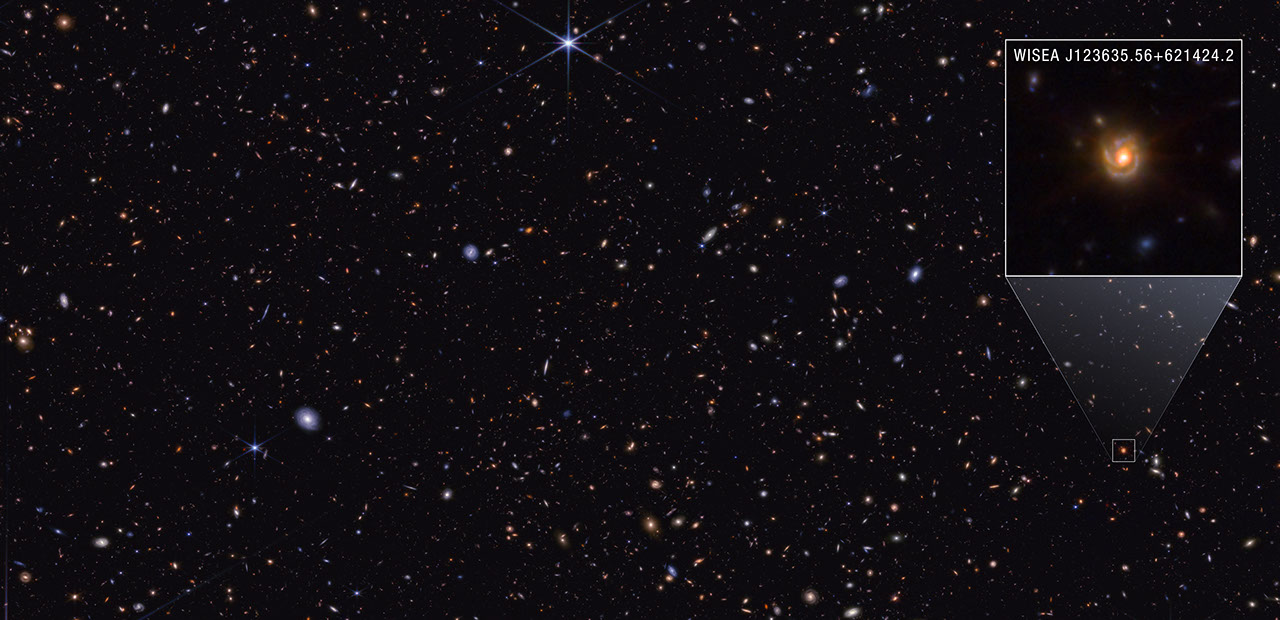
- Little red dots (LRDs) are extremely distant, compact red sources first identified with NASA’s James Webb Space Telescope in 2022.
- Astronomers are investigating what LRDs are and why they appear as small red sources.
- One prominent hypothesis is that LRDs are supermassive black holes in an active state.
- Researchers are exploring whether LRDs could correspond to a temporary phase of black hole activity or evolution.
- Further analysis of Webb observations is ongoing to distinguish between competing explanations.
Since their discovery by NASA's James Webb Space Telescope in 2022, little red dots (LRDs) have been the subject of great interest to astronomers. Understanding the nature of these extremely distant, compact red sources has been a puzzling scientific endeavor.
3 hours agoSince their discovery by NASA’s James Webb Space Telescope in 2022, little red dots (LRDs) have been the subject of great interest to astronomers. Understanding the nature of these extremely distant, compact red sources has been a puzzling scientific endeavor. One popular theory is that little red dots are supermassive black holes known as active […]
8 hours ago
Genesis announces U.S. pricing and specs for 2027 GV60 Magma
Genesis announces U.S. pricing for the 2027 GV60 Magma, the brand’s first high-performance “Magma” model. According to t...

Scotland win eight medals in five hours as Glasgow Commonwealth Games pass halfway
Scotland win eight medals within five hours on Wednesday as the Glasgow 2026 Commonwealth Games pass the halfway point....

France orders expulsion of Russian journalist Xenia Fedorova over alleged Kremlin propaganda
France orders Russian journalist and media commentator Xenia Fedorova to leave the country, the French interior ministry...