


The United States economy expands at a 1.5% annualised pace in the second quarter, according to the Commerce Department’s Bureau of Economic Analysis advance estimate released on Thursday. Growth slows from 2.1% annualised in the first quarter. The reports describe a mixed picture: consumer spending accelerates sharply, while external trade and inventories reduce the headline result. Consumer expenditures, which account for more than two-thirds of activity, rise at a 3.2% annualised rate after growing 0.5% in the previous quarter. Business investment also remains strong, supported by continued spending on artificial intelligence-related infrastructure and equipment, including industrial and transportation categories. Offsetting these gains, imports increase and subtract from GDP, with the trade deficit widening contributing to slower overall growth. Inventories also lower GDP in the quarter, according to one account. Inflation is still above the Federal Reserve’s target but shows signs of easing: the PCE price index rises 3.7% year-on-year in June, while core PCE is 3.3%. The Federal Reserve holds its benchmark interest rate steady for a fifth consecutive meeting, while some policymakers prefer a rate hike and economists look to possible further tightening later in the year.
US GDP grows 1.5% in Q2 as consumer spending rises but trade deficit drags
The United States economy expands at a 1.5% annualised pace in the second quarter, according to the Commerce Department’s Bureau of Economic Analysis advance estimate released on Thursday. Growth slow...
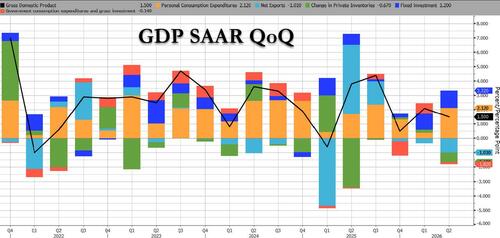
- US GDP increases at a 1.5% annualised pace in the second quarter, slowing from 2.1% in the first quarter.
- Consumer spending accelerates to a 3.2% annualised rate, supporting growth.
- Business investment remains strong, including spending tied to artificial intelligence infrastructure and equipment.
- The widening trade deficit and higher imports subtract from GDP, dragging on overall growth.
- Inflation measured by the Fed’s preferred PCE gauge eases but remains above target; the Federal Reserve keeps its interest rate unchanged.
US Grows Only 1.5% In Q2, Badly Missing Estimates, Despite Strong Spending, Investment The US economy grew at a far weaker than expected pace in the second quarter despite a pickup in consumer spending and solid business investment. According to the BEA, GDP (inflation adjusted) rose just 1.5% in the period, according to the first estimate issued Thursday by the Bureau of Economic Analysis. This was well below the 2.0% median estimate. The contributors to the increase in real GDP in the second quarter were increases in consumer spending, investment, and exports that were partly offset by a decrease in government spending. A decline in volatile net exports masked strength in underlying demand as imports, which are a subtraction in the calculation of GDP, increased. Consumer spending, which comprises about two-thirds of economic activity, rose at a 3.2% rate. Business investment continued to boom amid a debt-fueled rush to invest in artificial intelligence. A closer look at the underlying data: Business investment remained a key driver of growth in the second quarter. The massive AI investment push continued to play a critical role as did demand for industrial and transportation equipment. After the Fed decided to keep interest rates unchanged on Wednesday, Chairman Kevin Warsh described the economy’s resilience as “impressive” but noted its “most striking” feature is the strength of business investment. The GDP report showed nonresidential fixed investment rose at an 8.4% pace. Investment in industrial equipment surged by the most since 2011, and outlays for transportation equipment jumped by the most in two years. Information processing equipment and software outlays rose at a strong, albeit slower rate. Net exports subtracted a percentage point from the calculation of GDP in the second quarter. That likely reflected a mix of factors, including efforts to get goods into the country before a new wave of tariffs and the rapid pace of capital investment. Inventories stripped an additional 0.67% from GDP, suggesting many businesses drew down their inventories during the war. Federal government outlays declined, reflecting sales of crude oil from the Strategic Petroleum Reserve, according to the report. But because sales of the oil are reflected in other components of GDP, there is “no direct effect” on GDP. Even so, spending on national defense increased amid the war with Iran. Meanwhile, the strength in household outlays was fueled by spending on durable goods like furnishings and motor vehicles. Within services, consumers ramped up outlays on discretionary categories like recreation and food services and accommodation. Because swings in trade can distort GDP, economists pay close attention to a narrower metric of underlying demand known as final sales to private domestic purchasers that excludes net exports, changes in inventories and government spending. This measure climbed 3.9% in the second quarter, more than double the first quarter pace and the strongest since early 2023. As Bloomberg notes, the latest data highlight an economy that’s so far powering through the fallout of the Iran war, while getting the benefit of a historic credit-fueled spending spree behind AI spending. While the conflict has pushed prices higher and weighed on sentiment, a slide in gasoline costs at the end of the quarter alongside higher-than-usual tax refunds and sales promotions helped support household spending. As reported earlier, more up to date data released on Thursday showed inflation-adjusted consumer spending climbed a robust 0.4% in June, matching the strongest since July 2025. The Federal Reserve’s preferred measure of inflation - the personal consumption expenditures price index - fell 0.1% last month. Excluding food and energy, the index rose less than forecast. Looking ahead, Bloomberg notes that the recent flare-up in the Middle East and President Donald Trump’s new tariffs underscore the uncertainty around the outlook. Though the US central bank opted to keep rates unchanged on Wednesday, three policymakers voted to raise borrowing costs amid above-target inflation. But with layoffs limited, economists generally expect consumer spending to stabilize in the second half of the year. Executives at companies like JPMorgan Chase & Co. and Levi Strauss & Co. have underscored shoppers’ resilience, even as some like PepsiCo Inc. and General Mills Inc. have noted that Americans are growing more discerning in their spending. Tyler Durden Thu, 07/30/2026 - 10:00
4 hours agoThe US economy expanded at a slower-than-expected annualised pace of 1.5% in the April-June quarter, as a widening trade deficit weighed on growth despite strong consumer spending and continued investment in artificial intelligence-related infrastructure, according to data released by the Commerce Department on Thursday.The advance estimate from the Commerce Department's Bureau of Economic Analysis showed gross domestic product (GDP) slowed from a 2.1% annualised growth rate in the first quarter.Economists polled by Reuters had expected the economy to grow at a 2.1% pace.Also Read: The US is making the most fuel since pre-covid. It’s not enough.Consumer spending, which accounts for more than two-thirds of US economic activity, accelerated sharply, rising at a 3.2% annualised rate after growing just 0.5% in the January-March quarter, offering support to overall economic activity.Reuters reported that the resilience in consumer spending was supported by larger tax refunds this year, higher spending by wealthier households benefiting from gains in asset prices, and spending related to the recently concluded FIFA World Cup as well as the US midterm election campaign.Business investment also remained strong. According to AP, business investment excluding housing increased at an 8.4% annual pace, reflecting continued spending on artificial intelligence infrastructure, although it moderated from the 10.6% growth recorded in the previous quarter.Also Read: US trade deficit narrows, exports hit five-month low Imports, however, acted as a major drag on growth. It surged 11.5% during the quarter, driven partly by shipments of computer chips and other products supporting AI investment. Since imports are deducted while calculating GDP, they shaved 1.5 percentage points off second-quarter growth.Reuters noted that economists revised down their GDP estimates after June data showed only a moderate contraction in the goods trade deficit and unchanged retail inventories, with some lowering their forecasts to as little as 1.5%.Inflation showed signs of easing but remained above the Federal Reserve's target. The personal consumption expenditures (PCE) price index — the Fed's preferred inflation gauge — rose 3.7% in June from a year earlier, easing from 4.1% in May. Core PCE inflation, which excludes food and energy, stood at 3.3%, compared with 3.4% in May.The Federal Reserve on Wednesday kept its benchmark interest rate unchanged at 3.50%-3.75% for the fifth consecutive meeting. Reuters reported that three members of the central bank's policy-setting committee dissented and "preferred" a quarter-percentage-point hike.In its policy statement, the Fed said economic activity was "expanding at a solid pace despite elevated uncertainty that owes, in part, to the conflict in the Middle East."Reuters reported that economists expect the Fed to resume raising interest rates as early as September to contain inflation, while warning that the prolonged US-Iran conflict could weigh on demand and economic growth later this year as higher fuel prices pressure household budgets.US economy has remained more resilient than expected despite the Iran conflict and elevated energy prices, supported by an improving labour market, AP said in a report. Employers have added an average of 92,000 jobs a month this year, compared with fewer than 10,000 a month in 2025.However, households continue to face pressure from elevated prices. Reuters reported that with wages barely keeping pace with inflation, many consumers have relied on savings to sustain spending, a trend economists cautioned may not be sustainable over the longer term.(With inputs from Agencies)
5 hours agoUS economic growth slowed in the second quarter amid a widening in the trade deficit, but an acceleration in consumer spending and robust business investment in equipment related to the buildout of artificial intelligence infrastructure pointed to underlying strength. Gross domestic product increased at a 1.5 per cent annualised rate last quarter, the Commerce Department’s Bureau of Economic Analysis said in its advance estimate of second-quarter GDP on Thursday. Economists polled by Reuters...
5 hours ago
Jersey Mike’s seeks up to $1.09 billion in IPO as roadshow begins
Jersey Mike’s Subs Inc. and its shareholders are pursuing an initial public offering that could raise up to $1.09 billio...

US sanctions entities supporting Iran’s Mahan Air in multiple countries
The United States issues new Iran-related sanctions targeting what it describes as global support networks for Mahan Air...

Assam floods kill dozens as hundreds of thousands remain affected, relief and damage assessment continue
Floods in Assam are affecting multiple districts, with death tolls reported as rising over successive days and then stab...