


Scientists using the National Science Foundation’s Daniel K. Inouye Solar Telescope in Maui, Hawaii, capture new high-resolution images of the sun’s surface. The observations show a detailed, “strange” and dynamic outer layer, including feathery patterns that ripple across the solar surface. Researchers note that it is dangerous to look directly at the sun without proper eye protection, but telescope imaging allows study of the sun’s visible features. The images were taken for calibration and to test the telescope’s performance limits. After reviewing the results, the team reports they achieved a resolution of the sun’s bright outer shell higher than in prior observations. The observed ripples are linked to instabilities in magnetized plasma, where plasma elements move past one another at different speeds. Sources describe this as similar to wave-like disturbances caused by flowing materials interacting, a phenomenon that has been seen on Earth and in images of other planets such as Jupiter and Saturn. Study co-authors say the effect has not previously been observed at comparable detail on the solar surface. The findings are reported as published in the journal Nature.
High-resolution images from Inouye Solar Telescope reveal new sun surface patterns
Scientists using the National Science Foundation’s Daniel K. Inouye Solar Telescope in Maui, Hawaii, capture new high-resolution images of the sun’s surface. The observations show a detailed, “strange...

- Researchers use the Daniel K. Inouye Solar Telescope, operated with support from the National Science Foundation, located on Maui, Hawaii.
- New telescope images reveal fine-scale, rippling, feathery patterns on the sun’s visible outer layer.
- The observations were initially intended for calibration and to test the telescope’s limits before analysis of the higher-resolution results.
- Scientists attribute the ripples to instabilities involving magnetized plasma moving at different speeds relative to each other.
- The findings are reported as published in the journal Nature.
An anonymous reader quotes a report from the Associated Press: Scientists have captured images of the sun's surface in the finest detail yet, revealing a strange and dynamic facade. It's dangerous to look directly at the sun without proper eye protection. But researchers were able to peek at its scorching surface with the help of the National Science Foundation's Daniel K. Inouye Solar Telescope, located on the island of Maui in Hawaii. Scientists originally took the images for a different reason: to fine-tune and test the limits of the telescope. But when they looked at the results, they realized they'd photographed the sun's bright outer shell at higher resolution than ever before. What's more, they saw strange feathery patterns rippling across the surface. "That reminds me of famous paintings, like the swirling skies in Van Gogh's Starry Night," said solar physicist Ruizhu Chen with Stanford University, who was not involved with the new research. Researchers saw ripples of instability on the sun's surface caused by bits of magnetized plasma moving past each other at different speeds -- similar to waves that stir when a gust of wind blows over water. It's a well-known phenomenon that guides how fluids move. This has been glimpsed on Earth and other planets like Jupiter and Saturn, but "it has not been observed ever at that level on the solar surface," according to study co-author Friedrich Woger with the National Solar Observatory. The findings were published Wednesday in the journal Nature. Read more of this story at Slashdot.
4 hours agoScientists have captured images of the sun’s surface in the finest detail yet, revealing a strange and dynamic facade. It is dangerous to look directly at the sun without proper eye protection. But researchers were able to peek at its scorching surface with the help of the National Science Foundation’s Daniel K. Inouye Solar Telescope, located on the island of Maui in Hawaii. Scientists originally took the images for a different reason: to fine-tune and test the limits of the telescope. But when...
15 hours ago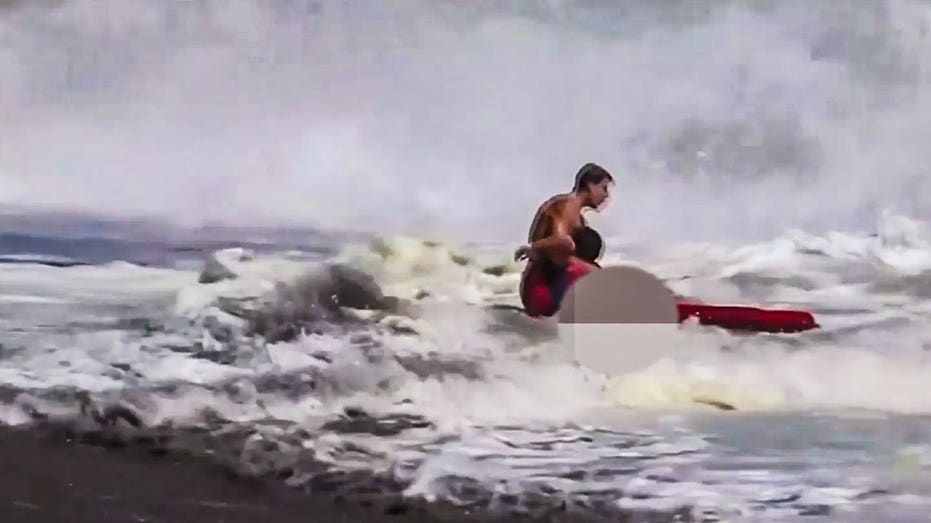
Teen lifeguard Ryder Williams describes dramatic Santa Cruz rescue of 10-year-old boy
Ryder Williams, a 16-year-old rookie lifeguard at Seabright Beach in Santa Cruz, California, is recounting details of a...

Study finds Apple Vision Pro helps surgeons perform some eye procedures faster
A peer-reviewed study from UC San Diego’s Shiley Eye Institute reports that surgeons using Apple Vision Pro as a wearabl...

Five more cheetahs collared in Hluhluwe-iMfolozi to strengthen conservation monitoring
Five additional cheetahs are fitted with tracking collars in Hluhluwe-iMfolozi Park as part of a conservation operation...