


NASA and Phys.org report that the Hubble Space Telescope has captured a new view of a galaxy cluster, showing many galaxies of different shapes and sizes concentrated toward the center-left of the image. The images also include several foreground stars that appear bright in the foreground. Because of how Hubble’s optics form images, those stars are marked by distinctive spikes extending outward from each point of light. The outlets describe these spikes as diffraction spikes, caused by the diffraction of light around the supports for Hubble’s secondary mirror. In the Phys.org coverage, the cluster is identified as MACS J1141.6-1905, linking the visual description to that specific target. NASA’s description focuses on the visual features of the scene—cluster member galaxies, foreground stars, and the diffraction artifacts produced by the telescope’s secondary mirror structure—without adding additional interpretation beyond how the features appear in the image. Both sources present the observation as an imaging result from Hubble, emphasizing the appearance of the cluster and the optical origin of the star spikes.
Hubble Space Telescope images galaxy cluster MACS J1141.6-1905
NASA and Phys.org report that the Hubble Space Telescope has captured a new view of a galaxy cluster, showing many galaxies of different shapes and sizes concentrated toward the center-left of the ima...
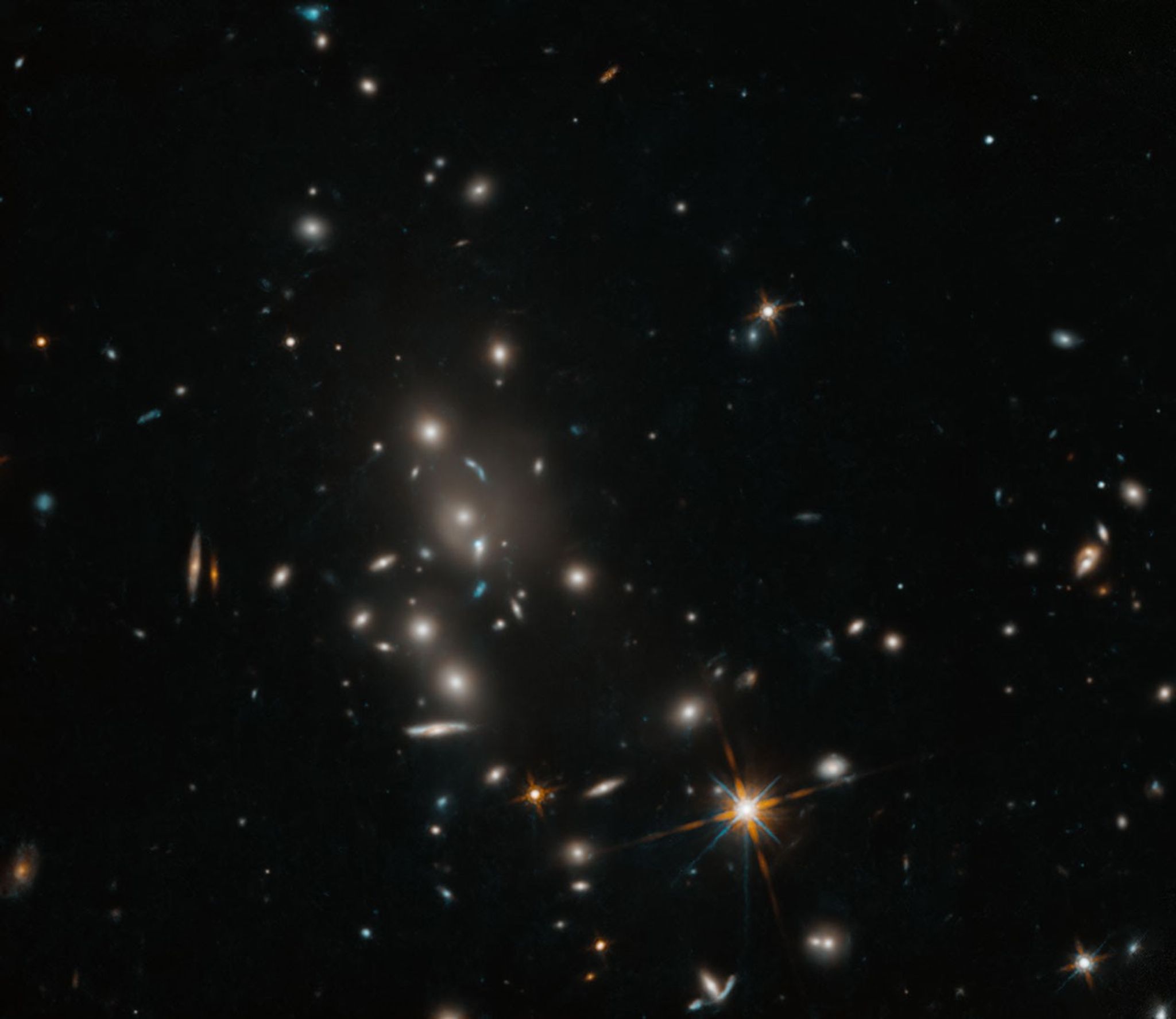
- Hubble Space Telescope images a galaxy cluster with many galaxies visible toward the center-left of the image.
- The cluster includes galaxies of various shapes and sizes.
- Several foreground stars appear bright in the image and show outward-pointing spikes.
- The spikes are identified as diffraction spikes caused by light diffracting around supports for Hubble’s secondary mirror.
- Phys.org identifies the target cluster as MACS J1141.6-1905.
Look closely at this image from NASA's Hubble Space Telescope and you'll see galaxies of various shapes and sizes clustered together toward the center-left of the image. A few foreground stars shine brightly and are easily distinguished by the spikes that appear to extend outward from each star. These spikes, called diffraction spikes, are the result of how point sources of light (such as stars) bend, or diffract, around the supports for Hubble's secondary mirror.
3 months agoLook closely at this image from NASA’s Hubble Space Telescope and you’ll see galaxies of various shapes and sizes clustered together toward the center-left of the image. A few foreground stars shine brightly and are easily distinguished by the spikes that appear to extend outward from each star. These spikes, called diffraction spikes, are the […]
3 months ago
Kidnapping cases rise above 4,600 as Gauteng reports South Africa’s highest total
Kidnapping remains a growing concern in South Africa, with 4,638 cases recorded between April and June 2026, according t...

Nepal floods overwhelm morgues as bodies wash up far downstream and identification continues
Flash floods in Nepal’s Rasuwa and Nuwakot districts keep producing new recoveries of bodies far downstream, straining h...

Trump signs order for first U.S. Space Academy; awards Congressional Medal to Artemis II crew
President Donald Trump signs an executive order establishing the first U.S. Space Academy and awards the Congressional S...