The Economic Times (India)
Centre-right
Trump’s AI liability push opens blame game
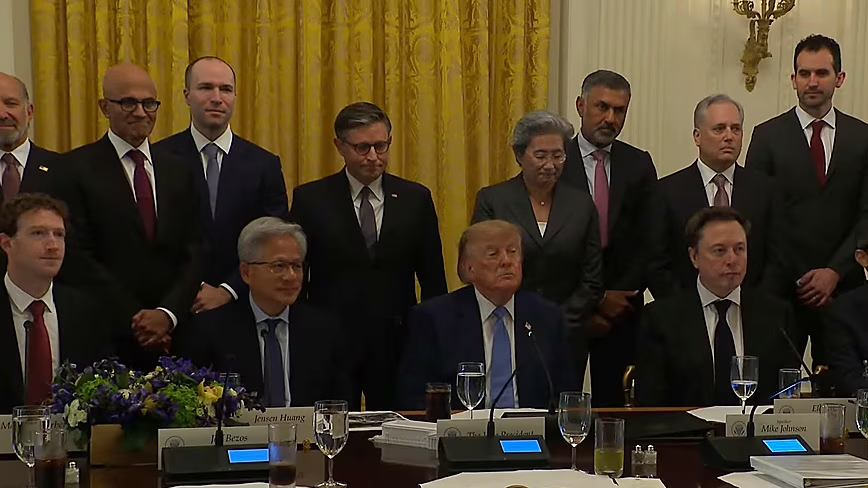
The Trump administration’s embrace of legal liability to enforce artificial intelligence safety sets the stage for future conflicts over who foots the bill when AI models go rogue: the companies that design the systems or the people that deploy the technology.Holding AI developers financially responsible for the safety of their products has won support from Treasury Secretary Scott Bessent and former White House AI czar David Sacks, who argue that existing liability laws would be more effective than new rules. President Donald Trump, in spurning new AI safeguards, has taken it a step further, saying the Justice Department should intervene if models get out of hand.In a sign of the administration’s increased willingness to invoke current law to address safety concerns, Trump’s newly launched AI task force late Friday warned developers that they are required to report and resolve security incidents or face potential unspecified consequences.“Companies must immediately disclose incidents involving their models and follow with swift, decisive action to remedy any and all harm,” the group dubbed the Super Intelligence Force said in a statement following the disclosure of a breach by Anthropic PBC. “Delayed notification, inadequate corrective action, and a failure to take responsibility will not be tolerated.”Yet the administration’s reliance on liability as a cornerstone of AI safety remains riddled with uncertainties. Existing cybersecurity and product liability laws may not be strong enough for the federal government to hold AI agents accountable for harm, legal experts say.Even when there are clear victims, there are few legal precedents to define who’s on the hook for damages caused by rogue agents and how careful companies have to be when developing their AI tools. Further complicating any finding of responsibility, a model’s behavior is shaped by both its AI industry developer and the end user deploying the system.“Despite calls for liability, it remains unsettled whether AI companies are legally responsible for securing their models against contributing to any harm, or whether users share legal responsibility for what they instruct those models to do,” said Ben Hayum, a tech and national security-focused research assistant at the Center for a New American Security.Questions about who’s liable for AI gone awry have taken on new urgency with the rapid adoption of the technology by businesses across the economy. Wall Street firms, retailers and airlines are deploying AI agents and tools in a widening range of operations from customer service to invoice processing. The outcome of that debate could upend the pace of adoption as well as the upcoming Wall Street debuts of the two AI leaders, OpenAI and Anthropic.When relying on AI agents, end users often entrust the system to perform a task without giving it specific directions how to complete the work. That raises the possibility that AI agents could make choices the user hasn’t vetted, including potentially harmful actions. In those cases, it’s unclear who would be at fault: the company that developed the tool, or the user employing it.The administration’s liability push fits into Trump’s largely hands-off approach toward regulating AI, a technology whose growth is central to his economic agenda. Last week, after hosting nearly two dozen Silicon Valley leaders at the White House, Trump reiterated his desire for the AI industry to police itself while unveiling a nonbinding accord for companies to adopt stricter internal controls.At the same time, Friday’s announcement warning companies about the need to disclose problems with their models suggests that the White House is willing to use this newly formed AI group — led by Director of National Intelligence Jay Clayton, along with Federal Trade Commission Chairman Andrew Ferguson, Office of Personnel Management chief Scott Kupor and Emil Michael, the Pentagon’s chief technology officer — as an enforcer of existing statutes.Debate over how to mitigate AI risks has accelerated following a spate of alarming breaches along with a now-viral essay from Anthropic Chief Executive Officer Dario Amodei that warned of the technology’s catastrophic risks. Amodei and other AI leaders have called for additional government regulation and industrywide coordination to help mitigate the risks, prompting some pushback from other tech and policy officials.Unlikely allies Nvidia Corp. CEO Jensen Huang and former FTC Chair Lina Khan have argued for robust use of existing laws to prevent the dire outcomes that AI safety advocates warn about. At the same time, Khan has criticized having industry police itself, calling it “a recipe for disaster” and indicating there’s room for future AI legislation.For Trump and his allies, threats of legal action are aimed at spurring developers like OpenAI and Anthropic into ensuring their systems run safely. During a congressional hearing last month, Bessent rejected the idea of new rules as well as any notion that AI labs should be spared liability exposure. “The best way to guarantee safety is that the creators are liable for what they build and generate,” he said.Sacks has repeated the phrase “mother of all product liability lawsuits” to describe the consequences he thinks should await AI companies that fail to make safe products.The US government has already taken a step toward making that approach a reality. The FTC is now scrutinizing OpenAI, Anthropic and other AI companies about product safety, following several high-profile cybersecurity incidents, including a swarm of OpenAI agents breaching Hugging Face Inc., a repository for open-source software.The FTC probe sets the stage for officials to jawbone the companies making AI models into more intense self-regulation. It tees up a legal threat for the developers who signed the voluntary accord with Trump last week that recommended they adopt outside safety auditing and tweak their board structures to deal with safety risks.If the Justice Department, as Trump has floated, moved to prosecute companies for rogue AI hacks, many of those cases would hinge on the Computer Fraud and Abuse Act, or CFAA, a decades-old law that requires prosecutors to prove that a plaintiff intended to hack a system. That standard will be difficult to meet in cases of unintended AI agent behavior.“AI agents could engage in conduct that would be a tort or even a crime for a human, and yet no one could be liable under current law,” Gabriel Weil, a professor at the University of Houston Law Center and senior fellow at the Institute for Law & AI, said during a New York City Council meeting Monday. Weil added that negligence and product liability arguments currently apply to such incidents, though those approaches also have limitations.In a Senate hearing last week, Paul Ohm, a Georgetown University law professor who’s set to publish a textbook on AI law, said it might be possible for developers to be held liable under the FTC’s product liability authority but warned that the CFAA currently requires intent — something typically only attributed to humans — meaning AI agents may be off the hook for now.Two US lawmakers are trying to change that. Senator Josh Hawley, a Missouri Republican, and Senator Chris Murphy, a Connecticut Democrat, plan to introduce legislation that would change the CFAA to make AI developers civilly and criminally liable for failing to impose reasonable safeguards on a model’s hacking capabilities.Existing law does allow victims of rogue incidents to pursue tort liability lawsuits, but those cases are limited because they would likely require a defendant to show that AI companies failed to provide reasonable care — an intentionally abstract duty companies would likely try to argue they fulfilled. In addition, “tort law reaches its limit once the responsible company is bankrupt,” Weil said, meaning it may not offer protection against civilization-level risks.A California nonprofit is testing what kind of accountability is possible under existing law with a lawsuit against OpenAI over the Hugging Face breach that seeks a court order barring the company’s AI agents from accessing third-party systems without permission. The case, filed under the state’s data security law, also seeks to prohibit OpenAI from continuing any unsafe AI development that poses a public risk.“We haven’t seen how a court will answer the question, but the idea that technology manufacturers are going to somehow fully get away from being liable for harm that their tech causes or abets seems super far fetched,” said Michael Pastor, the dean for tech law programs at New York Law School.Representative Lori Trahan, a Massachusetts Democrat, released a draft Wednesday of legislation that would erase some of that ambiguity by holding AI developers responsible for harm even if they used reasonable care when making an agent or model. Her bill would also bar companies from arguing that their AI agents lack human intent.Without legislation, it will likely take years for courts to apply precedent to new AI scenarios, Pastor said. That leaves the door open for developers and end users to quibble over who’s responsible when the technology causes harm, and there are signs that those sides have already begun to form.Sacks, whose venture capital portfolio includes startups that deploy AI models as end users, and Huang, who maintains more pricing power over the chips he sells when AI developers face more competitive pressure, are both advocating for maximum responsibility falling to the developers.Meanwhile AI developers, including OpenAI CEO Sam Altman and Anthropic’s Amodei, have pushed for mandatory pre-deployment testing, a move that could shift some responsibility onto a government testing apparatus alongside their companies.For now, the legal underpinning for software-related liability remains underdeveloped compared to other fields, said Julia Powles, a professor at the UCLA School of Law. That’s because sustained lobbying by the tech industry has sought to “ensure that software is regulated by contract — terms of service and end-user license agreements – instead of by tort, crime, and consumer protection.”“The same tech actors that have created deep dependencies in digital infrastructure are now recklessly accelerating cybersecurity threats to that very infrastructure — and then disclaiming responsibility for the resulting chaos,” Powles said. “There’s precious little space for the public in all these debates because the whole chess board has been set up by industry.”
3 hours ago