


Researchers report that bumblebees can use tools to solve a novel problem, suggesting flexible cognition rather than behavior driven only by instinct. The findings come from experiments adapted from a classic “box-and-banana” task first used about a century ago to show chimpanzees could figure out how to reach a reward by stacking boxes. In the new study, bees are presented with an artificial setup requiring two coordinated actions: they roll a polystyrene ball to a designated location and then climb onto it to reach an artificial flower positioned under a low ceiling. The work is presented as evidence that bees can generate a solution to a problem they have not been trained to perform, placing them among species previously documented to solve such tasks, including other animals such as primates, elephants, and crows. The research team emphasizes that the study does not claim bees think like humans; instead, it suggests that small nervous systems can still produce flexible solutions to new challenges. The study is published in the journal Science.
Study Finds Bumblebees Can Use Tools to Solve Novel Problems
Researchers report that bumblebees can use tools to solve a novel problem, suggesting flexible cognition rather than behavior driven only by instinct. The findings come from experiments adapted from a...

- Researchers report that bumblebees can use tools to solve a problem.
- The experiment is an adapted version of the classic “box-and-banana” task.
- Bees roll a polystyrene ball to a specific location and then climb on it to reach an artificial flower.
- The findings challenge the idea that insects rely only on instinct or trial-and-error learning.
- The study is published in the journal Science.
An anonymous reader quotes a report from The Guardian: Bumblebees can use tools to solve a problem, according to experiments that demonstrate their remarkably advanced cognitive abilities. The bees were given an adapted version of an experiment that, 100 years ago, first demonstrated chimpanzees could work out how to retrieve an out-of-reach banana by stacking boxes. Since then, various other primates, elephants and crows have joined an elite cohort of species known to be capable of this level of insight and spontaneous problem solving. In the latest research, bees were shown to be able to roll a polystyrene ball to a specific location and climb on to it in order to access an artificial flower on a low ceiling. The findings challenge the longstanding assumption that insects operate purely on instinct and mindless trial-and-error learning. "Most people think insects are reflex-based machines," said Dr Olli Loukola, a behavioral ecologist at the University of Oulu, Finland, and senior author. "That they can't have any emotional states or feel pain. Some people don't even realize that they have brains. I hope that these results change the worldview about that." "We are not claiming that bees think like humans," added Loukola. "But our findings show that miniature brains can generate flexible solutions to novel problems in ways we are only beginning to understand." The findings are published in the journal Science. Read more of this story at Slashdot.
2 months agoInsects join list of species capable of solving simple ‘box-and-banana’ problem that demonstrates basic intelligenceBumblebees can use tools to solve a problem, according to experiments that demonstrate their remarkably advanced cognitive abilities.The bees were given an adapted version of an experiment that, 100 years ago, first demonstrated chimpanzees could work out how to retrieve an out-of-reach banana by stacking boxes. Since then, various other primates, elephants and crows have joined an elite cohort of species known to be capable of this level of insight and spontaneous problem solving. Continue reading...
2 months ago
Kidnapping cases rise above 4,600 as Gauteng reports South Africa’s highest total
Kidnapping remains a growing concern in South Africa, with 4,638 cases recorded between April and June 2026, according t...
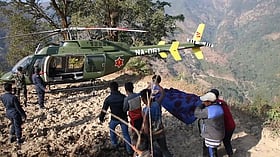
Nepal floods overwhelm morgues as bodies wash up far downstream and identification continues
Flash floods in Nepal’s Rasuwa and Nuwakot districts keep producing new recoveries of bodies far downstream, straining h...
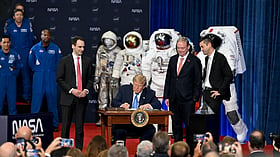
Trump signs order for first U.S. Space Academy; awards Congressional Medal to Artemis II crew
President Donald Trump signs an executive order establishing the first U.S. Space Academy and awards the Congressional S...