


Oracle reports stronger fiscal fourth-quarter results, but its stock drops after parts of its outlook disappoint. The company reports quarterly revenue of $19.18 billion, up 21% year over year and slightly above Wall Street’s estimate. Adjusted earnings per share also rise to $2.03–$2.11 (depending on the outlet’s presentation) and beat expectations. However, Oracle’s cloud performance comes in below estimates. Total cloud revenue is $9.91 billion, up 47% year over year but marginally under expectations, with cloud application (SaaS) revenue also missing. Analysts also focus on profitability risks tied to heavy infrastructure spending. Oracle’s remaining performance obligations (RPO) rise sharply to $638 billion, and Oracle attributes growth largely to large AI contracts that include customer prepayments for GPUs or customers supplying hardware. Even so, Oracle says it will raise about $40 billion in debt and equity financing in fiscal 2027, building on prior funding that totaled roughly $48 billion in fiscal 2026. Commentators cite rising capital expenditures and concerns about cash outflows as the company expands data-center capacity for cloud and AI workloads.
Oracle shares fall after cloud miss and plan to raise about $40 billion for data centers
Oracle reports stronger fiscal fourth-quarter results, but its stock drops after parts of its outlook disappoint. The company reports quarterly revenue of $19.18 billion, up 21% year over year and sli...
- Oracle reports fiscal fourth-quarter revenue of $19.18 billion, up 21% year over year, and slightly above Wall Street’s estimate.
- Oracle’s total cloud revenue of $9.91 billion grows year over year but misses analyst expectations; cloud application (SaaS) revenue also misses.
- Oracle’s remaining performance obligations (RPO) rise to $638 billion, and the company attributes much of the increase to large AI contracts with prepaid or customer-supplied GPU hardware.
- Oracle announces it expects to raise about $40 billion in combined debt and equity financing in fiscal 2027, including a previously disclosed at-the-market equity issuance.
- Oracle’s capital expenditures and related cash-outflow concerns are highlighted by investors as it builds AI data-center capacity.
Oracle Corporation reported increased revenue of 21% year-over-year (YOY) for its fiscal fourth quarter, but it wasn’t enough to please stockholders. The company’s shares (NYSE: ORCL) dropped over 10% during premarket, following Wednesday evening’s earnings report. At publication, shares were about 9% down. With $19.18 billion in revenue, Oracle beat Wall Street’s $19.10 billion estimate, according to a consensus cited by CNBC. Similarly, the company reported $2.03 adjusted earnings per share, up from a predicted $1.96 per share. However, Oracle missed Wall Street’s estimates for its Cloud revenue. At $9.91 billion, it made up 52% of the company’s overall quarterly revenue and was a 47% increase YOY. Analysts had expected $9.97 billion. Debt and equity financing Oracle also announced plans to raise about $40 billion in debt and equity financing in fiscal 2027. About $20 billion of that comes from a previously disclosed at-the-market equity issuance. It follows $48 billion raised in fiscal 2026 between the two avenues—a number the company doesn’t plan to further increase this year. “Importantly, these investments are being driven by committed customer demand, reflected in our record RPO [remaining performance obligations], giving us confidence in our long-term outlook as well as strong returns on the capital we’re deploying,” Oracle CFO Hilary Maxson said in a post-earnings call. “This demand is allowing us to garner customer prepayments and bring your own hardware at similar or better margins than the rest of our contracts.” Oracle’s RPO were up 363% YOY at $638 billion. The company credited the growth to “large scale AI contracts where the customer prepaid Oracle for the purchase of the GPUs, or the customer bought and supplied the GPUs to Oracle.” “The prepaid and customer supplied hardware portions of our large AI contracts now total $75 billion,” Oracle further stated in its earnings report. “This substantially reduces the amount of capital Oracle must raise to build out our AI datacenters.” Broader AI bubble fears have some analysts worried Yet, some investors still see risk in overfunding AI, with some analysts recently warning that the AI bubble could burst. Current trends are reminiscent of those during the dot-com bubble and subsequent market collapse in the early 2000s. At the end of May, the S&P 500 closed at a record high, but it was fueled by only 20 stocks hitting all time highs—13 of which were AI-related. Michael Hartnett at Bank of America pointed out that only 20 stocks also hit a high when the dot-com bubble was at its highest in March 2000, CNBC reports.
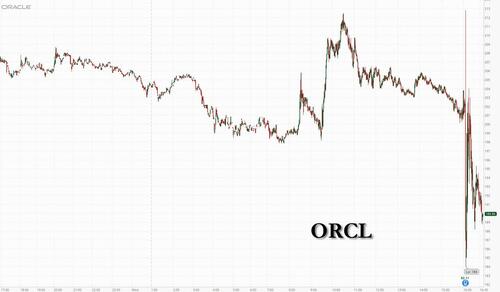
2 months agoOracle Tumbles After Mixed Results, Capex Comes In Hot; Warns Another $40BN Debt/Equity Capital Raise Coming With tech stocks cracking for a 3rd straight day, and with the broader market closing at the lows in a surprising sign of weakness, many were looking to ORCL to kickstart the AI euphoria which has been oddly missing in recent days (and which send NVDA stock briefly just below the key level of $200). Well, for those hoping that ORCL would be the much needed spark, they may be disappointed after ORCL stock pumped in kneejerk reaction (despite Q4 earnings that were mixed at best).... then dumped after the company announced it would be joining the circus of companies selling debt/equity to fund its runaway capex. Here is what ORCL reported for the just concluded fiscal Q4: Adjusted EPS $2.11 vs. $1.70 y/y, beating estimates of $1.97 Adjusted revenue $19.18 billion, +21% y/y, beating estimates of $19.09 billion The revenue breakdown was mixed at best, with ugly Software and SaaS prints offset by ok Infrastructure revenue" Cloud Infrastructure revenue (IaaS) $5.79 billion, +93% y/y, beating est $5.72 billion Cloud Infrastructure revenue (IaaS) in constant currency +92%, estimate +91.7% Cloud revenue (IaaS plus SaaS) $9.91 billion, +48% y/y, missing est $10 billion Cloud revenue (IaaS plus SaaS) in constant currency +46%, estimate +47.4% Cloud Application revenue (SaaS) $4.13 billion, +12% y/y, missing est $4.17 billion Cloud Application revenue (SaaS) in constant currency +10%, estimate +10.8% Software revenue $6.82 billion, -2.1% y/y, beating est of $6.88 billion Software Support revenue $4.94 billion, -0.4% y/y, estimate $4.98 billion Software License revenue $1.88 billion, -6.3% y/y, missing est $1.93 billion Hardware revenue $924 million, +8.7% y/y, beating est $836.2 million Service revenue $1.52 billion, +13% y/y, estimate $1.41 billion Going down the line: Adjusted operating income $8.59 billion, +22% y/y, beating est $8.27 billion Adjusted operating margin 45% vs. 44% y/y, beating est 43.5% As for ORCL's pride and joy, namely remaining performance obligations, or RPO backlog, it rose to $638 billion vs. $138 billion y/y. Good luck collecting on that. Looking at fiscal Q1 ahead, the company was quite cheerful of course: Total Revenues are expected to grow from 27% to 29% (in both constant currency and USD) Total Cloud revenue is expected to grow between 57% and 63% in constant currency and is expected to grow between 58% and 64% in USD. Non-GAAP earnings per share is expected to grow between 16% and 19% and be between $1.71 and $1.75 in constant currency and grow between 17% and 20% and be between $1.72 and $1.76 in USD. Looking at the full year fiscal 2027, the company reaffirmed its prior revenue guidance of $90 billion total revenue and raises its non-GAAP EPS guidance to $8.05, which is growth of 18%. As a reminder, AVGO imploded when it failed to raise its full-year guidance last week. Well, ORCL also failed to do so, likely disappointing the market. And indeed, according to a kneejerk take by Vital Knowledge, “The fact the F27 sales guide isn’t being raised is a disappointment.” It also writes that “this is an OK release with continued robust growth in backlog (RPOs), and the cash performance wasn’t as bad as feared,” but that the company “is still facing a period of heavy cash outflows as it builds the infrastructure needed to fulfill its backlog, and this will require more debt and equity.” And to that point, here is the kicker that sent the stock sliding after hours. But before we get there, one more point - ORCL said that free cash flow was negative $23.7 billion for fiscal year 2026 as "Oracle continued to execute on investments to support the growth of its Cloud Infrastructure business." As Bloomberg notes, Oracle's quarterly CapEx was higher than estimates, raising investor concerns about the profitability of the company’s AI infrastructure business. Capital expenditures, largely a measure of data center spending, were $15.9 billion in the period ended May 31, bringing the annual total to $55.7 billion, higher than Oracle’s projection for $50 billion in spending. The company didn’t offer an outlook on its spending in the new fiscal year. Wall Street expects $61.7 billion in capital spending in the year ending in May 2027. Which of course means that the company's free cash flow meltdown is only accelerating, and the only way ORCL can fund its staggering buildout - since it doesn't have nearly enough revenue and profit - is with even more equity and/or debt. $40 billion to be precise: "In fiscal year 2027, Oracle expects to raise approximately $40 billion through a combination of debt and equity financing including its previously announced $20 billion at-the-market equity issuance. Oracle does not expect to issue additional debt in calendar year 2026" The coming dilution follows the $43 billion in debt and $5 billion in equity raised in 2026 as part of the company's pivot away from database software to a provider of computing power for artificial intelligence work, which means it is embarking on a massive build-out of data centers for OpenAI and other customers. Alas, said pivot costs lots of money, in fact more than the company said just three months ago, and the stock is not happy, sliding more than 5% in afterhours trading after closing at $201.26. The company’s stock had climbed 35% over the past three months, likely driven by better investor sentiment toward computing providers and OpenAI, Oracle’s most important customer, wrote Derrick Wood, an analyst at TD Cowen. Tyler Durden Wed, 06/10/2026 - 16:55
2 months ago
Visa expands cybersecurity support for clients as organisations adopt AI
Visa is expanding its support for clients and the payments industry as organisations navigate an increasingly AI-driven...

OpenAI ends Cursor partnership after SpaceX acquisition, citing terms-of-service concerns
OpenAI says it will end its partnership with AI-coding platform Cursor after SpaceX completes its acquisition of Cursor....

OpenAI appoints Meta executive Sandhya Devanathan to lead Southeast Asia and Australia
OpenAI hires Sandhya Devanathan, a longtime executive at Meta Platforms, to lead its operations in Southeast Asia and Au...