


The Milky Way’s galactic bulge—a dense, bulb-like region surrounding the galaxy’s center—hosts large numbers of stars, planets, and other free-floating objects. For decades, astronomers study this region using both ground-based and space-based telescopes, including NASA’s Hubble and James Webb observatories. New results from a Hubble survey are used to set up future observations planned with NASA’s Nancy Grace Roman Space Telescope, which will also target the area near the Milky Way’s center. The goal of the survey planning is to provide a foundation for Roman’s upcoming view of the bulge, leveraging Hubble’s capabilities and prior measurements to guide what Roman will observe. By combining earlier observations with Roman’s future wide-field perspective, researchers aim to deepen understanding of the bulge’s stellar population and the objects within it. Both outlets emphasize that the bulge has been a key target of astronomical study and that Hubble’s survey data will inform Roman’s next look at this crowded region.
Hubble survey prepares NASA’s Roman Space Telescope observations of Milky Way’s galactic bulge
The Milky Way’s galactic bulge—a dense, bulb-like region surrounding the galaxy’s center—hosts large numbers of stars, planets, and other free-floating objects. For decades, astronomers study this reg...
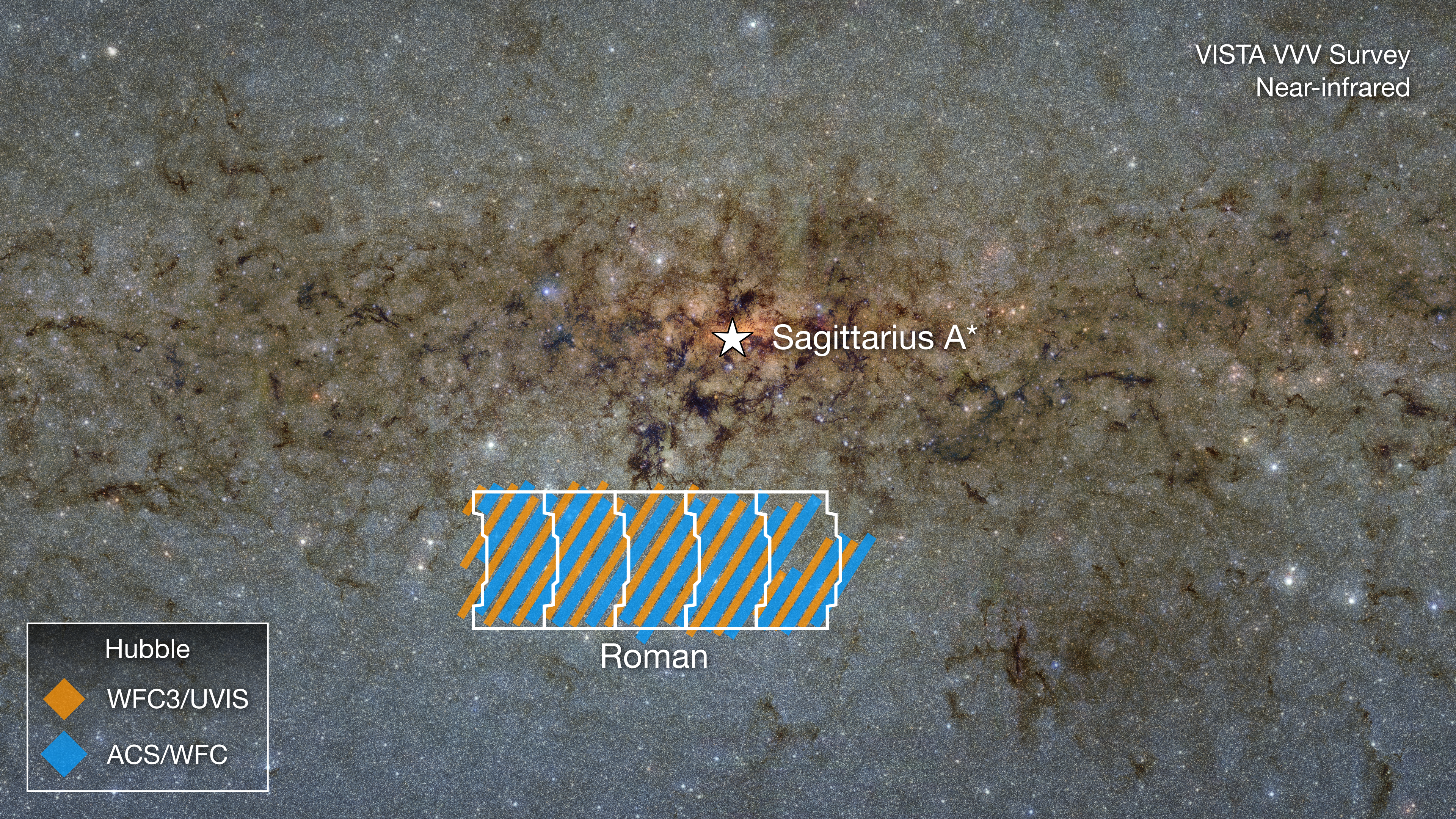
- The Milky Way’s galactic bulge lies around the galaxy’s center and contains many stars and other objects.
- The bulge has been studied for decades using both ground-based and space-based telescopes.
- NASA’s Hubble and James Webb have both observed the galactic bulge.
- The Hubble survey is used to prepare for future observations by NASA’s Nancy Grace Roman Space Telescope.
- Roman’s upcoming observations will focus on the region near the Milky Way’s center.
The Milky Way's galactic bulge, the bulbous region that surrounds the galactic center, contains a dense collection of stars, planets, and other free-floating objects. This region has been studied for decades with numerous ground-based and space-based telescopes, including NASA's Hubble and James Webb space telescopes.
3 months agoThe Milky Way’s galactic bulge, the bulbous region that surrounds the galactic center, contains a dense collection of stars, planets, and other free-floating objects. This region has been studied for decades with numerous ground-based and space-based telescopes, including NASA’s Hubble and James Webb space telescopes. Soon, NASA’s Nancy Grace Roman Space Telescope will be the […]
3 months ago
Chandigarh University researchers patent device to reuse kitchen wastewater amid water crisis
Chandigarh University biotechnology researchers have received a patent for an innovative device designed to reuse kitche...

Satellite images trace Nepal–China border flooding after glacier and bedrock collapse
A catastrophic flood hits areas along the Nepal–China border, and rescue teams search for people reported missing. Satel...

Scientists investigate whether a herpes virus is linked to sardine mass deaths off South Africa
Scientists in South Africa are investigating whether a herpes virus could be behind the mass deaths of sardines reported...