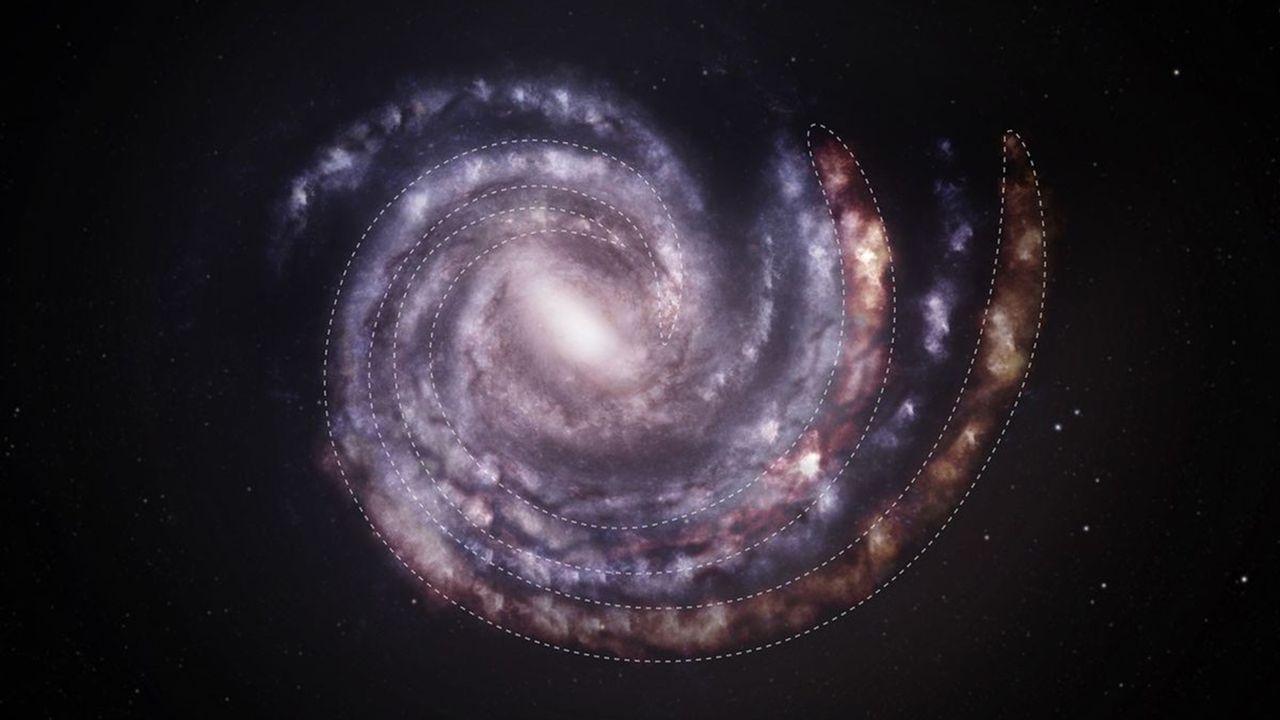
Astronomers are re-evaluating estimates of the Milky Way’s overall size and mass as new measurements indicate that parts of the galaxy extend farther than once thought. Multiple reports focus on revised distances to two of the Milky Way’s spiral arms, which are estimated to be about 10% farther from Earth than earlier calculations suggested. Because spiral-arm locations are used to model the structure of the galaxy, changing these distances can affect how wide the Milky Way appears and how its components are mapped.
The updated geometry also points to a more “lopsided” structure, meaning the distribution or placement of spiral features may not be as symmetric as some earlier models assumed. Taken together, these findings could require scientists to adjust prior estimates of the galaxy’s total dimensions and—by extension—its mass or how mass is inferred from its structure.
While the reports differ in framing, they converge on the same core result: revised arm distances are prompting revisions to structural and quantitative models of the Milky Way.